
A married couple buys a condo as a second property while still holding their HDB flat. At the 20 per cent ABSD rate that has applied to Singapore Citizens since April 2023, the tax on a $1.5 million unit is $300,000. They pay it upfront, fully expecting to claw it back once the flat is sold. Then life happens. Renovation runs over. A baby arrives. The resale market goes quiet. Six months pass and the flat is still unsold. The refund does not shrink. It disappears.
That is the mechanic every upgrader should understand before signing an Option to Purchase on a second property. The ABSD rate you pay gets the headlines, but the sale timeline is what actually decides your cash position.
Key Takeaways
- Married couples claiming the ABSD refund must sell their first residential property within six months of buying the second one, or within six months of the Temporary Occupation Permit (TOP) or Certificate of Statutory Completion (CSC) date if the second property was uncompleted, according to IRAS (updated 13 August 2026).
- IRAS treats the deadline as a hard cutoff. An extension of the six-month timeline will not be acceded to, and a missed deadline forfeits the entire refund rather than a prorated share.
- The property must be bought in both spouses’ names, and the purchaser has to declare the intention to sell the first property and claim the refund in the e-Stamping form at purchase. Get that declaration right, and for purchases stamped on or after 2 July 2023 the refund arrives automatically, within six weeks of the first property’s sale being stamped, per IRAS on claiming refunds (updated 20 January 2026).
Why the six-month clock decides your cash flow
ABSD is payable upfront when a married couple buys a second residential property, charged on the higher of the purchase price or market value. For a Singapore Citizen buying a second home, the rate has been 20 per cent since 27 April 2023, so the sums are large. A couple who qualifies for remission can reclaim it, but only if the first property is sold inside the deadline.
For an HDB upgrader, this turns the familiar “sell first or buy first” debate into a hard financial trigger. Buy the next home before the flat is sold and the clock starts from the date the option is exercised, no matter what the resale market, your buyer’s loan application, or the paperwork is doing. Readers who have worked through the HDB resale levy will recognise the pattern. Upgrading from HDB to private property carries a stack of deadline-driven costs, and they compound when timing slips.
Who qualifies, and what IRAS really checks
The remission is conditional, not automatic. Every item below has to hold, according to IRAS (updated 13 August 2026):
- The couple must include at least one Singapore Citizen.
- The second property must be purchased jointly, under both spouses’ names only. A purchase in one spouse’s name alone does not qualify for this remission, however quickly the first home sells.
- ABSD must have been paid on the second property.
- At the date of purchase, neither spouse may own an interest in more than one residential property.
- The first property, whether co-owned or owned separately, must be sold within six months of the applicable start date.
- The couple must remain married, and there must be no change of ownership in the second property at the time the first one is sold.
- The couple must not have bought or acquired any other residential property since purchasing the second one.
The conditions work together. Fail one and the remission falls away, no matter how fast the first flat moves. That second bullet catches people who assume the scheme follows the marriage rather than the title deed.
This is a different mechanism from decoupling, where one spouse transfers a share of an existing property to avoid ABSD on a new purchase. Couples weighing that route separately may find our piece on property decoupling in Singapore useful for comparison, though the “no change of ownership” condition above is one reason the two strategies interact badly.
When the clock starts on a completed or uncompleted property
The start date depends on whether the second property is finished at the point of purchase. According to the same IRAS guidance, a completed property, such as a resale condo or resale landed home, runs its clock from the date of purchase. An uncompleted property, such as a new launch bought off plan, runs it from the earlier of the TOP issue date or the CSC issue date.
“Date of purchase” has a specific meaning, and it is earlier than most buyers assume. IRAS defines it as the date of acceptance of the Option to Purchase, or the date of the Sale and Purchase Agreement, or the date of transfer where the first two are unavailable. In a normal resale or new launch transaction, that means the day the option is exercised, not the day you collect keys.
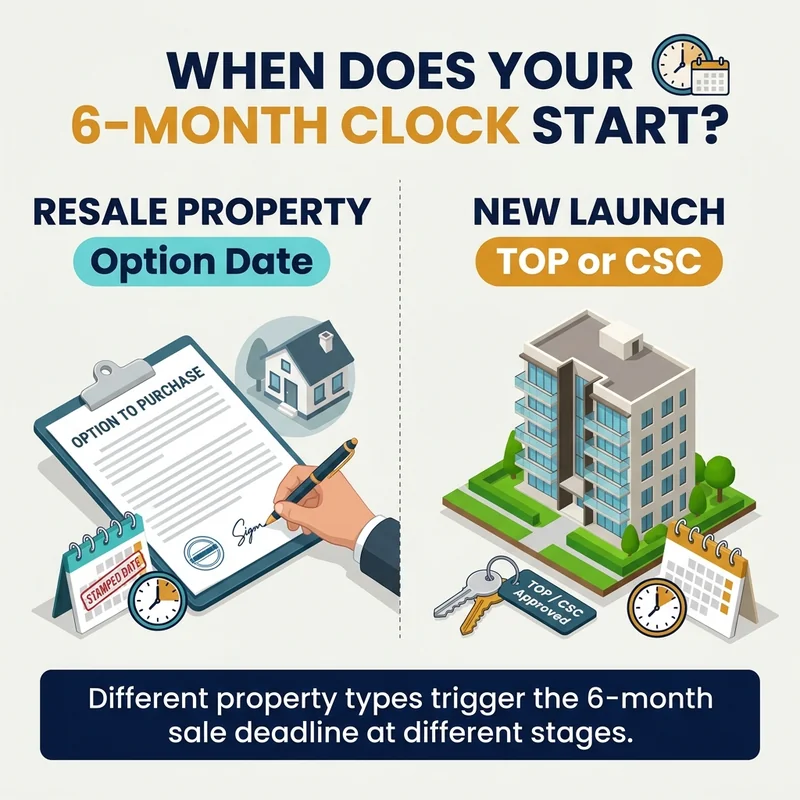
The distinction matters for anyone eyeing a new launch. Buying a unit three years from TOP does not buy you three years of breathing room, because the clock has not started. It starts when the project reaches TOP or CSC, whichever comes first, and from that point the first property genuinely has to be sold within six months. Couples tracking completion schedules, like those in our look at Q3 2026 completions and the supply queue, can use projected TOP dates to plan the sale of the existing flat well ahead of time instead of scrambling at key collection.
The zero-extension rule
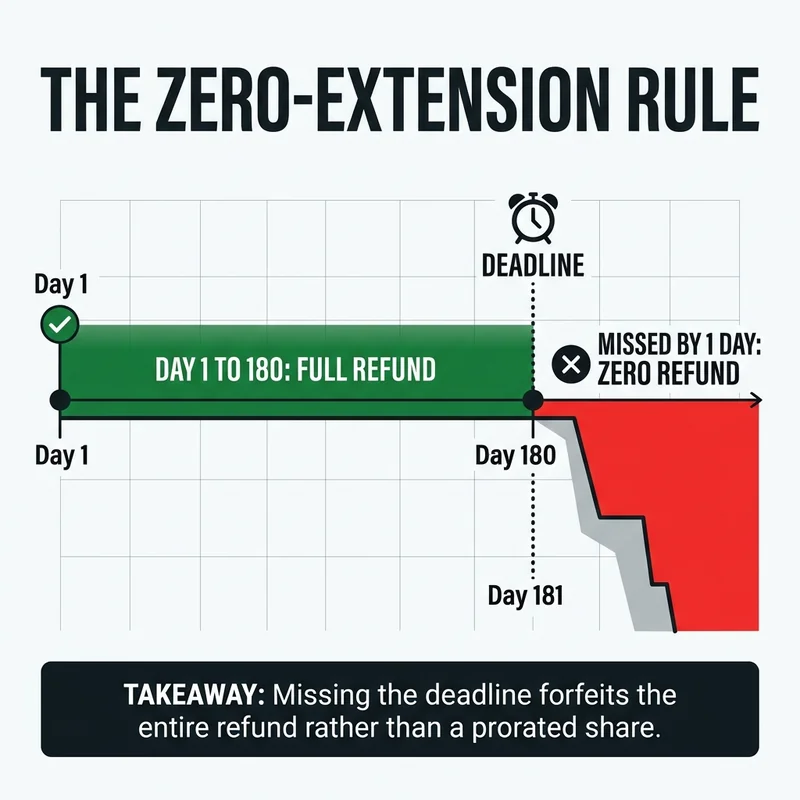
Miss the deadline by a day and the refund is gone, not reduced. IRAS is unusually direct about this. Its guidance states that an extension of the six-month timeline will not be acceded to, and its FAQ repeats the point: the conditions are consistently applied, and couples who cannot be confident of selling in time should sell first and buy the replacement afterwards.
There is no sliding scale. A couple who sells one day late does not receive 99 per cent of the refund. They receive nothing, and the ABSD, which can run into six figures, becomes a sunk cost.
The only extension IRAS has offered for this timeline was pandemic relief. On 6 May 2020, the Government extended the sale timeline by six months, taking it to twelve, for couples whose second property was jointly purchased on or before 1 June 2020 and whose deadline fell on or after 1 February 2020. That measure closed with the COVID period and does not reflect current policy. Anyone transacting today should plan around six months and assume no leniency.
How the refund actually reaches you
Selling inside the deadline is only half of the process. How the money comes back depends on when the purchase was stamped, and mixing up the two routes causes real problems.
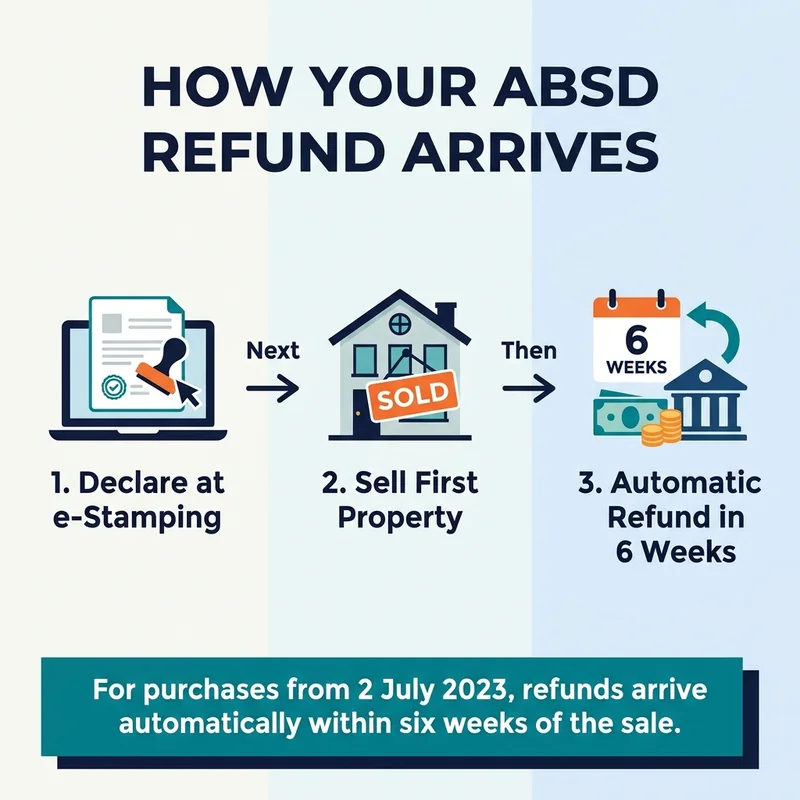
For “Sale and Purchase: Purchase or Acquisition” stamping forms submitted on or after 2 July 2023, IRAS refunds the ABSD automatically, with no application needed. Two conditions attach. The purchaser must declare the intention to sell the first property and claim the refund in the e-Stamping form when the purchase is stamped, and the remission conditions must be met. Once both hold, IRAS makes the refund within six weeks of the stamping of the sale of the first property.
Older purchases work differently. For stamping submitted before 2 July 2023, the couple has to file a refund application through myTax Portal under Request, then Apply for Refund. That application must be made within six months of the date of sale of the first property. The service runs on desktop only, not mobile. If the declaration was missed on a purchase stamped on or after 2 July 2023, do not assume the refund will still be automatic. Confirm the position with IRAS before relying on a manual application.
“Date of sale” is defined the same way as date of purchase, in the buyer’s shoes this time: the date the buyer accepts the Option to Purchase, or signs the Sale and Purchase Agreement, or the date of transfer. The clock stops at the buyer’s exercise of the option, not at legal completion.
| Scenario | Clock starts | Sell first property by | Refund route |
|---|---|---|---|
| Second property completed (resale) | Date of purchase (option exercised) | 6 months from that date | Automatic if declared at stamping. If stamped before 2 July 2023, apply within 6 months of the sale |
| Second property uncompleted (new launch) | Earlier of TOP or CSC issue date | 6 months from that date | Automatic if declared at stamping. If stamped before 2 July 2023, apply within 6 months of the sale |
One more group qualifies under a separate scheme: single Singapore Citizens aged 55 and above buying a second property on or after 16 February 2024, under the ABSD concession for SC seniors. The mechanics differ, so check that page before assuming the married couple rules apply.
What this means for HDB upgraders
Treat the sale of the existing flat as the critical path of the whole plan, not as cleanup after the new purchase is locked in.
- Get the flat marketed before or immediately after committing to the second property, rather than waiting until the option is signed.
- For new launches, treat the developer’s projected TOP date as the real anchor and build in a buffer, since the clock starts only when TOP or CSC is actually issued.
- Check every eligibility condition before purchase. A third property acquired mid-window, even through inheritance or a joint venture, can disqualify the remission.
- Keep both dates documented precisely: the date the second property’s option was exercised, and the date your buyer exercises the option on the first. IRAS tests them separately.
- If the purchase was stamped before 2 July 2023, diarise the refund application. That six-month window runs from the sale date and nobody will chase it for you. If the declaration at stamping was missed, get written confirmation from IRAS on the route before assuming anything.
Buyers whose financing involves an existing HDB loan may also want to review how refinancing choices interact with sale timing, covered in our guide on refinancing an HDB loan to a bank in 2026.
Risks worth planning around
The biggest risk is treating six months as a target rather than a cutoff. The exposure is narrower than it looks, though, and it sits in one place. Because the deadline is measured to the buyer’s exercise of the option, HDB’s processing of the resale application and the eventual legal completion do not normally move the date. What does move it is anything that delays the buyer from exercising: a loan application that drags, a valuation that comes in low, a buyer who walks away in week ten and forces a restart with someone new.
Two traps come up often. The first is informal advice that flexibility exists. IRAS addresses this directly in its FAQ, noting that buyers wrongly advised by an agent should seek recourse through the agent or the relevant professional body, which tells you how often it comes up. The second is eligibility: because the rules turn on not acquiring another residential property during the window, opportunistic purchases, including an inherited share of a family home, are worth checking before signing anything.
Frequently Asked Questions
Can a married couple get an extension on the six-month ABSD refund window?
No. IRAS states that an extension of the six-month timeline will not be acceded to, and the conditions are applied consistently to all couples, according to IRAS (updated 13 August 2026). The only extension IRAS has offered was the 2020 pandemic relief, for second properties jointly purchased on or before 1 June 2020 where the deadline fell on or after 1 February 2020.
When does the six-month clock start for an uncompleted property?
From the earlier of the TOP issue date or the CSC issue date, not the date of purchase. For a completed property, the clock starts from the date of purchase, which IRAS defines as the date the Option to Purchase is accepted.
What happens if we miss the deadline to sell our first flat?
The entire refund is forfeited. There is no proration and no partial refund. The ABSD paid on the second property stays paid.
How long does the refund take after we sell?
For purchases stamped on or after 2 July 2023, with the declaration made at stamping, IRAS refunds within six weeks from the stamping of the sale of the first property, with no application required. Where the purchase was stamped before 2 July 2023, apply through myTax Portal within six months of the sale date, per IRAS (updated 20 January 2026).
Timing a sale against a six-month cutoff is not something to sort out after the Option to Purchase is signed. If you are weighing when to list your flat against buying your next home, message us on WhatsApp and we can work through the timeline with you.
Data Sources: IRAS, Remission of ABSD for a Married Couple (updated 13 August 2026); IRAS, How to claim refunds (updated 20 January 2026).
This article is for general reference only and does not constitute financial, legal, or investment advice. Verify all details with the relevant authorities before making any decision.
Agent: Joe Chow | CEA Reg No.: R072635C
Agency: SRI Pte Ltd | Licence: L3010738A