
Here is the complete revised article, trimmed to target word count (approximately 1,850 words) while preserving all numbers, compliance elements, and structural requirements.
Here is a thought most buyers never voice out loud: earning $14,000 a month as a household feels like the finish line. You qualify for everything HDB offers, you hit the ceiling cleanly, and you assume the system works in your favour. But if you are buying a Plus or Prime flat — introduced under the Ministry of National Development’s (MND) flat classification framework announced on 26 October 2023 — that same income figure may quietly work against you in ways that only surface years later, when you are ready to move.
The problem is not the Minimum Occupation Period (MOP), though the extended 10-year MOP on Plus and Prime flats is real and worth understanding. The deeper issue is what happens at resale: buyers of your flat must also pass an income ceiling test, and that $14,000 cap does not move with inflation, career progression, or market cycles. A liquidity constraint is being baked into the asset from day one.
This article walks through how that ceiling compresses your eventual resale pool, why high-income households face a compounding exit problem, and what the actual decision framework looks like before you commit.
Key Takeaways

- A 10-year MOP applies to Plus and Prime flats — double the 5-year requirement for Standard BTO flats.
- The $14,000 household income ceiling applies not just to your purchase, but permanently to every subsequent resale buyer of your flat.
- Subsidy recovery levies of 6% (Plus) and 9% (Prime) are deducted from resale proceeds before CPF refunds and outstanding mortgage are settled.
- The combined effect of a narrower buyer pool, extended lock-in, and layered deductions means net cash proceeds at exit can be materially lower than the headline transacted price.
Understanding Plus and Prime Eligibility at Purchase and Resale
Under the flat classification framework implemented from the second half of 2024, all new HDB Build-To-Order (BTO) flats fall into one of three tiers: Standard, Plus, or Prime. Plus flats occupy better-located estates with enhanced subsidies; Prime flats sit in the most central locations and carry the deepest subsidy loading.
For the initial HDB purchase, the income ceiling is consistent across all three tiers: $14,000 per month for families and $7,000 per month for eligible singles under the singles scheme (Source: MND New Flat Classification Framework, 26 October 2023; HDB Standard, Plus, and Prime Housing Framework, 2024).
Where the framework diverges is at resale. Standard flats, once past their 5-year MOP, can be sold on the open market with no income ceiling imposed on buyers. Plus and Prime flats do not work this way. Buyers purchasing a Plus or Prime flat on the resale market must still meet the $14,000 household income ceiling — permanently, on every subsequent transaction (Source: MND New Flat Classification Framework, 26 October 2023).
This single structural difference contracts the eventual buyer pool for your flat in ways that compound over time.
Practical takeaway: Verify your household profile against the $14,000 ceiling using the HDB Flat Eligibility (HFE) letter, then model your resale scenario against the same ceiling — it applies to your buyer in exactly the same way it applied to you.

How Income Ceilings Affect Long-Term Property Liquidity
The $14,000 resale income ceiling is not a transitional measure. Per MND’s New Flat Classification Framework explainer (26 October 2023) and HDB’s Standard, Plus, and Prime Housing Framework (2024), this restriction is a permanent structural feature of the Plus and Prime classifications, attaching to the unit — not to the owner.
According to SingStat’s Key Household Income Trends 2024, median monthly household income from work among resident employed households was approximately $10,189. Households earning above $14,000 per month represent a proportionally smaller segment of the population. When a Plus or Prime flat enters the resale market after a 10-year MOP, it can only be transacted with buyers who fall within that ceiling, excluding higher-income households who might otherwise compete for the unit and support price discovery.
| Purchase Type | MOP Duration | Income Ceiling (Resale) | Subsidy Recovery |
|---|---|---|---|
| Standard BTO | 5 years | None | None |
| Plus Model | 10 years | $14,000/month (family) | 6% of resale price |
| Prime Model | 10 years | $14,000/month (family) | 9% of resale price |
Source: MND New Flat Classification Framework, 26 October 2023; HDB Standard, Plus, and Prime Housing Framework, 2024.
This ceiling, combined with the extended 10-year MOP and mandatory subsidy recovery on first sale, compresses both the timeline and the eligible buyer universe simultaneously.
Practical takeaway: Model your exit using only the income-eligible buyer segment — not total resale market volume. The liquidity profile of a Plus or Prime flat is materially different from a Standard BTO or a private condominium resale.

The 10-Year MOP Reality: Assessing Your Holding Capacity
The 10-year MOP means you are legally required to live in the flat for a full decade before selling on the open market or renting out the entire unit. According to HDB’s Standard, Plus, and Prime Housing Framework (2024), owners cannot sublet the entire flat during the MOP — eliminating the rental income option that some Standard flat owners use to offset housing costs during a relocation or life change.
The financial stress test is straightforward. If your household income sits near the $14,000 ceiling at application, model what that income looks like across the full holding window. A single-income household, a career change, or a caregiving period could reduce monthly income materially, affecting loan serviceability over a longer timeline. HDB loans require borrowers to remain within Total Debt Servicing Ratio (TDSR) and Mortgage Servicing Ratio (MSR) limits throughout the loan tenure, not just at application.
There is also a sequencing risk: if you intend to upgrade to private property after selling, the 10-year MOP compresses your window relative to age, CPF accrued interest accumulation, and prevailing market conditions at the point of sale — all of which are variable and subject to conditions that cannot be predicted with certainty.
Practical takeaway: Stress-test your monthly cash flow against a 10-year minimum holding horizon, accounting for income variability, potential life changes, and the absence of any interim rental income option.
Calculating Subsidy Recovery Upon Resale
When you sell a Plus or Prime flat after the 10-year MOP, a subsidy clawback is payable to HDB on the proceeds of that sale. According to MND’s New Flat Classification Framework explainer (26 October 2023), the levy is applied to the higher of resale price or market valuation: 6% for Plus flats and 9% for Prime flats.
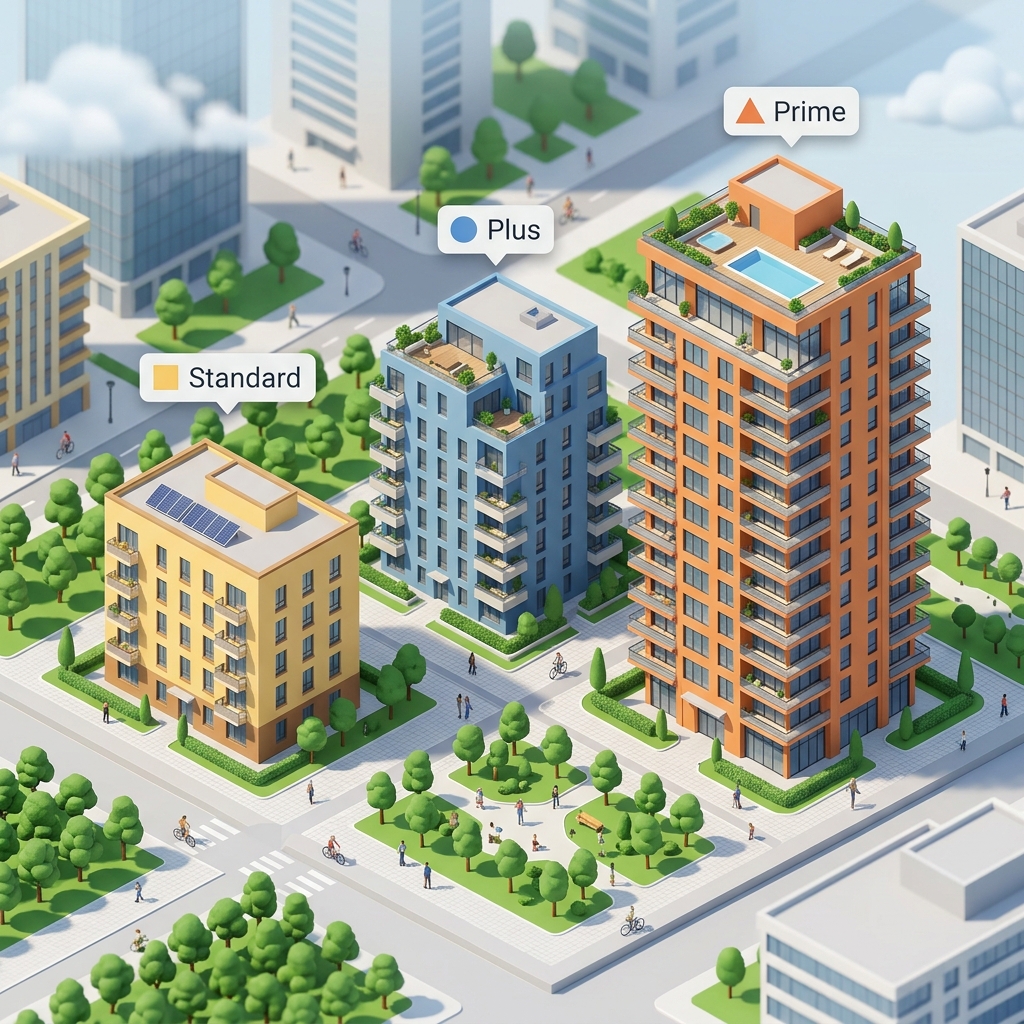
To illustrate with specific figures: if a Prime flat transacts at $900,000, the subsidy recovery payable to HDB would be approximately $81,000 at the 9% rate. A Plus flat selling at $750,000 would incur a clawback of approximately $45,000 at 6%. These deductions occur at the point of sale, before CPF refund obligations and agent fees are calculated — meaning actual cash-in-hand can be materially lower than the headline transacted price.
The sequence of deductions runs: resale levy first, then CPF refund with accrued interest, then outstanding mortgage, then transaction costs. Each layer compounds the gap between gross transacted price and net liquid proceeds.
Practical takeaway: Apply the applicable levy rate — 6% for Plus, 9% for Prime — to a conservative estimated resale price, then subtract CPF accrued interest and outstanding loan balance to arrive at a realistic net cash figure before planning your next purchase.
Strategic Considerations When Upgrading After MOP
When you eventually sell your Plus or Prime flat, your pool of eligible buyers is structurally narrower than it would be for a Standard flat. Resale buyers of Plus and Prime flats must satisfy the $14,000 per month household income ceiling (Source: MND New Flat Classification Framework, 26 October 2023). Standard resale flats carry no such restriction once they enter the open market. This thinner qualified buyer pool may affect your pricing strategy and marketing timeline, particularly during periods of tightened credit or subdued upgrader demand.
Timing your sale also intersects with the revised Seller’s Stamp Duty (SSD) framework. For private residential properties purchased on or after 4 July 2025, the SSD holding period extends to four years, with rates of 16% (within 1 year), 12% (within 2 years), 8% (within 3 years), and 4% (within 4 years) applied to the higher of selling price or market value (Source: IRAS, effective 4 July 2025). If your upgrade path involves purchasing private property shortly after MOP, factor this four-year SSD window into your holding cost projections.
On the CPF and loan front, CPF accrued interest returned to your CPF Ordinary Account at the point of HDB sale reduces the net cash available for your next downpayment. According to URA Realis, Q4 2025 resale price data, median transacted prices for comparable HDB resale units in central-adjacent locations trended upward over the preceding eight quarters — though past performance is subject to market conditions and does not indicate future outcomes.
Practical takeaway: Price your Plus or Prime resale realistically against the income-ceiling-restricted buyer pool, model the SSD exposure on any subsequent private property purchase, and calculate your deployable cash after CPF accrued interest is returned — not just the gross transacted price.
Frequently Asked Questions
What is the income ceiling for Plus and Prime HDB flats?
$14,000 per month for families and $7,000 per month for eligible singles — identical across Standard, Plus, and Prime BTO flat types at initial purchase. Critically, the same $14,000 ceiling also applies to every resale buyer of a Plus or Prime flat, permanently (Source: MND New Flat Classification Framework, 26 October 2023).
How long is the MOP for Plus and Prime HDB flats?
10 years, double the 5-year MOP that applies to Standard BTO flats. Whole-unit subletting is not permitted during this period (Source: HDB Standard, Plus, and Prime Housing Framework, 2024).
What is the resale levy for Plus and Prime flats?
6% of the resale price for Plus flats and 9% for Prime flats, applied to the higher of resale price or market valuation (Source: MND New Flat Classification Framework, 26 October 2023). On a $900,000 Prime flat, this equates to approximately $81,000 payable to HDB before CPF and mortgage deductions.
Can I rent out my Plus or Prime flat during the MOP?
Whole-unit subletting is not permitted during the 10-year MOP. Individual room rental may be permitted subject to HDB approval and eligibility conditions, but cannot be relied upon as a primary financial buffer (Source: HDB Standard, Plus, and Prime Housing Framework, 2024).
What SSD applies if I upgrade to private property after MOP?
For private residential properties purchased on or after 4 July 2025, SSD applies over a four-year holding period at rates of 16%, 12%, 8%, and 4% respectively, calculated on the higher of selling price or market value (Source: IRAS, effective 4 July 2025). Factor this into your post-MOP upgrade timeline and cost projections.
Ready to Map Out Your Property Timeline?
One message. No obligations. We can help you model the numbers before you commit.
Data Sources
All figures sourced from MND, HDB, IRAS, SingStat, CPF Board, and URA publications. Data current as of June 2026.
Agent: Joe Chow | CEA Reg No.: R072635C
Agency: SRI Pte Ltd | Licence: L3010738A
Contact: +65 8098 0916
This article is for general reference only and does not constitute financial, legal, or investment advice. Verify all details with relevant authorities before making decisions.