A married couple owns a condo. They want a second property, but a Singapore Citizen buying a second home faces a 20% Additional Buyer’s Stamp Duty (ABSD) bill — that is S$200,000 on a S$1 million purchase before we even talk about legal fees. For some private-property co-owners, a genuine part-sale can change who owns the next home. It is not an automatic ABSD exemption, and the transfer brings costs and funding requirements of its own.
Key Takeaways
- This article examines a part-sale between spouses who jointly own private property. The exiting spouse can buy at 0% ABSD if they are a Singapore Citizen buying alone with no other Singapore residential-property interest under IRAS’s counting rules, including beneficial ownership.
- HDB does not allow resale of part-share between married couples. Separate rules for ownership changes without a sale are not an investment-decoupling route, per HDB’s Resale of Part-Share policy.
- Check BSD, possible SSD, the receiving spouse’s ABSD position, legal and financing charges, and CPF refund funding. A CPF refund affects liquidity but returns money to the owner’s CPF accounts; it is not a tax or fee.
What Is Property Decoupling and When Can It Reduce ABSD?
In a private-property part-sale, one co-owner sells their entire interest to the other. The exiting owner’s next purchase is assessed using their citizenship and property count at the relevant purchase date. For a Singapore Citizen buying alone with no other Singapore residential-property interest, ABSD is not payable. This is a property-count test, not a claim that they have never owned a home. Non-citizens do not automatically receive the same treatment.
The citizen second-property rate is 20% of the higher of purchase price or market value for acquisitions from 27 April 2023, according to IRAS’s ABSD guidance. On a S$1.5 million dutiable value, that is S$300,000. Timing matters: IRAS can exclude an interest already contracted for sale once the buyer has exercised the option, rather than waiting for legal completion. Ask the conveyancing lawyer to confirm the disposal and next-purchase sequence before signing; merely removing a name from the title is not enough if a beneficial interest remains.
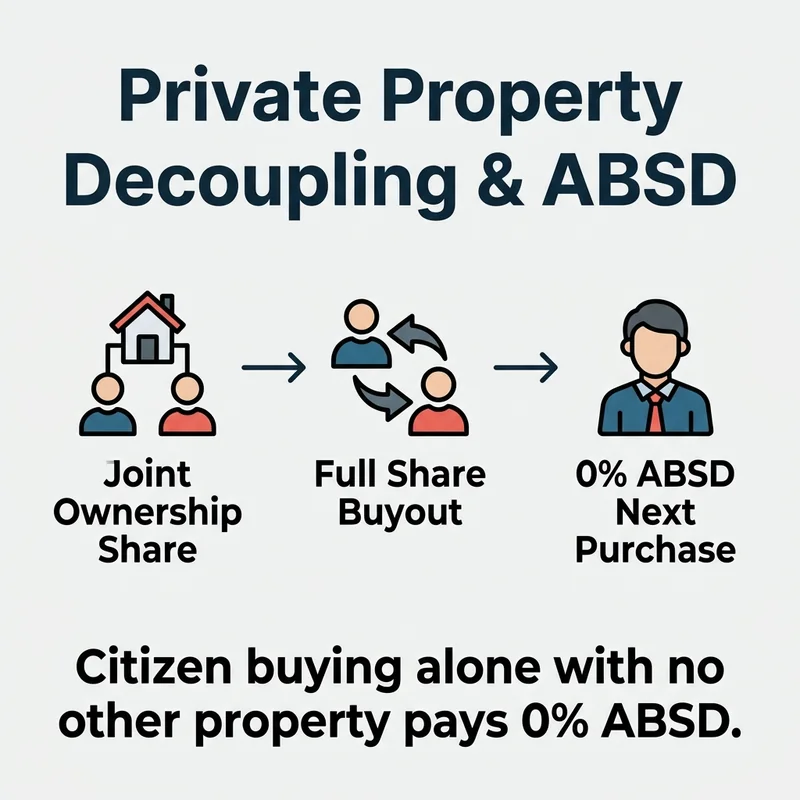
ABSD depends on each buyer’s profile, but a joint purchase generally attracts the highest applicable rate among its buyers. IRAS can disregard contrived or artificial tax-avoidance arrangements, recover duty and impose a surcharge. Do not treat a genuine transfer of existing ownership as blanket approval for a pre-arranged “99–1” scheme.
The Private Property Decoupling Mechanics: Part-Sale, Valuation, and Financing
The scenario here is one spouse formally selling their share to the other. Private-property transfers are not restricted to married couples, and gifts are possible too, but neither a gift nor a nominal price automatically removes stamp duty. A few mechanical points matter here.
First, establish the market value of the transferred interest. The agreed sale price need not equal that valuation, but stamp duty generally uses the higher of consideration and market value. Second, if borrowing is needed, the remaining owner must arrange lender-approved financing for the buyout and outstanding debt. Applicable Total Debt Servicing Ratio (TDSR) and lending rules must be checked for that loan; do not assume an ordinary refinancing exemption covers an ownership change. MAS’s TDSR guidance allows qualifying income and eligible financial assets, not salary alone. Even so, one borrower may support less debt than two, requiring a smaller loan or cash top-up.
Third, obtain the exiting owner’s CPF housing-refund amount and have the lawyer plan how it will be funded. CPF generally requires the principal used plus accrued interest, with specific part-share rules discussed below. Intending to use CPF for the next home does not remove the refund requirement.
The next private purchase must satisfy the buyer’s own ABSD and financing conditions. An HDB resale flat is not an interchangeable alternative: HDB assesses household eligibility, including the spouse’s private-property interests. Decoupling does not let a married couple buy an HDB flat while bypassing applicable private-property disposal requirements.
Why HDB Flat Owners Cannot Use This Route: Rules and Upgrader Realities
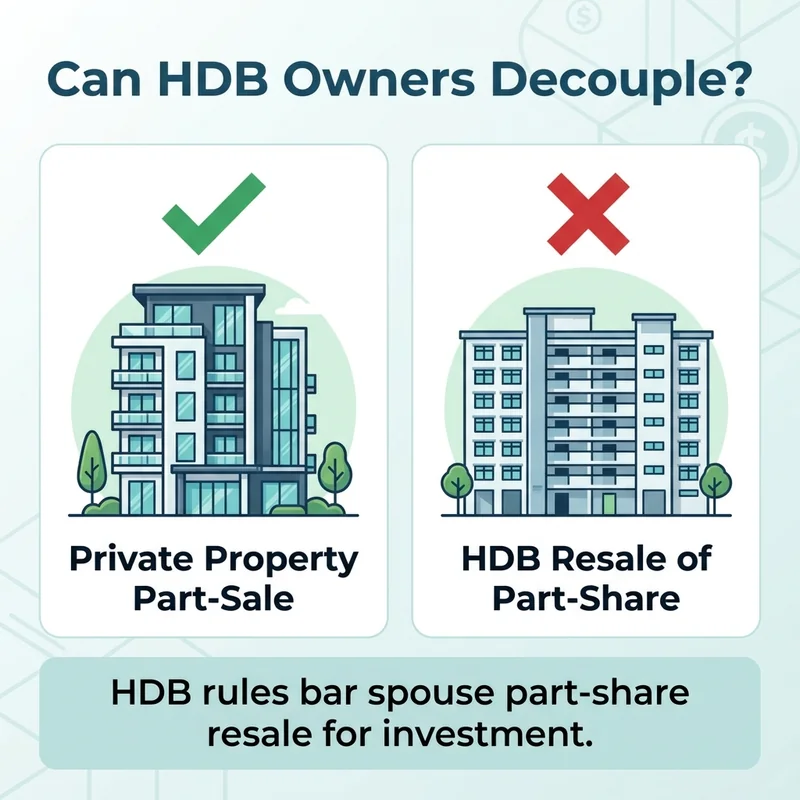
HDB’s Resale of Part-Share rules state that such a transaction is not allowed between a married couple. Separately, changes in flat ownership without a sale may be considered following changes in family circumstances, such as marriage, divorce or an owner’s death, subject to HDB’s eligibility conditions and approval. These are different procedures, not a list of exceptions permitting investment decoupling.
HDB upgraders must check their minimum occupation period, household eligibility and ABSD position separately. Nor does selling a private-property share remove the spouse’s interests from HDB’s household-level eligibility assessment for a subsequent flat purchase. For the separate question of retaining an existing flat, see Can You Keep Your HDB and Buy a Condo? The ‘Own Both’ Rules in 2026. Do not assume the two purchase sequences have identical rules.
The practical takeaway: this article’s spouse-to-spouse private-property part-sale is not a route for married HDB owners to free one name for an investment purchase.
Costs and Cash Flow: BSD, SSD, ABSD and CPF Refunds
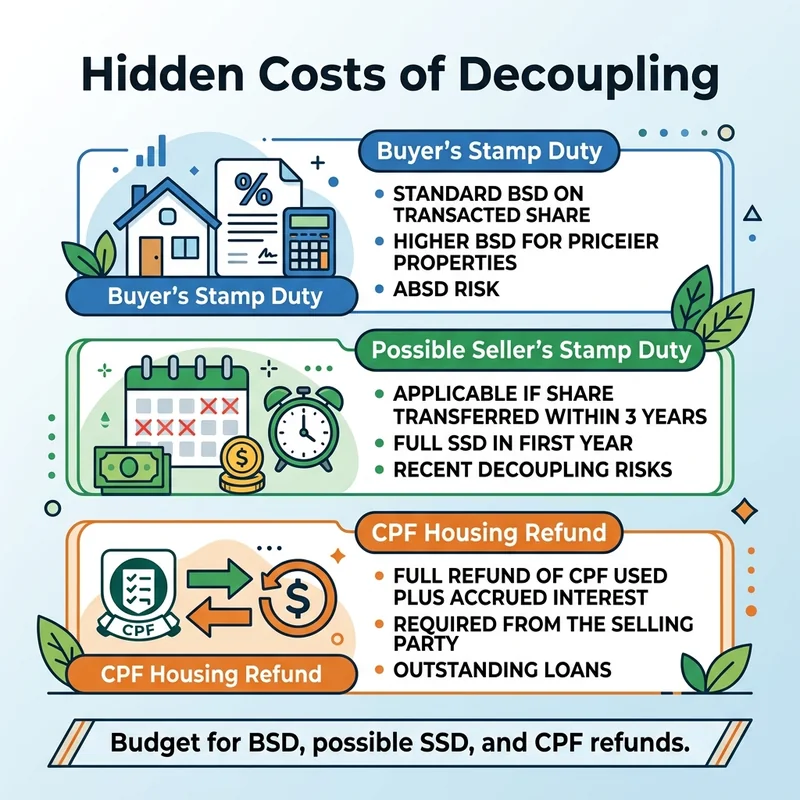
Decoupling is not free. Separate taxes and transaction expenses from money returned to CPF when comparing the saving with the cash required.
Buyer’s Stamp Duty (BSD) is payable on the higher of consideration or market value of the transferred share, using residential rates with a 6% top marginal tier above S$3 million, according to IRAS’s BSD guidance. Check the receiving spouse’s ABSD too: IRAS states that a Singapore Citizen who owns only this one residential property pays no ABSD when acquiring the co-owner’s additional interest. Other citizenship or property-count profiles can attract ABSD; any available remission has its own conditions.
Seller’s Stamp Duty (SSD) depends on when the exiting owner acquired the interest and when it is disposed of. Under IRAS’s SSD rules:
- Acquired 11 March 2017–3 July 2025: a three-year holding period, with rates of 12%, 8% and 4% in the respective first, second and third holding-year bands.
- Acquired from 4 July 2025: a four-year holding period, with rates of 16%, 12%, 8% and 4% in the respective first through fourth bands.
The newer regime does not retrospectively extend a 2023 acquisition to four years. Have the lawyer confirm exact acquisition and disposal dates and any exemption; SSD is based on the higher of consideration or market value of the disposed interest.
CPF refunds generally cover principal used plus accrued interest; a pledged amount may also need refunding for owners aged 55 and above. If a market-value part-sale cannot cover the housing refund after the seller’s share of the outstanding loan, CPF applies a specific part-share calculation—not an unconditional full-refund rule. Check CPF’s part-share refund guidance and obtain the actual figure. The refund remains the owner’s CPF savings, although retirement-account allocation and subsequent housing-use rules can affect what is available for the next purchase. Budget separately for legal fees and any loan redemption or refinancing charges.
| Dimension | Private Property Decoupling | HDB Ownership Restructuring |
|---|---|---|
| Eligibility | Here: a part-sale between private-property co-owning spouses; not restricted to marriage | No resale of part-share between married couples; other ownership changes require separate eligibility |
| ABSD on Next Purchase | 0% for a citizen buying alone with no other countable Singapore residential interest | A name change does not bypass household eligibility or property-disposal rules |
| Stamp Duty Implications | BSD; possible SSD and receiving owner’s ABSD | This investment-decoupling route is unavailable |
| CPF Refund Rules | Obtain the specific part-share refund; distinguish liquidity from expense | Check separately for any HDB-approved ownership change |
Risks and Considerations
Decoupling carries real financial and legal exposure that goes beyond the headline ABSD saving.
- Loan qualification risk. Obtain the lender’s approval for the remaining owner’s borrowing and confirm the exiting owner’s release from the existing loan. Available financing may be lower than expected.
- Combined cost drag. Stamp duties, legal fees and loan charges can erode the ABSD saving. Separately, CPF refunds affect cash flow and the funds available for the next home.
- Marriage and divorce contingencies. Restructuring ownership between spouses has implications for matrimonial asset division should the marriage later dissolve, and this should be discussed with a family lawyer, not assumed to be neutral.
- Not a universal strategy. Citizenship, other property interests, genuine ownership and purchase timing matter. Unmarried private-property co-owners can also transfer interests, but HDB restrictions remain separate.
Frequently Asked Questions
What is property decoupling in Singapore and how does it work?
In the scenario discussed here, one spouse sells their entire private-property interest to the other. Whether the next purchase attracts ABSD depends on the buyer’s citizenship, remaining interests and transaction timing under IRAS’s ABSD guidance. It is not a blanket exemption.
Can HDB flat owners decouple their ownership to buy a second property?
Not through this spouse-to-spouse investment part-sale. HDB bars resale of part-share between married couples. Ownership changes without a sale are assessed under separate conditions; they should not be presented as a decoupling workaround.
What are the hidden costs and stamp duties involved in decoupling private property?
Budget for BSD, any receiving-owner ABSD, possible SSD, legal fees and financing charges. Obtain the CPF part-share refund figure too, but treat it as money returned to CPF—not as another tax deducted from the saving.
How does the non-owning spouse buy a second property at 0% ABSD?
The example requires a Singapore Citizen buying alone with no other Singapore residential-property interest, including beneficial interests, under IRAS’s rules at the purchase date. The lawyer should confirm that the disposal qualifies for exclusion before the next acquisition. Buying jointly with a property-owning spouse can change the result.
Decoupling may suit couples whose genuine transfer produces a worthwhile net tax saving and whose financing and CPF refund funding are workable. Our guide on TDSR vs MSR 2026: How Much Can You Actually Borrow? is a useful companion read before committing to a part-sale.
Data Sources: IRAS ABSD, BSD and SSD; HDB ownership and household-eligibility guidance linked above; CPF’s part-share refund answer; and MAS TDSR guidance.
Considering whether decoupling makes sense for your situation? Message us on WhatsApp to talk through the numbers.
This article is for general reference only and does not constitute financial, legal, or investment advice. Verify all details with relevant authorities before making decisions.
Agent: Joe Chow | CEA Reg No.: R072635C
Agency: SRI Pte Ltd | Licence: L3010738A