
Here’s a scenario worth sitting with: you’re paying 2.6% on an HDB concessionary loan while considering an advertised bank fixed package at 1.5%. The gap looks obvious. But switching depends on your outstanding balance, remaining tenure and the bank’s terms — not a new LTV cut. The door to switch only swings one way.
Key Takeaways
- The HDB concessionary loan’s maximum LTV was cut from 80% to 75% for complete resale applications received on or after 20 August 2024 and BTO applications from October 2024 onward. This is purchase-financing background, not a new 2026 refinancing trigger, per MND and HDB, 19 Aug 2024.
- As checked on 7 September 2026, advertised HDB bank fixed examples include 1.40% for two years and 1.60% for three years, versus HDB’s current 2.60% p.a. The 100–120-basis-point gap applies to those examples, not every borrower or package, per Cashew’s HDB comparison.
- Switching from an HDB loan to a bank loan is irreversible for that flat — once you refinance out, you cannot switch that loan back to HDB, per CPF Board, 12 Jun 2026.
The 75% LTV Cap: Purchase Background, Not a New Reason to Refinance
The core appeal of an HDB concessionary loan used to be simple: you could borrow up to 80% of the flat’s value or purchase price (whichever is lower), versus 75% from a bank. That gap meant less cash or CPF needed upfront. That maximum-LTV gap has closed, but funding requirements still differ.
Under cooling measures announced in August 2024, the HDB loan LTV limit was cut to 75% for complete resale applications received on or after 20 August 2024 and BTO applications from the October 2024 exercise onward, according to MND and HDB. This change did not retrospectively reduce an existing HDB loan or itself require borrowers to refinance.
For a new purchase financed at 75% LTV, the remaining 25% differs in how it can be funded: an HDB loan allows CPF and/or cash, while a bank loan requires at least 5% in cash and the remaining 20% in CPF and/or cash, subject to CPF rules, per CPF Board. These are purchase downpayments, not a fresh 25% payment automatically due when refinancing. For a switch, ask the bank to assess your outstanding balance, valuation, remaining tenure and any funding shortfall. Both 75% figures are maximums, subject to applicable limits and eligibility.
The Numbers Game: HDB’s 2.6% vs Advertised Bank Packages
The rate gap is the main reason many borrowers consider switching. As checked on 7 September 2026, Cashew’s HDB comparison advertises 1.40% for a two-year fixed package, 1.60% for three years and 1.98% for five years. POSB’s own HDB page lists 1.78% fixed for three years. These are package examples, not a market-wide rate guarantee; eligibility and loan size matter. Keep floating benchmarks separate: Cashew’s 1.38% HDB example uses the bank’s six-month fixed-deposit-rate benchmark (FHR6), not the Singapore Overnight Rate Average (SORA). A SORA package instead adds the bank’s contractual spread to its specified compounded SORA benchmark.
The HDB concessionary rate is 2.60% p.a. for July–September 2026, pegged at 0.1 percentage point above the CPF Ordinary Account rate, according to CPF Board. Against the 1.40%–1.60% fixed examples, the gap is 100–120 basis points; against 1.78%, it is 82 basis points.
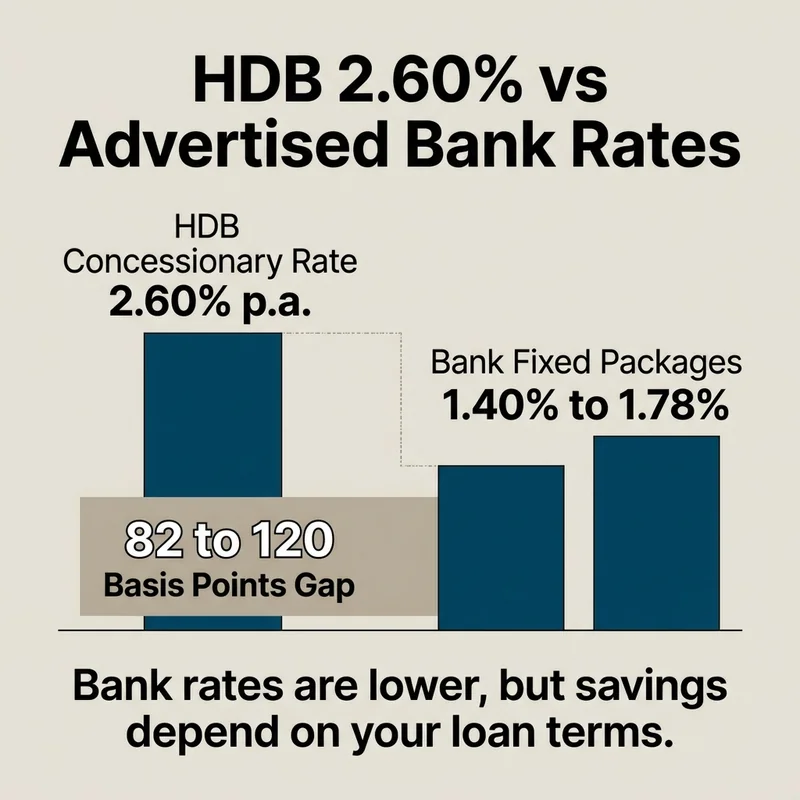
On a S$400,000 outstanding loan with 25 years remaining, a rate difference of this magnitude can translate into lower monthly instalments and interest during the bank package’s initial rate period, based on standard amortisation math. The exact savings depend on your outstanding loan quantum, remaining tenure, fees and which bank package you land on. This is not a guaranteed lifetime saving: rates may reprice after the fixed period. Keep the remaining tenure comparable rather than lowering instalments simply by extending repayment.
The One-Way Door: Why Switching to a Bank Loan Is Irreversible
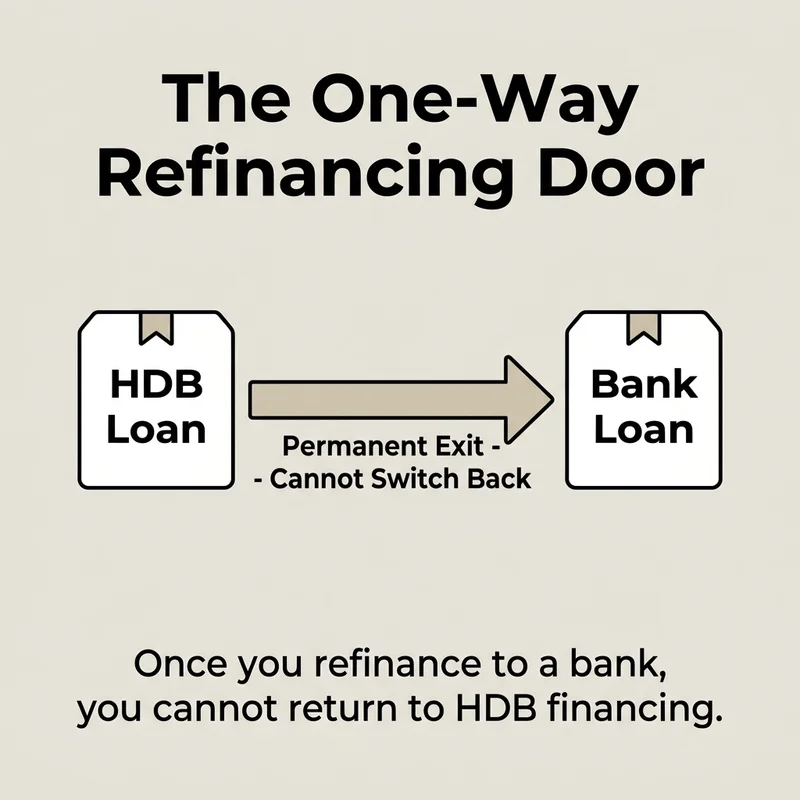
Once you refinance from an HDB loan to a bank loan, you cannot switch that loan back to HDB. This is not a temporary restriction or a cooling-off period. According to the CPF Board (12 June 2026), the rule is absolute: HDB loans are only available to those who have not previously taken a bank loan for the same flat, and switching to a bank loan permanently forfeits eligibility for any future HDB loan on that property.
This matters more than it sounds. If you switch to a bank loan chasing today’s low rates and interest rates later climb — whether due to global rate cycles, SORA movements, or bank repricing — you cannot retreat to the HDB loan’s relative rate stability. For that flat, you would have to consider bank repricing, bank-to-bank refinancing or repayment, with no switch back to HDB financing. This is the single most consequential detail in this decision, and it deserves more weight than the headline rate gap.
Hidden Costs: Lock-In Periods, Repricing Fees, and Legal Fee Clawbacks
Bank loans come with strings that HDB loans do not. Many have lock-in periods, commonly one to three years, although longer commitments exist. Full redemption or refinancing during lock-in may incur a penalty of around 1.5% of the outstanding or redeemed amount, depending on the contract, per CPF Board. Do not assume a sale always triggers it: POSB’s HDB package, for example, advertises a sale-related penalty waiver and no partial repayment fees. Read the letter of offer for the exact fee basis and waivers.
Banks also frequently sweeten packages with legal fee subsidies or cash rebates to offset switching costs. Check the separate clawback window and triggers: a subsidy may need to be repaid if you exit early, even where an early-redemption fee is waived. Do not assume the clawback and lock-in periods match. HDB loans, by contrast, have no lock-in period or early-repayment penalty.
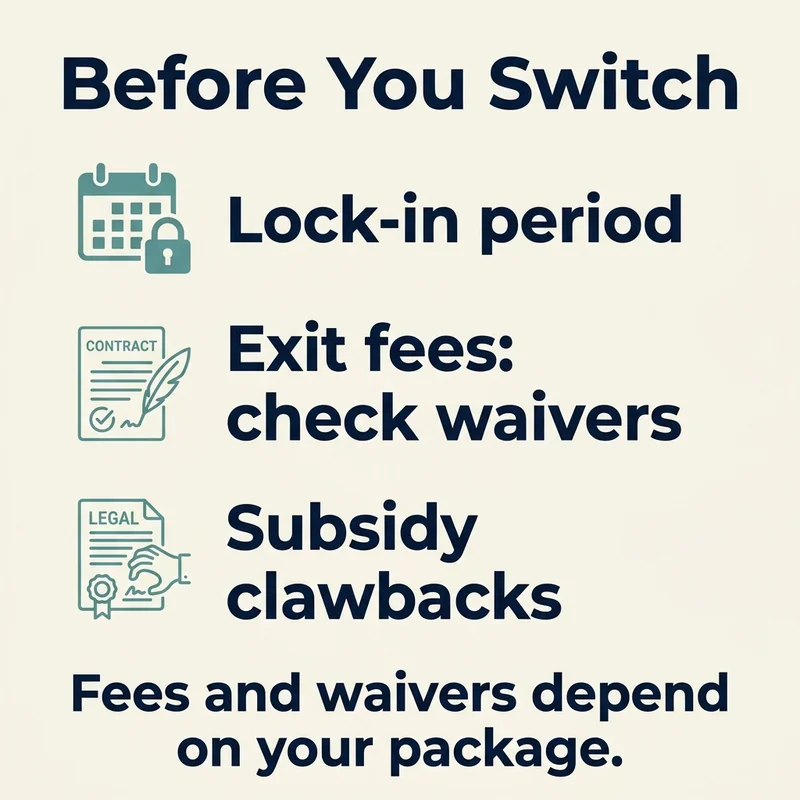
This matters if you’re an upgrader planning to sell within the next few years. Compare the proposed sale date with the specific package’s lock-in, sale waiver and subsidy-clawback terms. Any applicable exit costs could erode the interest savings, but a sale-friendly bank package may change that calculation.
TDSR, MSR, and Eligibility Hurdles When Refinancing
You still need the bank’s approval even if you already have an HDB loan. However, do not treat a qualifying refinance of your owner-occupied home as a new purchase loan: MAS’s refinancing concession exempts qualifying owner-occupied housing refinancing from the Total Debt Servicing Ratio (TDSR) threshold and extends the same concession to the Mortgage Servicing Ratio (MSR) limit for owner-occupied HDB flats and ECs, per MAS’s refinancing announcement. The familiar 55% TDSR and 30% MSR figures are not automatic pass-or-fail hurdles for every such switch.
An exemption from those regulatory limits is not guaranteed bank approval. The lender still assesses creditworthiness, income, repayment ability and its own lending conditions. Have it confirm that your application qualifies for the owner-occupied refinancing concession and explain any remaining requirements, rather than assuming either rejection or approval from the ratios alone.
Decision Framework: Should You Make the Switch?
| Feature | HDB Concessionary Loan | Commercial Bank Loan |
|---|---|---|
| Maximum LTV for a new purchase | Up to 75%, subject to eligibility | Up to 75%, subject to applicable limits |
| Interest rate (illustrative) | 2.60% p.a. currently, CPF OA-linked | Advertised fixed examples: 1.40% for 2 years, 1.60% or 1.78% for 3 years; terms vary |
| Switch-back flexibility | May refinance to a bank, subject to approval | Cannot switch that loan back to HDB |
| Lock-in period | None | Often 1–3 years; some commitments are longer |
| Early repayment penalty | None | Package-specific; around 1.5% may apply, with possible sale/repayment waivers |
| Legal fee subsidy clawback | Not applicable | Separate window and triggers; check the offer |
| Refinancing assessment | Existing HDB loan is not automatically reduced by the purchase LTV cut | Owner-occupied refinancing concessions may apply; bank credit approval still required |
For an existing borrower, the decision comes down to three questions: how large is the rate saving after fees over the initial rate period, how likely are you to sell or move within the next 2–3 years, and how much value do you place on the flexibility of no lock-in. Profiles such as households with stable long-term income, no near-term plans to sell, and bank approval may find a bank package worth the trade-off. Households anticipating a sale, upgrade, or income disruption should compare HDB’s flexibility with the bank’s specific sale waivers and subsidy-clawback terms, rather than assuming every early sale incurs a penalty.
This is not a decision to make on rate alone. Model both scenarios — including any applicable exit costs — before committing, since you cannot reverse the switch back to HDB financing for that flat.
Risks and Considerations
Bank fixed rates quoted today are not guaranteed for the life of the loan. After the fixed period, the contractual reversion formula applies: a future floating benchmark value is unknown, but the agreed spread is set out in the offer. The 2.6% HDB rate is also not fixed forever; it moves with the CPF Ordinary Account rate, though it has historically been more stable than bank floating rates. Anyone weighing this switch should also account for legal costs of refinancing (even where subsidised), valuation fees, and the administrative time required, and should verify current bank packages directly since rates shift monthly. This article does not account for individual credit history, existing debt obligations, or specific bank underwriting criteria, all of which affect actual approval and final rate offered.
Frequently Asked Questions
Can I switch back to an HDB loan if bank interest rates rise sharply?
No. Once you refinance from an HDB loan to a commercial bank loan, you permanently forfeit eligibility for an HDB loan on that flat, regardless of how bank rates move afterward, per CPF Board, 12 June 2026.
What is the current LTV limit for HDB housing loans?
The maximum LTV for HDB concessionary loans is 75%, subject to eligibility. The cut from 80% applied to complete resale applications received on or after 20 August 2024 and BTO applications from October 2024 onward, per MND and HDB. It is not a new 2026 change or a retrospective reduction of existing loans.
How much can I actually save by switching from an HDB loan to a bank fixed package?
The advertised 1.40%–1.60% HDB fixed examples on Cashew, checked on 7 September 2026, are 100–120 basis points below HDB’s current 2.60%. Actual savings depend on your outstanding balance, remaining tenure, fees and the rate after the fixed period. Compare the applicable initial period, not a full loan tenure at an introductory rate; a lower advertised rate is not a guaranteed offer.
Do I need to pass MSR and TDSR checks when refinancing my HDB loan to a bank?
Not automatically. Qualifying owner-occupied refinancing is covered by MAS concessions from the TDSR threshold and the MSR limit for HDB flats. Banks still carry out their own credit assessment. Ask the lender to confirm the exemption and conditions for your application, per MAS’s refinancing announcement.
If you’re weighing an HDB-to-bank switch and want to run the numbers against your specific loan quantum and timeline, message us on WhatsApp for a walkthrough.
Data Sources: MND and HDB: LTV change (19 Aug 2024), CPF Board: HDB loan vs bank loan (12 Jun 2026), CPF Board: July–September 2026 interest rates, MAS: refinancing concessions (Sep 2016), Cashew: advertised HDB packages, POSB: HDB package rates and terms. Package pages checked on 7 September 2026; confirm current offers directly.
This article is for general reference only and does not constitute financial, legal, or investment advice. Verify all details with relevant authorities before making decisions.
Agent: Joe Chow | CEA Reg No.: R072635C
Agency: SRI Pte Ltd | Licence: L3010738A