Picture an upgrading couple collecting the keys to their next flat: downpayment cleared, renovation booked, moving date set. Then one more figure has to be settled in full before the journey is complete: the HDB resale levy. It must be paid in cash or from the sale proceeds of the old flat, with no CPF and no housing loan allowed. HDB states it upfront in your HFE letter, but it is still one of the least-budgeted figures in an upgrading plan.
The resale levy is not a fine or a penalty. It exists to keep subsidies fair between first-timer and second-timer buyers of subsidised housing. But the way it is structured (fixed amounts, strict payment rules, and timing that lands right when your cash is already stretched thinnest) makes it one of the most underestimated costs in an HDB upgrade.
Key Takeaways
- For first subsidised flats sold on or after 3 March 2006, the levy is a fixed amount set by your first flat type: S$15,000 to S$55,000 for families, half that for singles, per HDB.
- It applies only when a second-timer buys another new flat from HDB (BTO, Sale of Balance or open booking) or a brand-new EC from a developer. Buying a resale flat or private property does not trigger it.
- Payment must be in cash and/or your flat sale proceeds. CPF savings and housing loans cannot be used (CPF Board).
- The amount is determined when you book your second subsidised flat; payment falls due at the later of your first flat’s sale or key collection for the second.
- Second-timers are informed of the levy upfront in their HFE letter. Check it early, not at settlement.
What is the HDB resale levy, and who has to pay it?
The resale levy reduces the housing subsidy on your second subsidised home. The logic is simple: subsidies such as grants and below-market pricing are meant to help first-timers most, and without a levy a household could keep tapping the system for a fresh subsidy every cycle.
You count as a second-timer once you have taken a housing subsidy, whether that was a flat bought from HDB, a resale flat bought with a CPF housing grant, a DBSS flat bought with a grant, an EC bought from a developer, or other forms of subsidy such as SERS benefits.
You pay the levy only when both halves line up: you have sold (or disposed of) your subsidised flat, and you are now buying either:
- another subsidised flat from HDB: a new BTO, Sale of Balance or open booking flat; or
- a brand-new Executive Condominium (EC) from a developer.
HDB is just as direct about the other side: you need not pay the levy if you are buying a resale flat or private residential property, and its eligibility rules state that the “resale levy is not applicable to buyers of resale flats.”
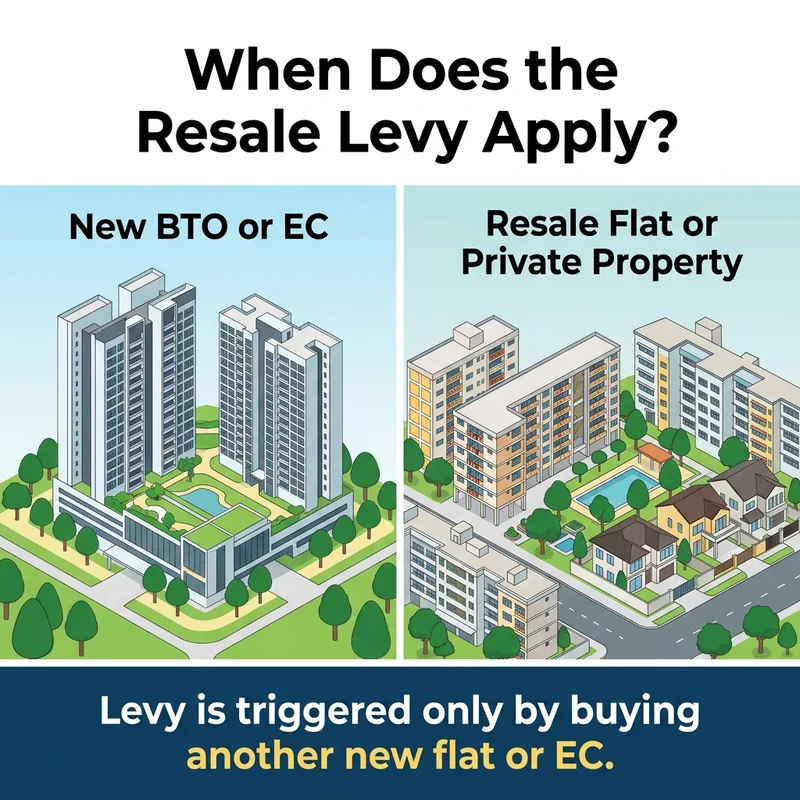
If you are weighing a resale flat instead of a new unit, the levy does not apply to that purchase, a distinction that changes the total cash picture materially.
How much is the resale levy by flat type?
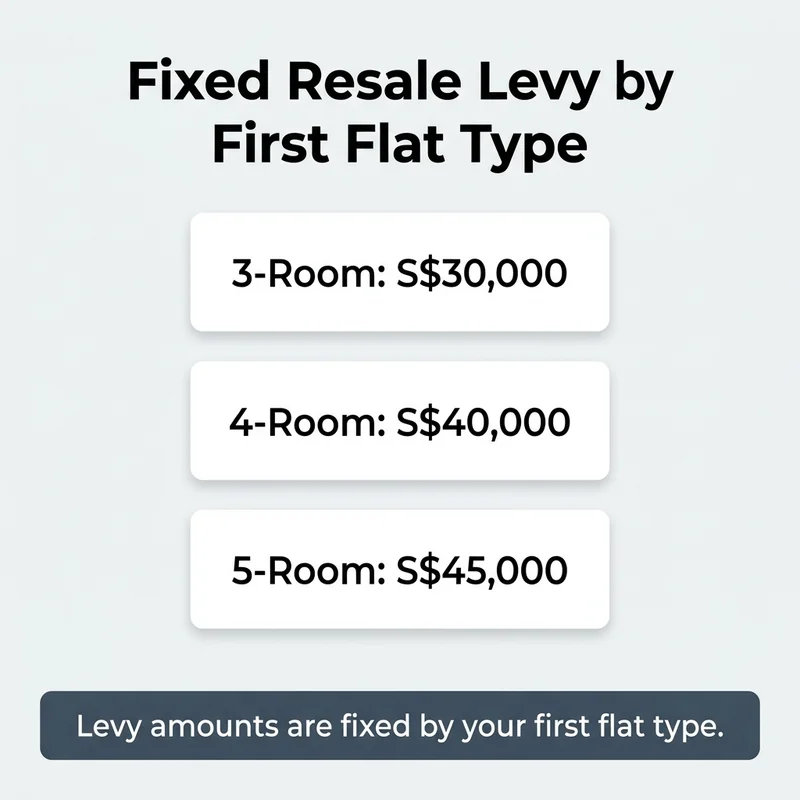
For first subsidised flats sold on or after 3 March 2006, the amount is fixed by your first flat type, not by the price you sold it for:
| First Flat Type | Resale Levy (Family) | Resale Levy (Single) |
|---|---|---|
| 2-room / 2-room Flexi | S$15,000 | S$7,500 |
| 3-room | S$30,000 | S$15,000 |
| 4-room | S$40,000 | S$20,000 |
| 5-room | S$45,000 | S$22,500 |
| 3Gen | S$45,000 | Not applicable |
| Executive | S$50,000 | S$25,000 |
| Executive Condominium (EC) | S$55,000 | S$27,500 |
*Singles generally pay half the family amount (HDB). For EC first homes, HDB’s conditions tables list S$27,500 for singles, while its summary resale-levy page marks the Singles Grant reduction “not applicable” to the EC line, and the EC levy applies to units bought with the CPF Housing Grant or from projects whose EC tender closed on or after 9 December 2013. If your first home was an EC, verify your case with HDB. Sources: HDB, conditions after buying a new flat; HDB, resale levy.*
Two points are worth internalising. First, it is your first flat that sets the bill: sell a 5-room flat and the levy is S$45,000 (or S$22,500 as a single) even when you are moving into a new EC. The S$55,000 row applies where your first subsidised home was itself an EC. Second, the amount is fixed: whether your 4-room sold for S$450,000 or S$650,000, the levy tied to that flat type stays at S$40,000.
Why it catches upgraders out: no CPF, no housing loan
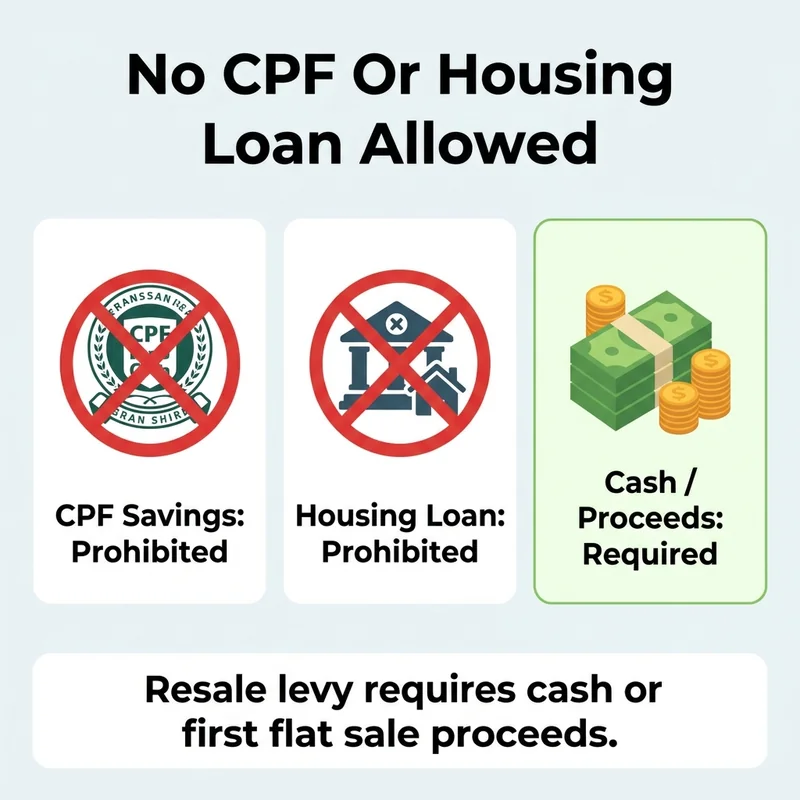
Most people focus on the amount. How you are allowed to pay it is what trips them up. HDB requires the levy to be paid “using cash and/or your flat sale proceeds, and not a housing loan.” The CPF Board’s housing scheme terms are equally clear: CPF savings cannot be used to pay the resale levy.
That matters because most HDB upgraders are used to CPF absorbing large chunks of their property costs: downpayments, stamp duties, monthly instalments. The resale levy breaks that pattern entirely. If your sale proceeds from the first flat are fully earmarked for CPF refunds (principal plus accrued interest) and the downpayment on your new flat, the shortfall can only be filled with hard cash.
This is one reason the resale levy deserves the same upfront planning as tools like the TDSR and MSR borrowing limits. It is a fixed obligation that sits outside your loan structure and must be accounted for separately in your cash-flow planning.
When exactly must you pay the resale levy?
You pay the levy at whichever comes later: the disposal of your first subsidised flat, or taking possession (collecting the keys) of your second. HDB sets out how it works in practice:
- If you sell the first flat after collecting the keys to the second, the levy is deducted from the net proceeds of the sale, with any shortfall paid in cash.
- If you sell the first flat before collecting the keys to the second, the levy is paid in cash at key collection.
The amount itself is locked in earlier: it is determined at the point you book your second subsidised flat, and it applies regardless of ownership type (joint tenancy or tenancy-in-common) or your share of the flat.
For a BTO booked years before completion, that means the liability can sit known but unpaid until the new flat is ready. The earlier you check it, the more runway you have to plan the cash component of your transaction, rather than discovering it as a surprise closer to completion.
Risks and Considerations
The most immediate risk is a cash-flow mismatch. Many households structure their upgrading budget around CPF refunds, sale proceeds and a new loan, without setting aside a separate pocket of cash for the levy. If your first flat’s sale proceeds are thin after paying off an outstanding mortgage and CPF accrued interest, an S$40,000 or S$45,000 cash requirement can derail or delay the purchase of your next flat.
A second risk applies to legacy cases. If your first subsidised flat was sold before 3 March 2006, a percentage-graded regime applies instead: 10% to 25% of the resale price (or 90% of market valuation, whichever is higher), with half-rates for singles and minimum amounts of S$15,000 to S$50,000 depending on flat type. If the payment was deferred, interest is charged at 5% per annum (described in a parliamentary answer as compound interest), which is why some older cases now face figures far above the original levy. HDB has waived accrued interest for elderly right-sizers and considers hardship appeals. Under the current policy, the fixed post-2006 amounts carry no interest component.
Given these moving parts, it is worth checking your specific resale levy liability with HDB before signing any Option to Purchase on your next flat, rather than relying on rough estimates from flat type alone.
Frequently Asked Questions
What is the HDB resale levy and who needs to pay it?
The resale levy is a fixed charge payable by second-timers who previously bought a subsidised home and are now buying another new flat from HDB (BTO, Sale of Balance or open booking) or a brand-new EC from a developer. It is based on the type of your first flat for flats sold on or after 3 March 2006, per HDB. Buying a resale flat or private property does not trigger it.
Can I use my CPF Ordinary Account to pay the HDB resale levy?
No. The levy must be paid in cash and/or from your first flat’s sale proceeds. CPF savings and housing loans, whether from HDB or a bank, cannot be used, according to the CPF Board and HDB.
How much is the HDB resale levy for a 4-room or 5-room first flat?
For a first flat sold on or after 3 March 2006, the fixed levy is S$40,000 if your first flat was a 4-room, and S$45,000 if it was a 5-room, per HDB. Singles pay half these amounts.
When must the HDB resale levy be paid when buying an EC or BTO flat?
The levy is payable at whichever comes later: the sale of your first subsidised flat, or key collection for your second. The amount itself is fixed at the point you book the second flat, per HDB.
Do I pay a resale levy if I buy a resale flat instead of a new one?
No. HDB states that the resale levy is not applicable to buyers of resale flats. The levy targets a second subsidised purchase: another new flat from HDB or a new EC from a developer.
Data Sources
This article draws on HDB’s official resale levy information (conditions after buying a new flat, selling a flat: resale levy and conditions after buying an EC) and CPF Board’s terms and conditions for use of CPF under the CPF Housing Scheme. Legacy interest and waiver details come from a Singapore Parliament record, 2 July 2017. Readers should verify the latest rules with HDB before making decisions.
Planning an upgrade and unsure how the resale levy fits into your numbers? Message us on WhatsApp and we can walk through your specific flat history and timeline.
This article is for general reference only and does not constitute financial, legal, or investment advice. Verify all details with relevant authorities before making decisions.
Agent: Joe Chow | CEA Reg No.: R072635C
Agency: SRI Pte Ltd | Licence: L3010738A