If you sold your HDB flat this past quarter, you probably found a buyer faster than you expected. If you’re holding one hoping to time an upgrade, the numbers tell a more complicated story — more buyers showed up, but they’re not paying more for the privilege.
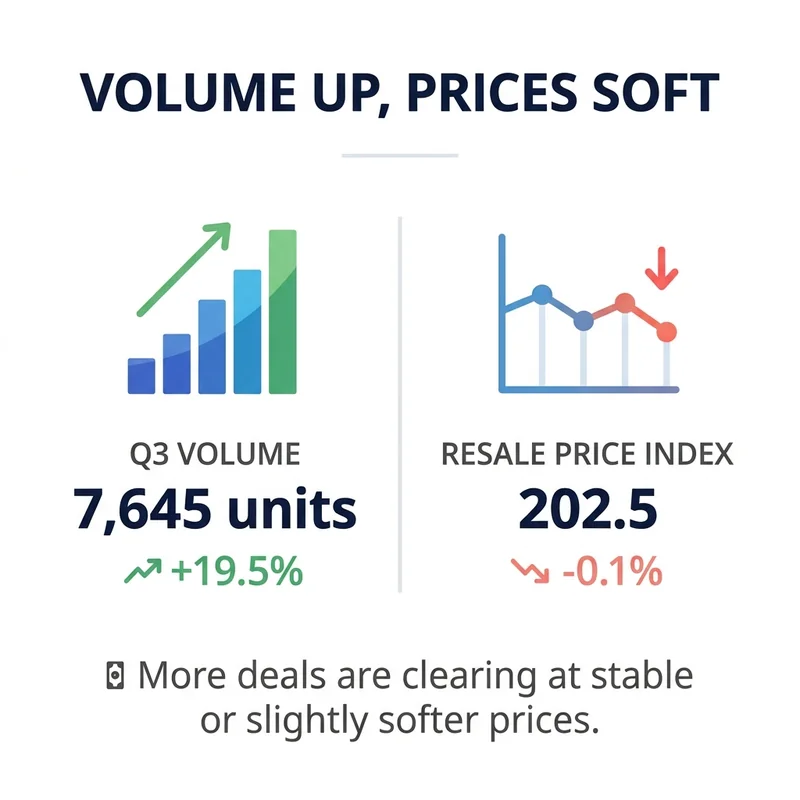
HDB resale transactions hit 7,645 units in Q3 2026, up 19.5% quarter-on-quarter from 6,396 in Q2, according to EdgeProp Singapore’s 23 October 2026 report. At the same time, the Resale Price Index (RPI) — HDB’s official gauge of resale flat prices — edged down 0.1% to 202.5, the third straight quarterly decline, per HDB’s Q3 2026 public housing data release, October 2026. More deals, softer prices. That combination matters a lot if your upgrade plan assumes your current flat will fetch more than it did last quarter.
Key Takeaways
- HDB resale volume rose 19.5% quarter-on-quarter to 7,645 transactions in Q3 2026, the highest since 2024, while the Resale Price Index fell 0.1% to 202.5 — the third consecutive quarterly decline (HDB Q3 2026 data release, October 2026; EdgeProp, 23 October 2026).
- Five-room flat transactions jumped 26.7% to 1,867 units and executive/multi-generation flats rose 41.6% to 545 units, with Huttons Asia’s Lee Sze Teck attributing part of this to private-home owners entering the resale market after July’s removal of the 15-month wait-out period, though HDB says it did not observe a significant increase in purchases by this group (AsiaOne, 26 October 2026).
- Nine of 26 HDB towns recorded price declines, led by the Central Area (-8.4%), Ang Mo Kio (-4.7%) and Jurong East (-4.3%) (EdgeProp, 23 October 2026).
Why HDB Resale Volume Is Surging While Prices Fall
HDB resale volume surged because more buyers entered the market, not because sellers extracted higher prices. The 7,645 transactions logged in Q3 2026 mark a 19.5% jump from the 6,396 deals in Q2, the strongest quarterly volume since 2024, based on EdgeProp Singapore’s analysis of the HDB data release. Yet the RPI, which tracks actual transacted prices across the resale market, slipped to 202.5 — a modest 0.1% decline, but the third in a row following drops of 0.1% in Q1 and 0.3% in Q2, per HDB’s official figures.
This divergence is not a shifting mix of cheap flats. The flat-type data shows demand grew fastest in the larger, higher-priced segments — five-room and executive flats — and million-dollar transactions hit a quarterly record of 596, the first time the figure has passed 500. HDB’s RPI is also a stratified index weighted for flat type and location rather than a simple average, so heavier activity in one segment does not mechanically drag it down. What the combination points to is a liquidity story rather than a price-appreciation one: sellers are clearing flats more easily, at prices broadly in line with recent quarters rather than above them. Huttons Asia’s Lee Sze Teck put it plainly in EdgeProp’s report — despite considerably more demand in the five-room and larger segment, “the impact on prices was relatively subdued”.
What the Q3 2026 Numbers Mean for HDB Upgraders
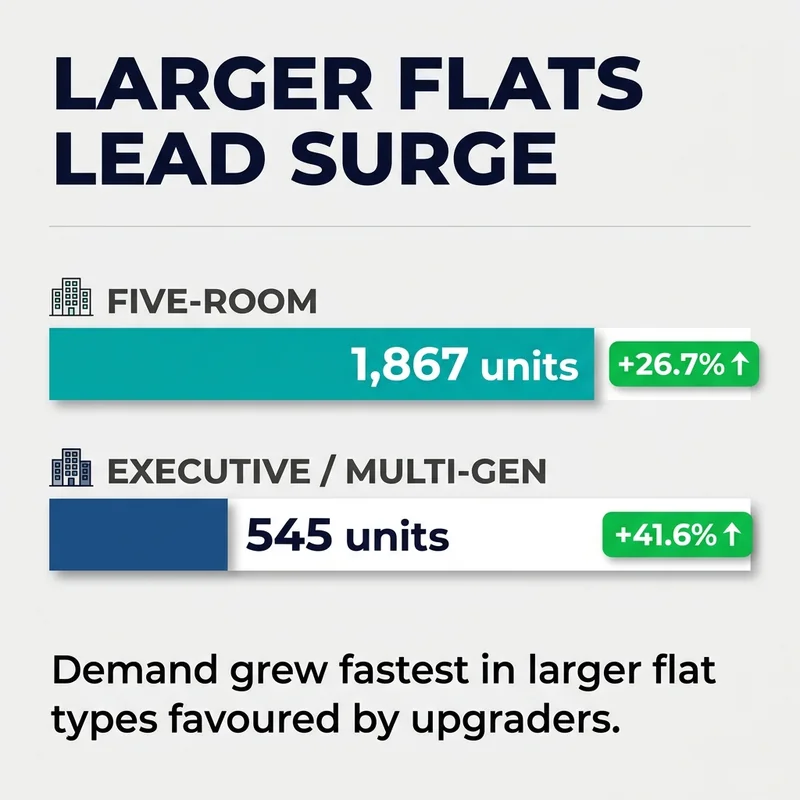
The flat-type breakdown is where the story gets interesting. Five-room flat transactions climbed 26.7% quarter-on-quarter to 1,867 units, and executive and multi-generation flat transactions jumped 41.6% to 545 units, according to data cited by AsiaOne on 26 October 2026. These are the flat types typically bought by upgraders and larger households — and the surge suggests more of these buyers were active in Q3. If you have been following the “HDB resale prices third consecutive quarter decline 2026” story, this is the practical part: the flat types upgraders typically move into are also where transaction volume grew fastest.
Huttons Asia’s Lee Sze Teck, quoted in that AsiaOne report, attributes part of this rise to private-property owners who moved into HDB flats after the 15-month wait-out period ended on 28 July 2026. HDB’s own reading is more cautious than the analyst’s: the board said it did not observe a significant increase in resale prices or in the number of flats bought by this group of buyers. Treat the downgrader effect as one analyst’s attribution, not an established driver — and note it applies specifically to that July policy change, not to the whole of the second half.
For upgraders, the practical takeaway is this: a larger pool of buyers for five-room and executive flats does not automatically mean your flat will sell for more. It may mean it sells faster. If your upgrade budget depends on your current flat fetching a price above recent comparable transactions, the RPI’s third consecutive quarterly decline is a reason to stress-test that assumption before committing to a new purchase. Readers weighing the resale levy on a second subsidised flat may also find our guide on the HDB Resale Levy useful background.
Town-by-Town Breakdown: Where Are HDB Prices Dropping?
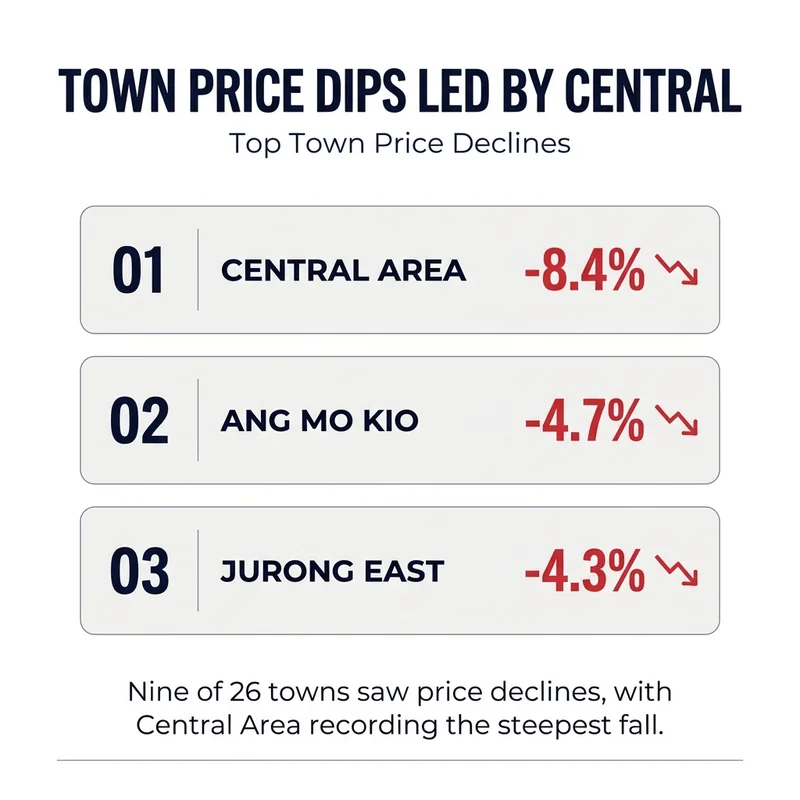
Nine of HDB’s 26 towns posted price declines in Q3 2026, with the Central Area, Ang Mo Kio and Jurong East recording the steepest drops, per EdgeProp’s 23 October 2026 report.
Resale transactions by flat type, Q3 2026
| Flat type | Q3 2026 transactions | QoQ change |
|---|---|---|
| Five-room | 1,867 | +26.7% |
| Executive / multi-generation | 545 | +41.6% |
Largest town-level price declines, Q3 2026
| Town | QoQ price change |
|---|---|
| Central Area | -8.4% |
| Ang Mo Kio | -4.7% |
| Jurong East | -4.3% |
The other 17 towns did not record a price decline in the quarter, which means the headline RPI fall is not evenly distributed. Central Area’s -8.4% stands out sharply against the other two towns. Anyone selling or buying in Ang Mo Kio or Jurong East specifically should treat these town-level figures as more directly relevant than the national RPI average.
Risks and Considerations
The volume-price divergence cuts both ways depending on which side of the transaction you’re on. Buyers in declining towns may find more room to negotiate, but should verify whether a specific unit’s asking price reflects the broader town trend or an outlier listing. Sellers banking on five-room or executive flat demand should note that higher transaction counts reflect more buyers transacting, not necessarily higher clearing prices — the RPI data from HDB is the more reliable gauge of actual price direction.
Upgraders relying on the July wait-out period removal as a tailwind should also recognise this is one analyst’s attribution of a trend, based on AsiaOne’s reporting, not a guaranteed driver that will persist into future quarters. For readers who tracked the wait-out rule change itself, our earlier piece on HDB’s wait-out rule removal and July’s 2,660 resale volume covers the policy mechanics in more detail. As with all quarterly data, three consecutive quarters of decline is a trend worth watching, not a guarantee of where Q4 lands. Verify current listing prices and comparable transactions for your specific town and flat type before making a financial commitment.
Frequently Asked Questions
What were the HDB resale transaction volumes in Q3 2026?
HDB recorded 7,645 resale-flat transactions in Q3 2026, a 19.5% increase from 6,396 transactions in Q2 2026, according to EdgeProp Singapore.
Why are HDB resale prices falling despite a surge in transaction volume?
The Resale Price Index fell 0.1% quarter-on-quarter in Q3 2026 even as transaction volume rose sharply. Because the RPI is stratified by flat type and location rather than being a simple average, the dip points to slightly softer clearing prices rather than a rush of cheaper flats changing hands — five-room and executive volumes actually grew fastest, and million-dollar deals hit a record 596, per HDB’s Q3 2026 data release and EdgeProp’s analysis. This marks the third consecutive quarterly decline.
Which HDB towns recorded price drops in Q3 2026?
Nine of 26 towns saw price declines, led by the Central Area (-8.4%), Ang Mo Kio (-4.7%) and Jurong East (-4.3%), based on EdgeProp Singapore’s analysis.
How does the third consecutive quarter of HDB price decline affect upgraders?
It means upgraders should not assume their current flat will sell above recent comparable transactions. Five-room and executive flat volumes rose sharply in Q3 2026, but higher transaction counts reflect more buyer activity, not confirmed price appreciation, per HDB’s Q3 2026 data release and EdgeProp.
Did the removal of the wait-out period for private property owners cause the Q3 2026 volume jump?
Huttons Asia’s Lee Sze Teck attributed part of the rise in larger-flat transactions to private-home owners entering the resale market after the 15-month wait-out period ended on 28 July 2026, as reported by AsiaOne on 26 October 2026. However, HDB said it did not observe a significant increase in resale prices or in the number of flats bought by this group, so this remains the analyst’s attribution rather than a confirmed cause of the broader volume increase.
Data Sources: This article draws on transaction and price data from HDB’s Q3 2026 public housing data release (October 2026), EdgeProp Singapore’s reporting on Q3 2026 resale transactions (23 October 2026), and AsiaOne’s coverage of flat-type trends and industry commentary (26 October 2026), with the index level cross-checked against ERA Singapore’s 3Q 2026 HDB quarterly commentary.
If you’re weighing an HDB upgrade and want to stress-test your numbers against current town-level data, message us on WhatsApp for a straight conversation.
This article is for general reference only and does not constitute financial, legal, or investment advice. Verify all details with relevant authorities before making decisions.
Agent: Joe Chow | CEA Reg No.: R072635C
Agency: SRI Pte Ltd | Licence: L3010738A