Two Government Land Sales (GLS) tenders closed in September 2026 at prices that made property watchers do a double take. EcoWorld submitted a record bid for a residential plot near Sin Ming, while a UOL–CapitaLand joint venture set a suburban benchmark at New Upper Changi Road in Bedok. These bids followed a quiet August for new-home sales and lower sales across the first eight months of the year. Why pay more for land when fewer homes are selling? The answer involves the launch calendar, developers’ different business plans and the particular sites they want—not a guarantee that home prices must rise.
Key Takeaways
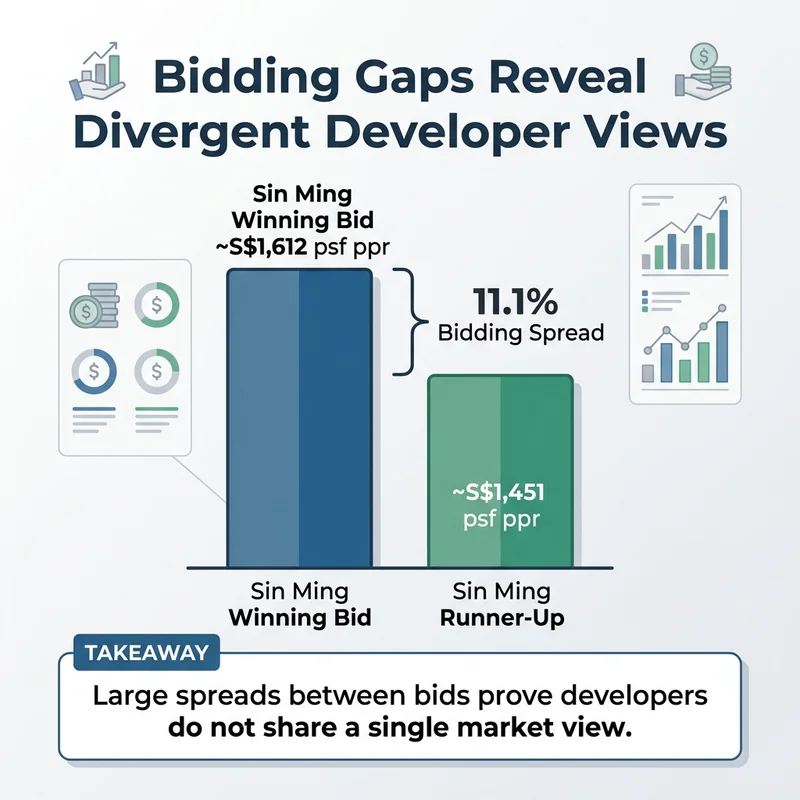
- Eco World Development’s top bid for the Lorong Puntong/Sin Ming Avenue site came in at approximately S$1,612 psf ppr, a reported record for a 99-year pure private residential Rest of Central Region (RCR) GLS site, ahead of a runner-up bid of about S$1,451 psf ppr from a Hong Leong Holdings–TID consortium, according to The Business Times, 15 September 2026.
- A UOL–CapitaLand joint venture won the New Upper Changi Road site at approximately S$1,537 psf ppr (S$1,425,388,000 in total), a new benchmark for a pure-residential Outside Central Region (OCR) site, per The Business Times.
- January–August developer sales excluding executive condominiums (ECs) fell 34.3% year-on-year, while units launched fell 43.8%, according to Huttons’ analysis of URA data. Lower sales coincided with substantially fewer launches; the figures do not isolate demand strength.
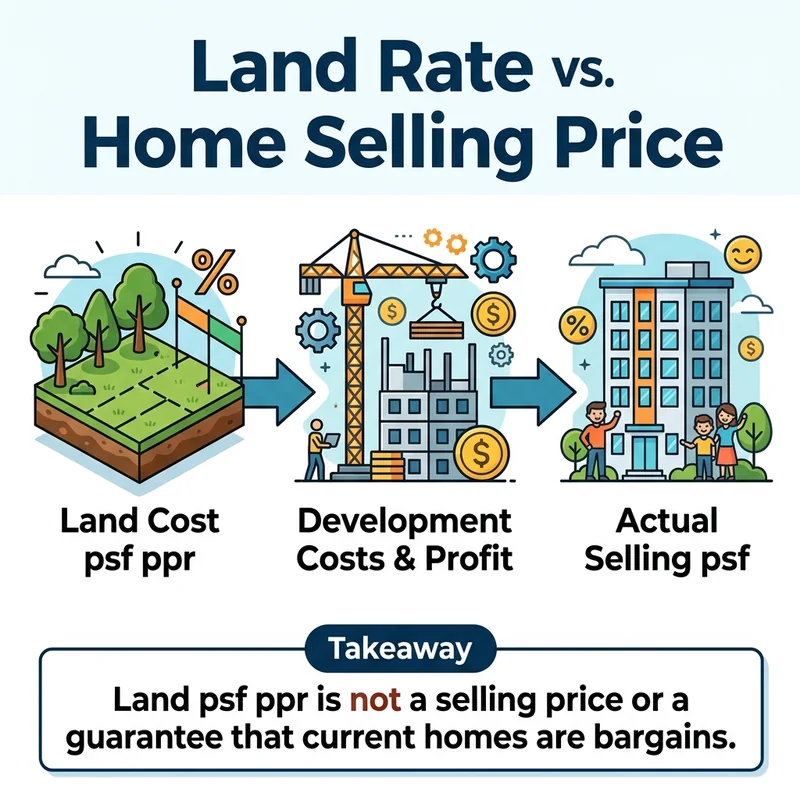
- A high land bid shows what a bidder is willing to pay now for a future development. It is a cost input, not a selling price or a guarantee that an available home is good value.
Why Are Developers Bidding Record Highs When Sales Volumes Slow?
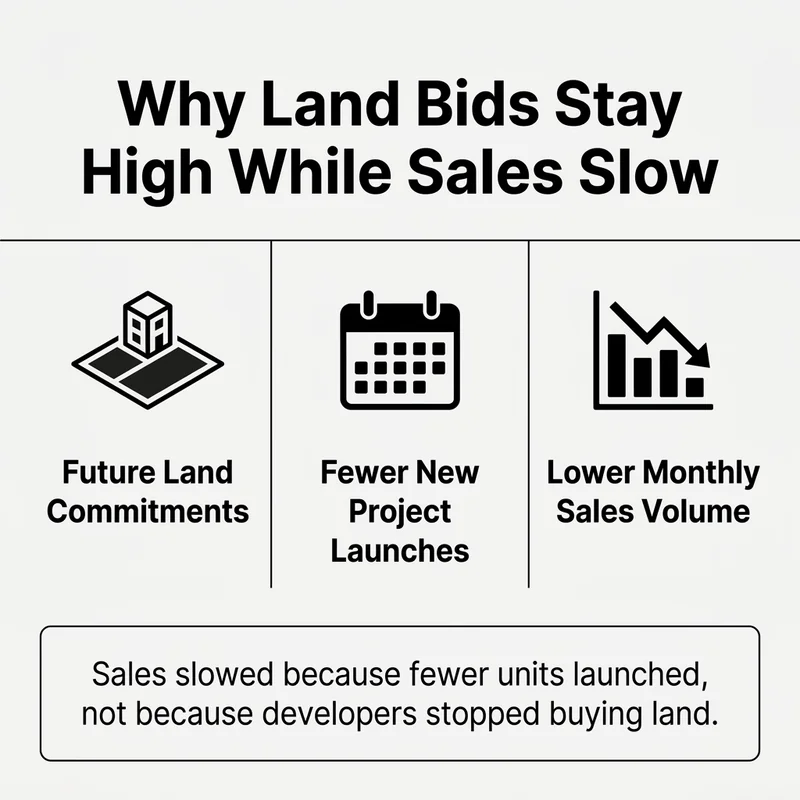
Land tenders and home sales run on different clocks. A tender captures developers’ willingness to commit to a future project; monthly developer sales record purchases from projects already on the market. Fewer fresh launches can reduce sales opportunities, but sales totals alone cannot separate the effects of launch supply, pricing and underlying demand.
August 2026 had a quiet launch calendar: no brand-new project launched that month, with the 116 units released all coming from the existing Union Square Residences, according to PropNex’s summary of URA data, 15 September 2026. Developers sold 153 new private homes excluding ECs, down from 731 in July. SRI’s 17 September commentary linked the moderation largely to limited launches and the Hungry Ghost Festival period. That is an agency’s interpretation of the quieter month, not a measurement proving that underlying demand was unchanged.
The broader comparison matters too. Huttons’ August sales report, using URA data downloaded on 15 September, estimated January–August sales excluding ECs at 5,038 units, against 7,669 a year earlier—a 34.3% decline. Units launched fell further, from 8,247 to 4,632, or 43.8%. The slowdown was therefore not confined to August, but it coincided with substantially fewer units being released. These totals do not tell us how much of the sales decline came from fewer launches versus buyers resisting prices.
The developers’ reasons are more specific than a general bet that Singapore prices must rise. In its 4 September SGX announcement, UOL explicitly said the acquisition would replenish its Singapore residential land bank. UOL and CapitaLand also highlighted the mature neighbourhood and potential appeal to HDB upgraders and surrounding landed-home residents in their joint statement, reported by The Business Times on 1 September. That explains their commercial reasoning; it does not prove future buyers will accept any launch price.
EcoWorld’s position is different: Sin Ming marks its maiden development venture in Singapore, rather than replenishment of an existing local pipeline. The Star’s 24 September report puts its target launch in 2028. That is a reported target, not a guaranteed date or completion timetable. An established consortium securing future inventory and a developer entering a new market can both bid aggressively despite a quieter current sales period. Their strategies need not represent every other bidder’s view—which is why the runner-up bids matter.
Tender comparison: how far apart were the bids
| Site | Region | Winning bid (psf ppr) | Winning bid (total) | Runner-up bid (psf ppr) | Record claimed |
|---|---|---|---|---|---|
| Lorong Puntong / Sin Ming Avenue | RCR | ~S$1,612 | S$208.099 million | ~S$1,451 | Record for a 99-year pure private residential RCR GLS site |
| New Upper Changi Road (Bedok) | OCR | ~S$1,537 | S$1,425,388,000 | ~S$1,350 | New benchmark for a pure-residential OCR site |
*Sources: The Business Times, 15 September 2026; The Business Times, 1 September 2026; URA’s New Upper Changi Road tender annex. The New Upper Changi runner-up’s S$1.252 billion total bid equates to approximately S$1,350 psf ppr; rates are rounded.*
The gap between the top and second bid at Sin Ming—roughly S$1,612 versus S$1,451 psf ppr—was about 11.1%. At New Upper Changi Road, the top total bid was about 13.8% above the runner-up. These spreads show that competing developers did not attach the same value to the sites. The winners were willing to pay substantially more; that is evidence of their particular confidence, not agreement across the market.
Do Record Land Bids Mean Homes for Sale Today Are Automatic Bargains?
No. A psf ppr land rate and a home’s selling psf are different measurements answering different questions, and conflating them is where the “buy now before prices catch up” pitch usually breaks down.
The land rate is the acquisition price divided by permissible gross floor area, not the selling price per square foot of a home’s strata area. Land acquisition is only one part of development cost: construction, financing, professional fees, taxes and marketing also have to be covered. Breakeven means recovering the relevant costs without profit. A developer’s target profit sits above that cost base, while the market determines what buyers will actually pay. Two developers can therefore pay similar land rates and still launch at different prices. Higher costs may influence their pricing ambitions, but neither those costs nor a desired margin create a guaranteed price floor for existing homes.
Launch and completion are separate milestones. Buyers may commit to a new project before it is built, so eventual launch pricing must find buyers when sales open—not only when construction finishes. The sites at Sin Ming and Bedok indicate what their winning bidders are prepared to invest in future developments. That is useful market context, but it does not establish the fair value of a particular resale or currently launched unit nearby.
How Should Buyers Compare Available Units Against Future Launches?
The useful comparison is unit against unit, not headline against headline. If you are deciding between a condo available now and waiting for a project that might spring from one of these record sites, run the comparison on comparable terms: total quantum for a similar size and layout, actual selling psf (not land psf ppr), distance to the same MRT line or town centre, tenure remaining, and the realistic completion timeline if you wait.
A unit selling today at, say, S$1,750 psf in an established RCR project is not automatically “cheap” just because a nearby land parcel traded at S$1,612 psf ppr. Nor is it automatically overpriced. The only honest test is whether that unit’s size, layout, tenure and location suit your needs at a price you have independently checked against recent comparable transactions in the same project or a genuinely similar one nearby. If you are weighing decoupling or restructuring ownership to buy an additional property, our guide to property decoupling in Singapore covers the cost and risk side of that decision separately from any land-price narrative.
Risks and Considerations
Treat land-bid headlines as one input, not a signal to act. A record bid reflects a developer’s assessment of one site; it signals confidence but does not settle where the broader resale or new-sale market is heading. Equally, fewer sales alongside fewer launches do not establish either a collapse in demand or unchanged buyer appetite. The commercial risk is that a developer’s intended pricing may exceed what buyers will accept. Watch how actual launches are priced and received, rather than treating land costs as a settled forecast for the market.
Frequently Asked Questions
Does a record GLS land bid mean property prices will definitely go up?
No. A record bid reflects a developer’s cost basis and expectations for a specific future project, not a market-wide guarantee. Costs and desired profit influence its pricing plans, but buyers’ willingness to pay when units are offered for sale determines whether those plans can be achieved.
Are slower developer sales in 2026 a sign of collapsing buyer demand?
Not necessarily. Huttons’ January–August comparison shows sales down 34.3% and units launched down 43.8% year-on-year. August itself had no brand-new project launches, per PropNex, 15 September 2026. These figures show lower activity alongside fewer launches, not how much underlying demand strengthened or weakened.
Should I buy an available condo now or wait for upcoming GLS projects?
This depends on your own timeline, budget and unit requirements, not on land-bid headlines. Compare actual selling psf, quantum, tenure and location of available units against your needs, rather than assuming a high land bid nearby makes today’s listings a bargain.
How do developers calculate launch prices from land bid psf ppr rates?
There is no direct one-to-one conversion. Land cost uses permissible gross floor area, while home selling psf uses the unit’s saleable area. Development costs and area assumptions must first be reconciled to estimate breakeven. Desired profit is additional—not part of breakeven—and achievable prices still depend on buyers and competing homes.
Data Sources
This article uses URA’s tender records for Sin Ming and New Upper Changi Road, UOL’s SGX announcement, and the Business Times, The Star, Huttons, PropNex and SRI sources linked above. Sales comparisons refer to the specified reporting periods; the EcoWorld launch date is a reported target. Readers should verify the latest project and market information before making decisions.
For separate context on regional price movements, see our earlier coverage on CCR vs OCR price divergence.
Have a specific unit or launch you are weighing against these tender benchmarks? Message us on WhatsApp and we can walk through the comparison together.
This article is for general reference only and does not constitute financial, legal, or investment advice. Verify all details with relevant authorities before making decisions.
Agent: Joe Chow | CEA Reg No.: R072635C
Agency: SRI Pte Ltd | Licence: L3010738A