
Imagine sitting on a paper profit from your HDB flat for six months while waiting for the “perfect” private property entry point, only to discover that the $45,000 you gained in HDB resale value has been quietly eaten up — and then some — by appreciation in the private segment you were eyeing. That is not a hypothetical. It is a pattern that repeats itself for upgraders who treat timing as a strategy without accounting for what the waiting period actually costs them.
Here is the uncomfortable truth: in Singapore’s property market, inaction carries a price tag just as real as a stamp duty bill. Between Q2 2024 and Q1 2026, the HDB Resale Price Index (compiled by HDB and disseminated via SingStat, base Q1 2009 = 100) climbed from 198.0 to 203.4 — a cumulative gain of approximately 2.7%. Meanwhile, the private residential market moved on its own trajectory, indifferent to your timeline.
This article unpacks the mechanics of what we call the 6-to-12-month upgrader trap — the holding costs, index divergences, and decision-making blind spots that quietly erode your upgrade budget — and what a clearer-eyed transition plan looks like in practice.
Key Takeaways
- The HDB Resale Price Index rose approximately 2.7% from Q2 2024 to Q1 2026 (Source: SingStat, May 2026), while private residential prices followed a faster independent trajectory — widening the gap upgraders must bridge.
- The 4-year SSD holding period for private properties purchased on or after 4 July 2025 requires more disciplined long-term planning than the previous 3-year schedule (Source: IRAS / MAS, effective 4 July 2025).
- Based on standard loan calculations, each 1% rise in interest rates reduces a typical household’s loan quantum by approximately 8–10%, compressing available leverage at the point of delayed entry.
Why the 6-12 month waiting gap erodes upgrader equity
The private residential market appreciates independently of — and historically faster than — the HDB resale segment, meaning every month spent waiting for a “better” entry point can widen the price gap an upgrader must eventually cross.
According to SingStat’s Property Price Indices (base Q1 2009 = 100, published May 2026), the HDB Resale Price Index rose from 198.0 in Q2 2024 to 203.4 in Q1 2026 — a cumulative gain of approximately 2.7% over seven quarters. On a $500,000 flat, that translates to roughly $13,500 in paper appreciation. For many upgraders, that figure feels like runway. The problem is what is happening on the other side of the transaction.
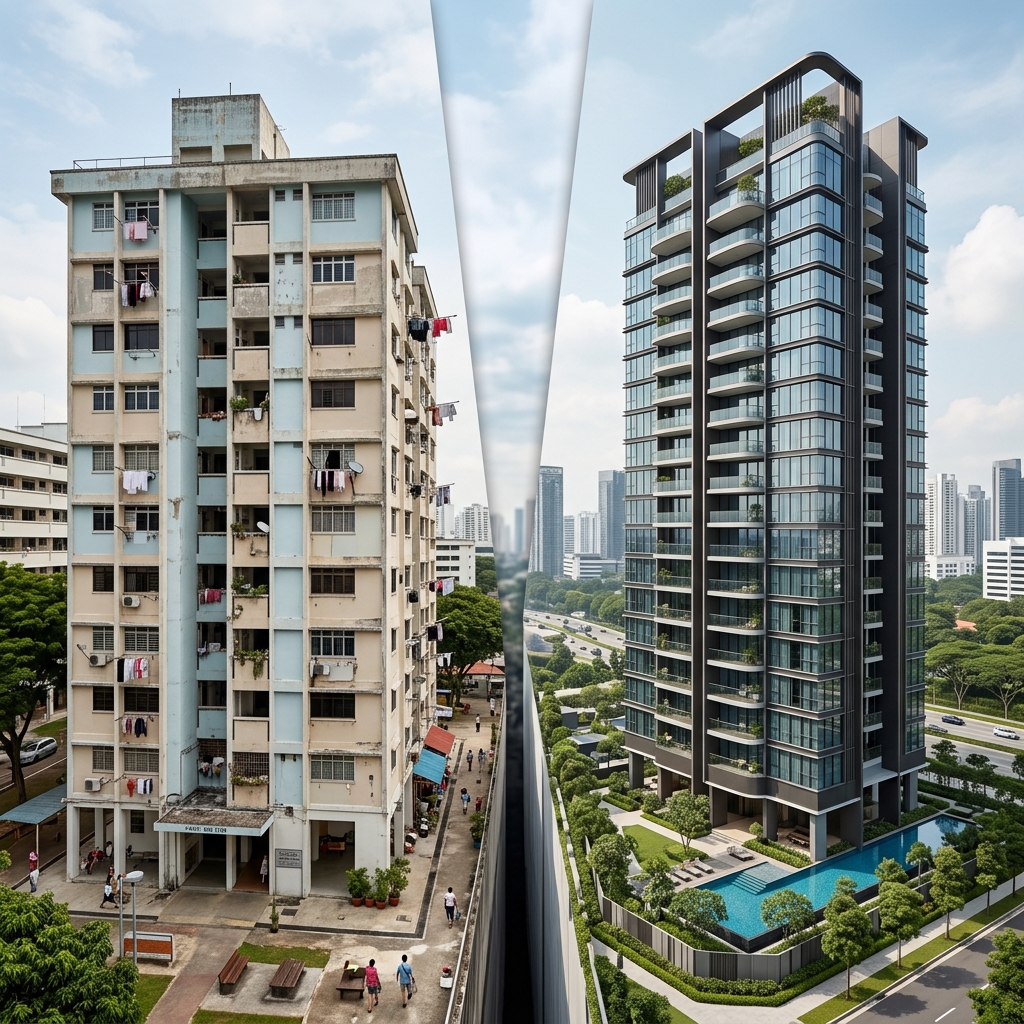
The URA Private Residential Property Price Index — which tracks all private residential properties island-wide and is compiled by the Urban Redevelopment Authority (URA) and disseminated via SingStat — moved on a separate trajectory across the same period. When the gap between HDB resale appreciation and private price movement is measured in absolute dollar terms rather than percentage points, the asymmetry becomes visible: a $1.2 million private unit appreciating at even a modest 1.5% annually adds approximately $18,000 in cost per year to the upgrader’s target purchase, before accounting for financing, stamp duties, or opportunity cost on sales proceeds sitting idle.
Layered on top of price movement are holding costs that accumulate in real time during any deliberate pause: mortgage interest on an outstanding HDB loan (at HDB’s concessionary rate of 2.6% per annum, as published by HDB), property tax, maintenance fees, and time-value erosion on cash tied up in CPF Ordinary Account proceeds that cannot be redeployed until the flat is sold and Option to Purchase exercised on the replacement unit.
A six-month delay on a $500,000 HDB loan at 2.6% costs approximately $6,500 in interest alone — none of which builds equity.
Practical takeaway: Measure the cost of waiting in the same units as the cost of buying — absolute dollars, not index percentages — and account for both sides of the transaction simultaneously before concluding that a pause is neutral.
Understanding the mechanics of the 4-year Seller’s Stamp Duty holding period
The 4-year Seller’s Stamp Duty (SSD) holding period means that any private residential property purchased on or after 4 July 2025 cannot be sold within four years without incurring a stamp duty penalty — a direct regulatory constraint on the timing flexibility HDB upgraders may have previously relied upon.
Under the revised schedule issued by IRAS and MAS (effective 4 July 2025), SSD is levied on the higher of the transacted price or market value as follows: 16% if sold within 1 year, 12% within 2 years, 8% within 3 years, and 4% within 4 years. Properties purchased before 4 July 2025 retain the previous 3-year schedule with rates of 12%, 8%, and 4% respectively. The one-year extension directly affects upgraders who may have planned a shorter ownership horizon before decoupling, refinancing, or laddering into a second property.
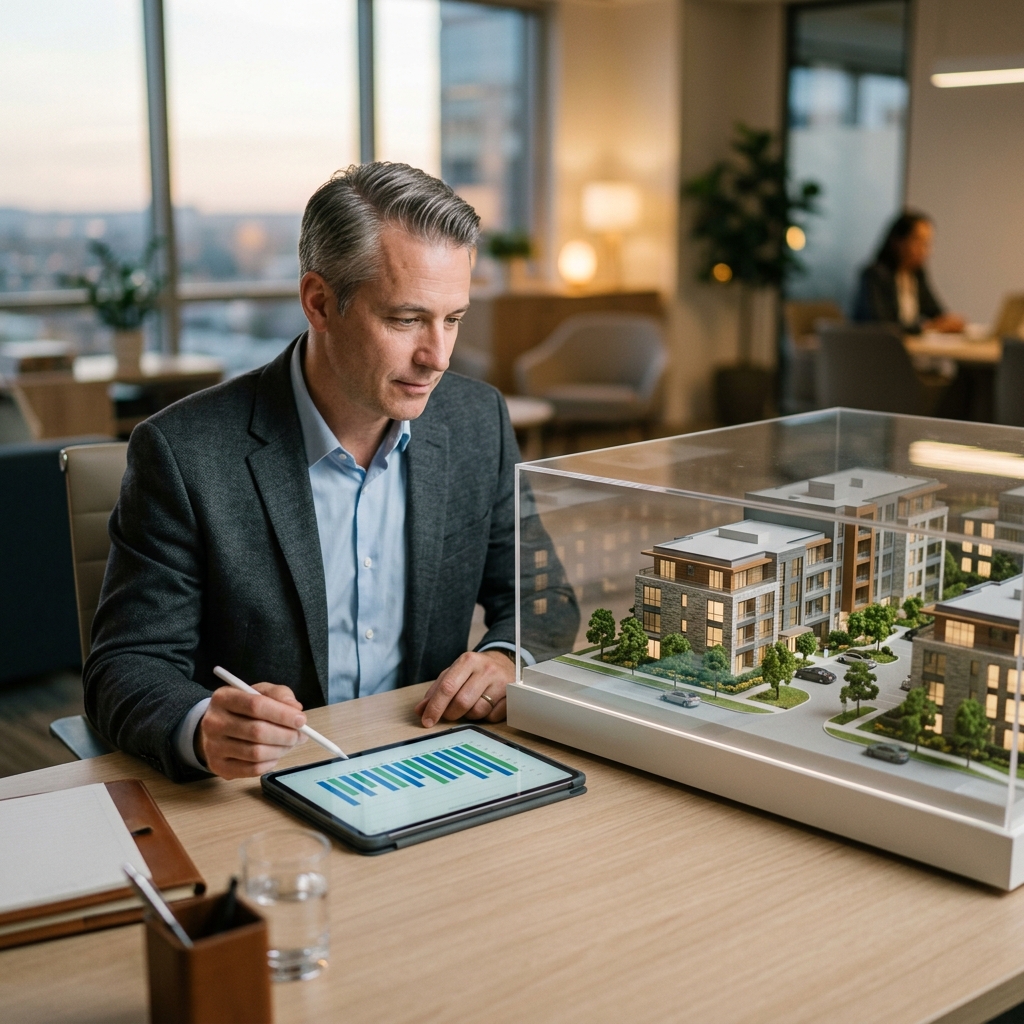
To illustrate the combined impact of market appreciation and a 12-month delay in entry, the table below uses estimated Q1 2026 price benchmarks and projected growth rates based on historical index trends (Source: SingStat Property Price Indices, base Q1 2009 = 100, published Q1 2026):
| Comparison Metric | HDB Resale (4-Room) | Private Non-Landed (OCR) | Impact of 12-Month Delay |
|---|---|---|---|
| Average Price (Estimated Q1 2026) | ~$570,000 | ~$1,350,000 | Baseline — no delay cost yet |
| Projected Appreciation (Est. annual) | ~2% (est.) | ~4% (est.) | OCR unit adds ~$54,000 in value while upgrader waits |
| Financing Cost Variance | Lower quantum, lower TDSR exposure | Higher quantum; each 1% rate rise reduces loan by ~8–10% | Delayed entry risks higher prevailing rates eroding loan eligibility |
| Total Equity Gap (12-month estimate) | +~$11,400 | +~$54,000 | Upgrader faces ~$42,600 wider price gap to bridge |
Note: Appreciation estimates are projections based on historical SingStat index trends and do not constitute guaranteed returns. Actual figures are subject to market conditions.
The 4-year SSD window also means that an upgrader who delays entry by 12 months effectively compresses their planning horizon — selling in year three of a four-year holding period now attracts an 8% penalty rather than triggering a clean exit.
Practical takeaway: For private residential properties purchased on or after 4 July 2025, factor a minimum 4-year hold into your financial modelling from day one — any shorter horizon materially increases exit costs and may offset projected capital appreciation entirely.
HDB resale price growth versus private residential market momentum
HDB resale prices and private residential prices have not moved in lockstep — and the divergence between the two indices is precisely what makes the upgrader’s waiting period financially costly.
According to SingStat’s Property Price Indices (base Q1 2009 = 100, published May 2026), the HDB Resale Price Index rose from 198.0 in Q2 2024 to 203.4 in Q1 2026, a cumulative gain of 2.7% over seven quarters. Year-on-year growth decelerated steadily: from 4.8% in Q2 2024 to 3.2% by Q1 2026, with Q1 2026 recording a marginal quarter-on-quarter dip of 0.1% — the first quarterly decline in approximately seven years, a trend also flagged by PropNex Research in their Q1 2026 market commentary.
The URA Private Residential Property Price Index traced a materially different trajectory over the same window. While both indices share the same Q1 2009 base of 100, the private index entered Q2 2024 at a structurally higher absolute level, reflecting cumulative gains driven by land scarcity, new launch pipeline absorption, and sustained upgrader demand from the HDB segment itself.
The practical consequence for upgraders is asymmetric price movement: the asset being sold (HDB flat) is appreciating at a decelerating pace, while the asset being purchased (private residential) continues to reflect independent demand drivers including limited new supply in established districts. Every quarter an upgrader defers action, the price gap widens — not because their flat loses value in absolute terms, but because the private market does not pause to wait.
Practical takeaway: An upgrader whose flat appreciated 2.7% over seven quarters gains roughly $13,500 on a $500,000 valuation — a figure that diminishes in real terms if private residential prices advance at a faster rate over the same period, increasing the cash or CPF top-up required to bridge the difference at the point of purchase.
Financial risks of timing the market during interest rate fluctuations
Attempting to time a property purchase around interest rate movements exposes HDB upgraders to a compounding cost structure that erodes purchasing power faster than most rate savings can recover.
The core risk is asymmetry: while upgraders wait for rates to fall, the properties they are targeting continue rising in price. On a $1.5 million private condominium, a 1% annualised price appreciation equates to $15,000 in additional capital outlay per year. If the rate differential being anticipated is 0.25 percentage points on a $900,000 loan, the annualised interest saving amounts to approximately $2,250 — a fraction of the price drift cost, based on standard loan calculations.
Home loan rates in Singapore are benchmarked primarily to SORA (Singapore Overnight Rate Average), the risk-free reference rate administered by the Monetary Authority of Singapore (MAS). SORA-pegged packages are variable by design, meaning a borrower who defers purchase expecting a rate reduction absorbs that wait in two ways simultaneously: continued HDB mortgage repayments at existing rates, and price appreciation on the private unit being deferred.

The Q1 2026 HDB Resale Price Index reading of 203.4 (Source: SingStat, published May 2026) — the first quarterly dip in nearly seven years — may signal moderating momentum, but a single quarter does not constitute a downward trend sufficient to base a purchase deferral decision upon.
Practical takeaway: Model the total cost of waiting in absolute dollar terms — price appreciation on the target private unit plus ongoing HDB loan interest — and compare that figure directly against the projected interest saving from a lower rate environment before treating a rate pause as a viable reason to delay.
Strategic planning for the transition from HDB to private property
Strategic planning for the HDB-to-private upgrade begins with a clear-eyed assessment of your actual cash proceeds today — not a projected future HDB valuation that may or may not materialise under continued cooling measures.
With the HDB Resale Price Index (Source: SingStat, May 2026) decelerating from 4.8% year-on-year growth in Q2 2024 to 3.2% by Q1 2026 — and posting its first quarterly decline in approximately seven years — the assumption that waiting six to twelve months will yield a materially higher sale price is increasingly difficult to support with current data.
Successful upgraders typically prioritise entry into the private market based on existing cash proceeds rather than projected future HDB gains that may plateau during cooling measure cycles. This approach requires mapping three figures with precision before committing to any timeline: the net sales proceeds after outstanding HDB loan repayment and CPF refund with accrued interest (per CPF Board guidelines); the Additional Buyer’s Stamp Duty (ABSD) exposure under current MAS-gazetted rates; and the financing quantum available under the Total Debt Servicing Ratio (TDSR) framework set by MAS, currently capped at 55% of gross monthly income.
For HDB flat owners who have met their Minimum Occupation Period (MOP) — five years for standard Build-To-Order flats, per HDB policy — the practical planning window is typically 12 to 18 months. This covers sale preparation, Option to Purchase (OTP) negotiations on the private unit, legal conveyancing, and the bridging loan period where dual housing costs may apply. According to URA Realis transaction records, median private non-landed transaction volumes in the Outside Central Region (OCR) remained relatively stable across Q3 2025 to Q1 2026, suggesting entry opportunities exist for buyers who have completed their financial structuring.
Practical takeaway: Before extending your HDB holding period in anticipation of further price gains, calculate your current net proceeds, stress-test your TDSR position, and compare those figures against the private units you are targeting — the cost of waiting is quantifiable, while the upside of waiting is not.
Frequently Asked Questions
How much have HDB resale prices increased in the last two years?
According to SingStat’s Property Price Indices (compiled by HDB, base Q1 2009 = 100, published May 2026), the HDB Resale Price Index rose from 198.0 in Q2 2024 to 203.4 in Q1 2026 — a cumulative gain of approximately 2.7% over seven quarters. Year-on-year growth decelerated from 4.8% in Q2 2024 to 3.2% by Q1 2026, with Q1 2026 recording the first quarterly dip of 0.1% in approximately seven years.
Is it worth waiting for interest rates to drop before buying a condominium?
Based on standard loan calculations, the financial cost of waiting typically outweighs projected interest savings when property price appreciation is factored in. On a $1.5 million private condominium, a 1% annualised price increase adds $15,000 to your purchase cost per year — compared to an annualised interest saving of approximately $2,250 on a $900,000 loan if rates fall by 0.25 percentage points.
What is the MOP for HDB flats before upgrading to private property?
According to HDB policy, the Minimum Occupation Period (MOP) is five years for standard Build-To-Order (BTO) flats, after which owners are eligible to sell their flat and purchase private residential property. Note that the ABSD framework under current MAS-gazetted rates applies if a private property is purchased before the HDB flat is sold and transferred.
How do I calculate my actual cash proceeds from selling my HDB flat?
Your net sales proceeds are calculated after repaying your outstanding HDB loan in full and refunding all CPF monies used for the purchase — including accrued interest at the CPF Ordinary Account rate — back to your CPF account, per CPF Board guidelines. The remaining cash after these deductions, rather than the gross transaction price, is what funds your private property down payment.
How long does the HDB-to-private upgrading process typically take?
The practical planning window is typically 12 to 18 months, covering sale preparation, OTP negotiations on the private unit, legal conveyancing, and any bridging loan period where dual housing costs may apply. According to URA Realis transaction records, median private non-landed transaction volumes in the OCR remained relatively stable across Q3 2025 to Q1 2026, suggesting entry opportunities exist for financially prepared buyers who have completed their TDSR assessment.
Ready to map your upgrade timeline?
One conversation. No obligations. We’ll help you see the full picture — proceeds, TDSR, timing, and what the numbers actually say about your position today.
Data Sources
All figures sourced from official URA, HDB, CPF Board, and MAS publications, supplemented by SingStat, PropNex Research, and EdgeProp reporting. Data current as of June 2026.
Agent: Joe Chow | CEA Reg No.: R072635C
Agency: SRI Pte Ltd | Licence: L3010738A
Contact: +65 8098 0916
This article is for general reference only and does not constitute financial, legal, or investment advice. Verify all details with relevant authorities before making decisions.