

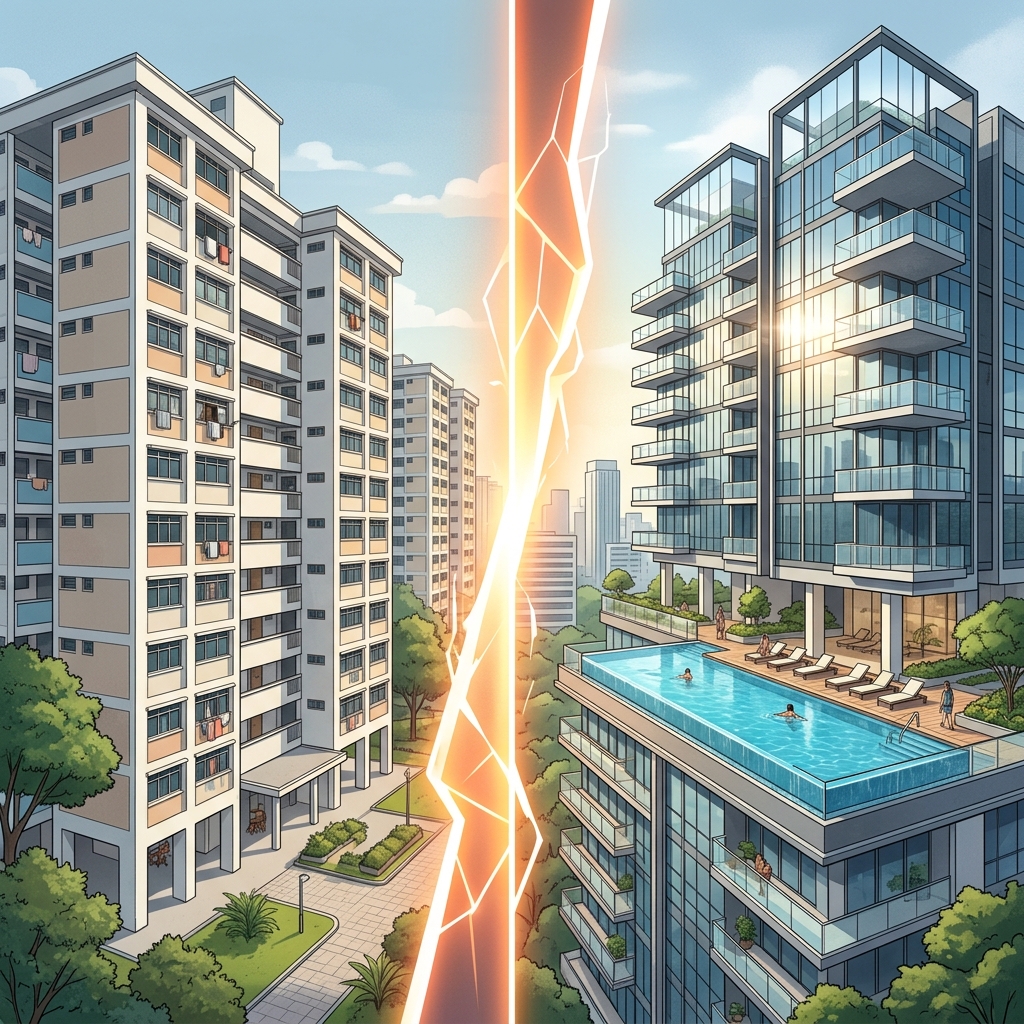
With the average price gap between new private condominiums and HDB resale flats widening to approximately 85% as of Q1 2026, the traditional upgrader path that once felt like a natural next step now warrants serious scrutiny. That 85% figure — drawn from URA Private Residential Price Index flash estimates and HDB transactional data via data.gov.sg — is not uniform across Singapore, and that distinction matters enormously depending on where you are in your housing journey.
The raw numbers tell one story. The full cost picture tells another. Beyond the headline quantum gap, upgraders face a layered calculation involving Additional Buyer’s Stamp Duty (ABSD), CPF (Central Provident Fund) usage constraints, loan-to-value limits, and ongoing maintenance costs that do not appear in any price index.
This article walks through the real, all-in cost comparison between BTO flats and private condominiums in 2026 — region by region, line item by line item — so you can make a clear-eyed assessment of whether upgrading still makes financial sense for your specific situation.
Key Takeaways
- The price gap between new private condos and HDB resale units sits at approximately 85%, based on Q1 2026 URA and HDB data.
- First-time upgraders retaining their HDB flat face an additional 20% ABSD on any private property purchase, payable in cash within 14 days of exercising the Option to Purchase.
- Historical URA data indicates a 15-year average annual appreciation rate for private non-landed property of approximately 3.2%, subject to market conditions.
- HDB resale prices rose approximately 65% between Q1 2017 and Q4 2025 in percentage terms — outpacing private condo indices over the same window — but private condos carry fewer exit restrictions.
- Second-time BTO buyers are eligible for the Step-Up CPF Housing Grant of up to S$15,000 only, versus up to S$120,000 for first-timers under the Enhanced CPF Housing Grant.
Understanding the Price Gap: BTO vs Condo in 2026
The price gap between a new HDB BTO (Build-To-Order) flat and a comparable private condominium unit ranges from approximately 74% to 119% depending on the planning area, based on HDB BTO launch data via data.gov.sg and URA Private Residential Price Index figures from Q4 2025 to Q1 2026.
That spread is wider than most upgraders expect, and the regional variation is where the real planning insight lies. In the Rest of Central Region — covering towns such as Toa Payoh and Bishan — a 4-room BTO launched in February 2025 carried a median price of approximately S$950,000, while a comparable condominium in the same cluster traded at a median quantum of around S$1.65 million in Q4 2025 (Source: URA Realis PPI, Q4 2025, ura.gov.sg). That translates to a premium of roughly 74%, or a S$700,000 absolute gap.

Move further out and the percentage premium actually widens. In the Outside Central Region — covering areas such as Jurong West and Woodlands — a 5-room BTO launched in January 2026 was priced at approximately S$480,000, while the median private condominium quantum in the same corridor sat near S$1.05 million in Q4 2025 (Source: HDB BTO Launch Data, data.gov.sg, January 2026; URA PPI, Q4 2025). The condo premium here reaches approximately 119%, even though the absolute dollar gap of around S$570,000 is nominally smaller.
This counterintuitive pattern — lower absolute gap, higher percentage premium — matters because CPF usage, mortgage servicing ratios, and Total Debt Servicing Ratio (TDSR) limits set by MAS (Monetary Authority of Singapore) are all calculated on quantum, not percentage. A S$570,000 gap in Jurong West places identical financing pressure on a household as a S$700,000 gap in Bishan, depending on income profile.
Practical takeaway: Before comparing BTO and condo prices, anchor your analysis to a specific planning area and flat type, then model the absolute dollar gap against your CPF Ordinary Account balance and MAS TDSR threshold — the percentage premium headline will not reflect your actual financing shortfall.
Calculating the True Cost: Mortgage, Levies, and Interest Rates
The true cost of owning either a BTO flat or a private condominium extends well beyond the purchase price. Once mortgage servicing, stamp duties, and the opportunity cost of CPF funds are factored in, the gap between the two options widens considerably from the headline price difference.
For a first-time upgrader retaining their existing HDB flat and purchasing a private condo, ABSD — a tax levied on the purchase price of a second residential property — of 20% applies under IRAS regulations current as of Q1 2026. Buyer’s Stamp Duty (BSD), applicable to all purchases, follows a tiered structure reaching up to 6% on the portion of purchase price exceeding S$1.5 million (Source: IRAS, January 2024 revised BSD table).
On the mortgage side, HDB BTO buyers remain eligible for the HDB Concessionary Loan at a fixed 2.6% per annum (pegged at 0.1% above the CPF Ordinary Account rate), while private property purchasers must use commercial bank loans, with average rates currently estimated at 3.2% to 3.5% per annum (Source: MAS Monthly Statistical Bulletin, March 2026).

| Cost Component | HDB BTO (New) | Private Condo (New) | Notes / Assumptions |
|---|---|---|---|
| Initial Downpayment | S$95,000 (10% cash or CPF) | S$330,000 (25% min; 5% cash) | BTO: S$950K Toa Payoh unit; Condo: S$1.65M median quantum, Q4 2025 |
| Monthly Mortgage (Est.) | S$2,860 | S$6,450 | HDB loan at 2.6%; bank loan at 3.3%; 25-year tenure |
| Stamp Duty (ABSD/BSD) | S$21,600 (BSD only) | S$429,000 (BSD ~S$99K + ABSD 20% S$330K) | ABSD applies if retaining HDB flat; Source: IRAS, Q1 2026 |
| Opportunity Cost of CPF | S$38,000 over 5 years (est.) | S$132,000 over 5 years (est.) | CPF OA accrued interest at 2.5% p.a. on amounts withdrawn; Source: CPF Board |
| Exit / MOP Timeline | 5-year MOP before sale | No MOP; Seller’s Stamp Duty applies within 3 years | SSD: 12% Year 1, 8% Year 2, 4% Year 3; Source: IRAS, Q1 2026 |
The stamp duty differential alone — estimated at over S$400,000 for an upgrader retaining their HDB flat — represents a carrying cost that typically requires several years of projected capital appreciation to offset, based on URA historical price index trends.
Practical takeaway: Before comparing monthly mortgage figures, calculate your total acquisition cost inclusive of ABSD, BSD, CPF accrued interest obligations, and Seller’s Stamp Duty exposure — these levies can add an estimated 25% to 35% on top of the private condo purchase price for an upgrader who has not yet sold their HDB flat.
The Role of CPF and Housing Grants for Second-Time Buyers
CPF savings and housing grants remain accessible for second-time buyers, but the quantum and eligibility conditions differ substantially from what first-timers receive — and understanding those differences directly affects how much of the price gap you can bridge.
For HDB upgraders returning to a BTO flat, the primary grant available is the Step-Up CPF Housing Grant, administered by HDB. According to HDB’s official grant framework (hdb.gov.sg, updated 2025), eligible second-timer households purchasing a 2-room Flexi or 3-room BTO in a non-mature estate may receive up to S$15,000. This grant applies only to households earning a gross monthly income of S$7,000 or below, and is significantly lower than the Enhanced CPF Housing Grant (EHG) — available to first-time buyers — of up to S$120,000 under the same income band.
If you are bypassing BTO and purchasing a private condominium instead, CPF Ordinary Account (OA) savings may still be used for the down payment and monthly mortgage instalments, subject to the Valuation Limit and Withdrawal Limit rules set by the CPF Board (cpf.gov.sg). Once CPF withdrawals reach the property’s Valuation Limit, further usage requires the remaining lease to cover the youngest buyer to at least 95 years of age — a condition that rules out older leasehold condominiums for full CPF utilisation.
One structural cost asymmetry worth noting: second-time HDB buyers who previously received a CPF Housing Grant must refund the grant amount plus accrued interest to their CPF OA upon selling their flat. Based on CPF Board guidelines (cpf.gov.sg, 2025), accrued interest compounds at 2.5% per annum, which reduces the net cash proceeds available for the next purchase.

Practical takeaway: Second-time buyers should request a CPF Property Withdrawal Statement and simulate the accrued interest refund amount before committing to any upgrade timeline, as this figure directly reduces usable equity for bridging the price gap.
Market Performance: Historical Trends in Capital Appreciation
Private condominiums have historically delivered stronger nominal capital appreciation than HDB flats over equivalent holding periods, though the gap narrows significantly when entry cost, ABSD exposure, and CPF accrued interest are accounted for.
According to URA’s Private Residential Property Price Index (PPI), private non-landed residential prices rose approximately 37% cumulatively between Q1 2017 and Q4 2025, with the Outside Central Region recording an estimated 42% appreciation over the same period (Source: URA Realis PPI, Q4 2025). HDB resale flat prices, tracked by the HDB Resale Price Index (RPI), rose approximately 65% over the same window (Source: HDB Resale Price Index, Q4 2025) — though this figure applies to open-market resale transactions, not subsidised BTO launch prices.
On a per-square-foot basis, OCR condominiums transacted at a median of approximately S$1,380 psf in Q4 2025 (Source: URA Realis, Q4 2025), compared with an estimated S$620–S$680 psf for comparable HDB units in the same planning areas — reflecting a condo premium of roughly 100–115% on a psf basis, though HDB units typically offer larger floor areas at equivalent quantum levels.
These figures are based on historical index data and are not indicative of future performance. Projected returns are subject to market conditions, supply pipeline changes, and policy adjustments.
Practical takeaway: Based on historical index data from Q1 2017 to Q4 2025, HDB resale prices appreciated more in percentage terms, but private condominiums offer superior psf pricing power and fewer exit constraints — two factors that materially affect net proceeds for an upgrader planning a subsequent sale within a 10-year horizon, subject to market conditions.
Key Financial Considerations Before Upgrading
The most significant hurdle for upgraders is often the ABSD liability and its cash-flow timing. Under the ABSD framework revised in April 2023 (Source: IRAS, updated 2025), Singapore Citizens purchasing a second residential property pay ABSD at 20% of the purchase price — due in cash within 14 days of exercising the Option to Purchase, before any CPF funds can be applied. On a median OCR condominium priced at approximately S$1.05 million, that translates to S$210,000 upfront.
For upgraders selling their existing HDB flat first, the ABSD remission scheme for married couples offers a potential refund, provided the first property is sold within six months of the second property’s purchase completion. This remission applies only to completed private properties, not new BTO flats.
TDSR rules administered by MAS cap total monthly debt obligations — including the new mortgage — at 55% of gross monthly income. At the median Rest of Central Region condominium quantum of approximately S$1.65 million (Source: URA Realis, Q4 2025), estimated monthly mortgage servicing runs S$6,500 to S$7,200 for a 25-year loan at prevailing rates. Households must stress-test this figure at MAS’s stipulated medium-term interest rate of 4% per annum.
Additional transaction costs — legal fees (estimated S$2,500–S$4,000), valuation fees (estimated S$300–S$500), and agent commissions on the HDB sale (typically 1–2% of transacted price) — should be included in any full-cost model.
Practical takeaway: Model your full cash outlay — ABSD, down payment, legal costs, and up to six months of bridging costs if holding two properties concurrently — against your verified CPF Ordinary Account balance and liquid savings before committing to either path.
Frequently Asked Questions
How much more expensive is a condo compared to a BTO flat in Singapore in 2026?
The gap varies significantly by region. Based on URA Realis data (Q4 2025), OCR condominiums transacted at a median of approximately S$1,380 psf, compared with an estimated S$620–S$680 psf for comparable HDB units in the same planning areas — a condo premium of roughly 100–115% on a per-square-foot basis. In mature estates, 4-room BTOs launched at a median of approximately S$950,000 (Source: HDB BTO Launch Data via data.gov.sg, February 2025), while comparable Rest of Central Region condominiums reached approximately S$1.65 million in Q4 2025.
Do I have to pay ABSD if I buy a condo before selling my HDB flat?
Yes. Under the ABSD framework revised in April 2023 (Source: IRAS, updated 2025), Singapore Citizens purchasing a second residential property pay ABSD at 20% of the purchase price, due in cash within 14 days of exercising the Option to Purchase. On a median OCR condominium priced at approximately S$1.05 million, that amounts to S$210,000 upfront. Married couples may apply for an ABSD remission refund, provided the existing HDB flat is sold within six months of the second property’s completion — but this remission applies only to completed private properties.
Can I use CPF to buy a condo if I already own an HDB flat?
Yes, CPF Ordinary Account savings can be applied toward the down payment and monthly mortgage instalments on a private condominium, subject to the Valuation Limit and Withdrawal Limit rules set by the CPF Board (Source: cpf.gov.sg, 2025). However, second-time buyers who previously received a CPF Housing Grant must first refund the grant amount plus accrued interest — compounding at 2.5% per annum — to their CPF OA upon selling their HDB flat, which reduces the usable CPF balance for the next purchase.
Did HDB or condo prices rise more in the past 10 years?
On a percentage basis, HDB resale prices outperformed, rising approximately 65% between Q1 2017 and Q4 2025 (Source: HDB Resale Price Index, Q4 2025). Over the same period, URA’s Private Residential PPI recorded approximately 37% overall, with the OCR segment at an estimated 42% (Source: URA Realis PPI, Q4 2025). Private condominiums, however, carry fewer exit restrictions and stronger psf pricing power — factors that affect net proceeds for upgraders planning a sale within a 10-year horizon. Past performance is not indicative of future results.
What is the income ceiling for HDB grants as a second-time buyer?
Second-time buyers returning to a BTO flat are eligible for the Step-Up CPF Housing Grant of up to S$15,000, limited to 2-room Flexi or 3-room flats in non-mature estates, for households earning S$7,000 gross monthly income or below (Source: HDB, hdb.gov.sg, updated 2025). This compares with the Enhanced CPF Housing Grant of up to S$120,000 for first-time buyers in the same income band. Second-time buyers purchasing private condominiums are not eligible for any CPF Housing Grant.
Risks and Considerations
Interest rate volatility. Mortgage repayments on private condominiums are directly exposed to SORA fluctuations. Based on historical MAS data (2020–2025), rates have shifted materially within short periods. Stress-test your monthly obligations at rates 1.5–2 percentage points above your current package before committing.
BTO construction delays. HDB’s construction pipeline has experienced projected completion shifts on select projects in recent years (Source: HDB Annual Report 2024). Avoid synchronising BTO key collection with fixed financial deadlines such as loan expiry windows.
MOP liquidity lock-in. HDB flat owners face a 5-year Minimum Occupation Period before selling or purchasing private property, restricting your ability to respond to market shifts during that window. Maintain adequate liquid reserves independent of property equity.
ABSD exposure on concurrent holding. Upgraders who purchase a condominium before selling their HDB flat face 20% ABSD on the second property (Source: IRAS, updated 2023). Sequence transactions carefully with a licensed conveyancing lawyer.
Capital appreciation is not guaranteed. Projected returns on both BTO and private residential properties are based on historical URA Realis price indices and are not indicative of future performance. Supply increases, policy changes, or macroeconomic headwinds may compress returns.
Need Clarity on Your Next Property Move?
One message. No obligations. We can help you model the full cost picture for your specific situation.
Data Sources
All figures sourced from official URA, HDB, CPF Board, IRAS, and MAS publications. Data current as of April 2026.
Agent: Joe Chow | CEA Reg No.: R072635C
Agency: SRI Pte Ltd | Licence: L3010738A
Contact: +65 8098 0916 | jjproperty.com.sg
This article is for general reference only and does not constitute financial, legal, or investment advice. Verify all details with relevant authorities before making decisions.