A 1990s condo can look like good value next to a new launch down the road. Same district, larger floor plate, lower psf. Then the CPF numbers come back from the bank or the conveyancing lawyer, and the gap widens. Where the remaining lease cannot carry the youngest owner to age 95, CPF Ordinary Account usage gets cut to a percentage, and the shortfall has to be paid in cash or borrowed. It is an easy rule to miss before the option fee, and a costly one to discover after.
Key takeaways
- CPF Ordinary Account savings can be used up to the lower of the purchase price or valuation only if the remaining lease covers the youngest owner using CPF to age 95. Where it does not, usage is capped at a percentage from an official table. Where the remaining lease is 20 years or less, no CPF can be used at all. Source: CPF Board T&C for use of CPF under the CPF Housing Scheme, Part B, accessed 19 October 2026.
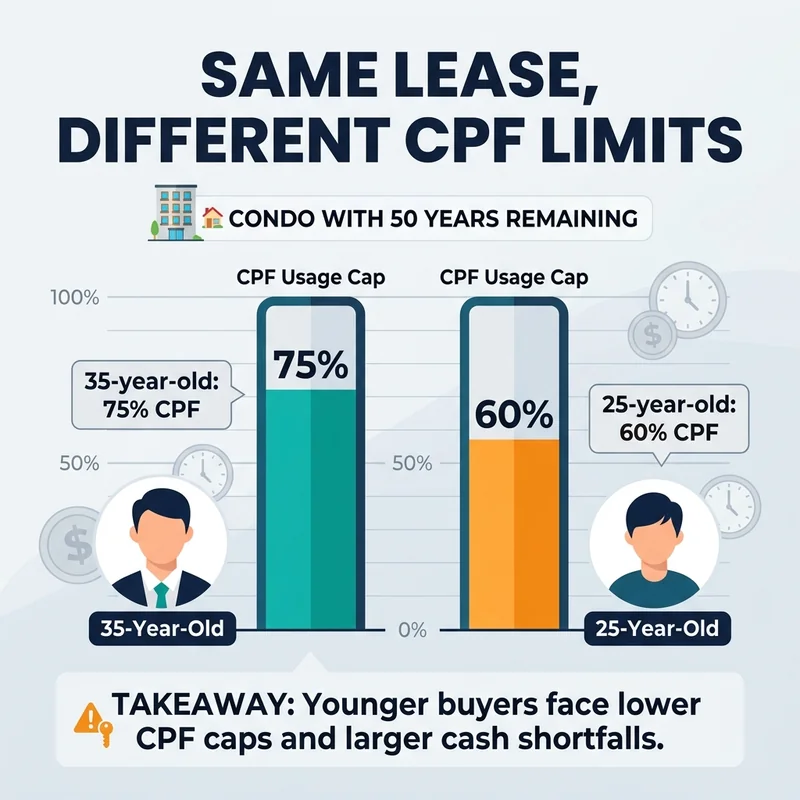
- The percentage depends on two things: the youngest owner’s age and the remaining lease. A 35 year old buying a unit with 50 years left gets 75 percent. A 25 year old buying the same unit gets 60 percent.
- Where the lease does cover the youngest owner to 95, and the property is bought with a bank loan on or after 1 September 2002, the ceiling is 100 percent of the lower of price or valuation, or 120 percent if the buyer can set aside the Basic Retirement Sum. The extra 20 percent goes towards the housing loan.
What the age 95 rule decides
The rule turns on one comparison. Does the property’s remaining lease last until the youngest owner using CPF turns 95? If yes, CPF usage runs to the lower of the purchase price or the valuation at the time of purchase, with no reduction. If no, usage is pro-rated to a percentage of that lower figure, provided the lease still has more than 20 years to run. At 20 years or less, CPF usage is not reduced. It is removed entirely. For purchases from 10 May 2019, that cutoff applies to private residential property, not only HDB flats. (Source: CPF Board T&C for use of CPF under the CPF Housing Scheme, Part B, accessed 19 October 2026.)
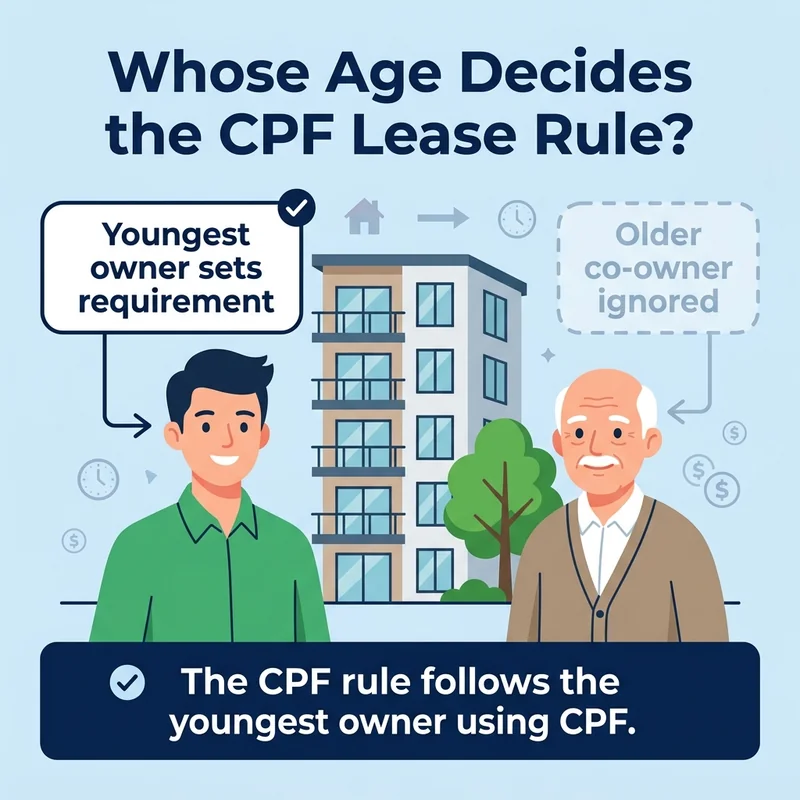
The age used is not an average, and it is not the oldest owner’s. It is the youngest owner who is using CPF. That detail trips up intergenerational purchases. Pair a 28 year old with a 60 year old parent on a condo with 45 years left, and the test is run against the 28 year old, because that owner needs the longest runway to reach 95. The parent’s age does nothing to soften the calculation. Adding a young co-owner is what makes the lease requirement harder, not adding an older one.
How pro-ration becomes a cash number
CPF publishes a table, Table 1 under Part B paragraph 3(d), that crosses the youngest owner’s age against the remaining lease. It is a rough guide, and the CPF housing usage calculator is the authoritative figure for an actual purchase. The percentages read like this:
| Youngest owner’s age | 70+ years remaining | 60 years remaining | 50 years remaining | 40 years remaining |
|---|---|---|---|---|
| 25 | 100% | 80% | 60% | 40% |
| 35 | 100% | 100% | 75% | 50% |
| 45 | 100% | 100% | 100% | 67% |
| 55 | 100% | 100% | 100% | 100% |
(Source: CPF Board T&C for use of CPF under the CPF Housing Scheme, Table 1 under Part B paragraph 3(d), accessed 19 October 2026.)
The table only covers the combinations printed in it. It gives no formula for working out the space between rows and columns. A 30 year old, or a lease of 55 years, falls outside the printed figures. Use the calculator, not interpolation.
The comparison in the table shows how much the age of the youngest owner matters. On a unit with 50 years remaining, a 35 year old can use CPF up to 75 percent of the lower of price or valuation. A 25 year old on the same unit is capped at 60 percent. Same property, same price, same lease. On a S$1.5 million unit, that 15 percentage point gap is S$225,000 more to find in cash or loan, purely because of who is youngest on the title.
None of this can be worked out without the real remaining lease. That number is rarely printed on a listing, and it is not a single stated figure on the title deed either. It comes from the lease commencement date and the original lease term. A 99 year leasehold block that commenced in 1998 is not in the same position as one that commenced in 1992, even when both are marketed as “99 year leasehold, older development”. Ask the agent or the conveyancing lawyer for the commencement date and the term, and work from those.
The 120 percent rule, and where it stops
Some buyers can use more than the lower of price or valuation. That is the 120 percent allowance, and it is narrower than it sounds.
For a private residential property bought with a bank loan on or after 1 September 2002, and where the lease covers the youngest owner using CPF to 95, the standard limit is the lower of purchase price or valuation. That applies to buyers who cannot set aside the Basic Retirement Sum. Buyers who can set aside the BRS may use an additional 20 percent of that lower figure, taking total usage to 120 percent. The extra 20 percent is applied to the housing loan, not to the purchase price. (Source: CPF Board T&C for use of CPF under the CPF Housing Scheme, Part B, accessed 19 October 2026.)
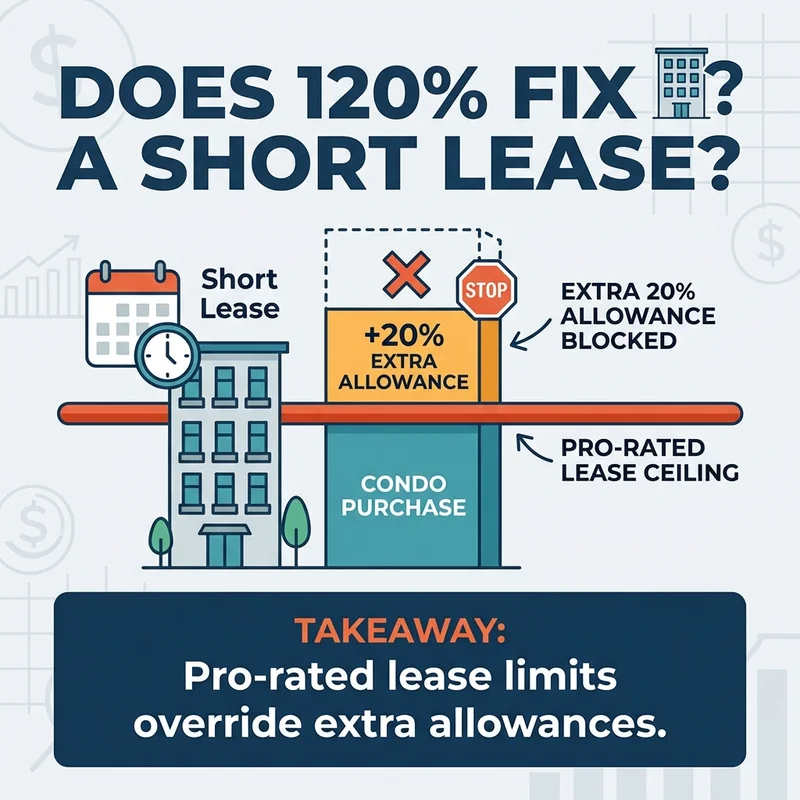
The allowance does not sit on top of a pro-rated lease. If the remaining lease falls short of age 95, the pro-rated percentage is the ceiling for the property, and the additional 20 percent is not available above it. This is where a lot of self-directed research goes wrong. A buyer reads “120 percent”, assumes it can lift a 60 percent pro-ration to 80 percent, and builds a cash plan on a number CPF will not release.
Second properties and retirement sums
A second or subsequent property adds a set-aside requirement on top of the lease rules. For a purchase from 10 May 2019, a buyer must set aside the latest Basic Retirement Sum before using further CPF if they already own at least one property bought with CPF, or if the property being bought covers them to age 95. A buyer with no property that covers them to 95 must set aside the latest Full Retirement Sum instead. Where the existing property is being sold, a 6 month grace period applies. (Source: CPF Board T&C for use of CPF under the CPF Housing Scheme, Part C, accessed 19 October 2026.)
The two mechanisms stack. A second property with a short lease faces the Table 1 reduction on that purchase, and separately, the requirement to lock away the BRS or FRS before any CPF can be used at all. Buyers running an upgrade, a decoupling exercise or a parallel purchase should map both layers before assuming a number is available. Our guide to property decoupling in Singapore covers the restructuring side.
Bank lending is a separate gate
CPF rules and bank lending rules are not the same test, and passing one does not mean passing the other. Banks set their own internal credit policies on remaining lease. A lender may shorten the tenure it will offer, or reduce the loan quantum, on a unit with a short lease. That is commercial practice at each bank, not a Monetary Authority of Singapore directive, and it differs between lenders. Check the CPF calculator result and the specific bank’s stance on that property, because the two constraints can compound. For how the borrowing limits themselves are calculated, see our guide on TDSR vs MSR.
What to check before you commit
The cash risk with an older condo is real, but it is predictable if you do the work in the right order.
- Get the lease commencement date and the original lease term from the title, not from the brochure.
- Confirm the age of the youngest owner using CPF at completion, not today.
- Run the CPF housing usage calculator with those exact figures.
- Treat the shortfall as its own line in the budget, separate from the down payment and stamp duty.
- Check whether the purchase counts as a second property, because the BRS or FRS set-aside can reduce what is available before the lease rules even apply.
For HDB upgraders there is an extra wrinkle. The plan usually leans on the CPF refund from the flat sale to fund the next purchase. If the condo’s lease triggers pro-ration, that refund covers less of the price than expected, and the gap lands in cash at the point when the flat has already been sold.
Frequently asked questions
Can I use CPF if a condo has 20 years or less remaining lease?
No. No CPF savings may be used where the remaining lease of a private residential property is 20 years or less at the time of purchase, regardless of the youngest owner’s age. Source: CPF Board T&C for use of CPF under the CPF Housing Scheme, Part B, accessed 19 October 2026.
How do I work out the remaining lease?
Subtract the years elapsed since the lease commencement date from the original lease term on the title. Do not rely on the listing or the marketing name of the development. Ask the agent or the conveyancing lawyer for both figures.
Does buying with an elderly co-owner restrict my CPF usage?
No, it works the other way. Pro-ration follows the youngest owner using CPF. An older co-owner does not relax the rule. A younger co-owner is what lengthens the lease requirement and lowers the percentage.
What is the difference between the BRS and the FRS for a second property?
For a second or subsequent property bought from 10 May 2019, a buyer sets aside the latest Basic Retirement Sum if they already own at least one property bought with CPF, or if the property being bought covers them to age 95. A buyer with no property covering them to 95 sets aside the higher Full Retirement Sum. A 6 month grace period applies where the existing property is being sold. Source: CPF Board T&C for use of CPF under the CPF Housing Scheme, Part C.
Get the numbers run before you commit
Older condos bring CPF pro-ration, bank lending policy and sometimes a retirement sum set-aside into the same decision. If you want the figures run against a specific unit, message us on WhatsApp and we will work through what applies to your age, your lease and your timeline.
Data sources: CPF Board, Terms and Conditions for use of CPF under the CPF Housing Scheme, Parts B and C, accessed 19 October 2026.
This article is for general reference only and does not constitute financial, legal, or investment advice. Verify all details with relevant authorities before making decisions.
Agent: Joe Chow | CEA Reg No.: R072635C
Agency: SRI Pte Ltd | Licence: L3010738A