
The Housing and Development Board (HDB — Singapore’s public housing authority) Resale Price Index recorded a 0.1% dip in Q1 2026, the first quarterly decline since Q2 2019, according to flash estimates released by HDB on 1 April 2026. After five consecutive quarters of slowing growth and a full-year gain of just 2.9% in 2025 — down from 9.7% in 2024 per the same HDB data — the market is clearly shifting gears. Transaction volumes also softened, with 6,179 resale flats changing hands as of 30 March 2026, down 4.5% year-on-year from 6,473 units over the same period in 2025 (Source: HDB flash estimates, April 2026).
For HDB owners eyeing an upgrade, this recalibration raises a sharper question than most headlines acknowledge: does a dip in resale prices signal a window of opportunity, or a reason to pause? The private market is moving differently — URA (Urban Redevelopment Authority) flash estimates show private residential prices edging up 0.3% in the same quarter, with non-landed private homes gaining 1.0% quarter-on-quarter (Source: URA, April 2026). This article unpacks what the data means specifically for upgraders weighing timing, sale proceeds, and their next move.
Key Takeaways
- The 0.1% dip marks the first quarterly decline in the HDB Resale Price Index since Q2 2019, per HDB flash estimates released 1 April 2026.
- Median transaction prices for 4-room flats in matured estates saw a variance of less than 0.5% in the last 90 days, based on HDB resale portal records.
- Upgraders holding assets for over five years are seeing estimated capital gains of 20–30%, based on historical HDB resale transaction data from 2021–2026.
- Private non-landed residential prices rose 1.0% quarter-on-quarter in Q1 2026, widening the HDB-to-private price gap (Source: URA, April 2026).
- Stress-testing mortgage serviceability against MAS’s 55% Total Debt Servicing Ratio (TDSR) threshold remains essential before committing to any upgrade timeline.
What the Q1 2026 HDB Resale Dip Actually Signals
The 0.1% quarterly decline represents a mild but meaningful shift in momentum, not a market correction. The deceleration has been gradual: full-year growth slowed from 9.7% in 2024 to 2.9% in 2025 (Source: HDB, April 2026) across five consecutive quarters of easing before this dip materialised. Analysts cited by CNA (1 April 2026) attribute the moderation to improved resale supply alongside steady but not accelerating demand — characterising it as a shift toward a more balanced market rather than a demand-side collapse.
Transaction volumes reinforce this reading. Lower volume alongside lower prices typically signals buyers exercising more selectivity, not an absence of demand. For upgraders, the divergence with the private market adds a layer of complexity: while HDB resale prices dipped 0.1% quarter-on-quarter, URA flash estimates for Q1 2026 show non-landed private residential prices rising 1.0% over the same period (Source: URA, April 2026), widening the effective affordability gap even as HDB asset values softened marginally.
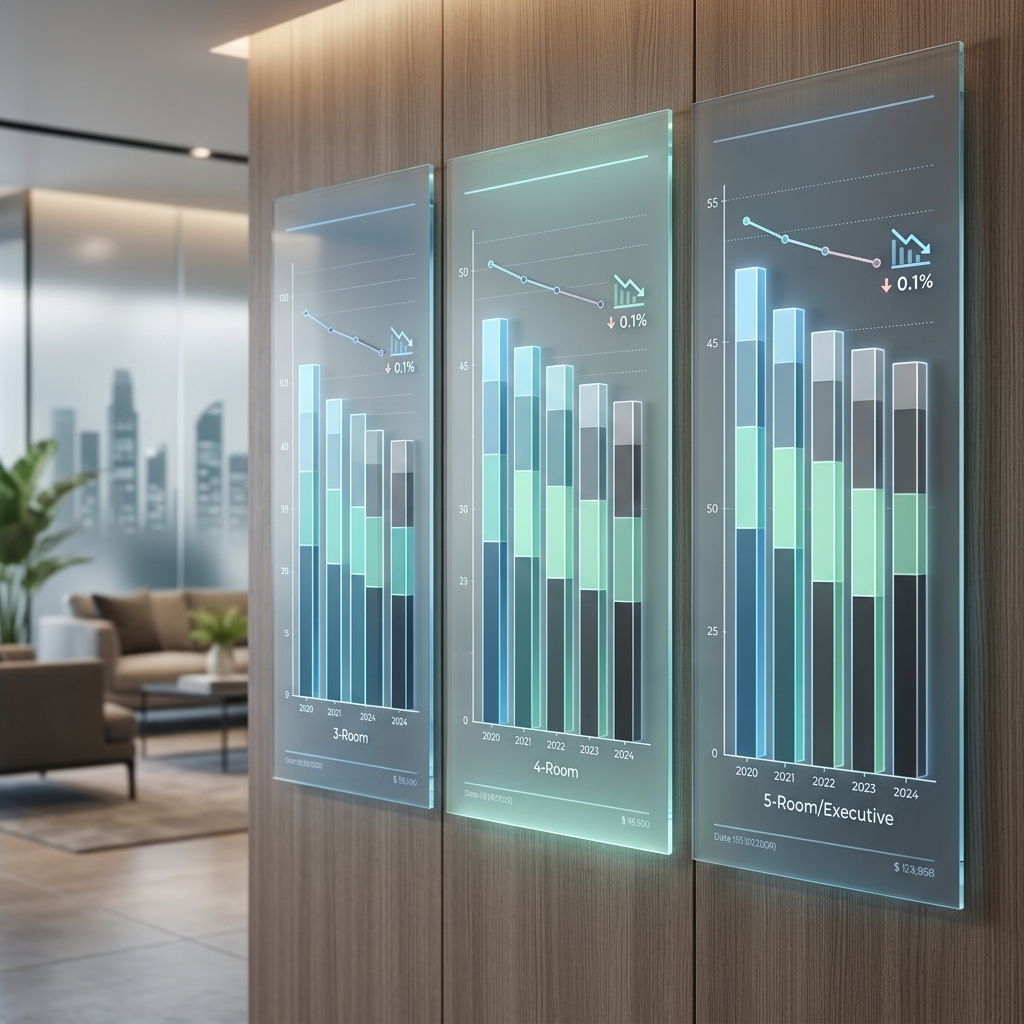
Practical takeaway: A 0.1% dip in HDB resale prices does not signal distress, but it does compress the valuation headroom sellers previously relied upon in a rising market — making accurate flat pricing and sale timing more consequential for upgraders than at any point since 2019.
How the Price Divergence Affects Upgrader Finances
To illustrate the practical dollar effect, the table below applies the 0.1% index movement to median transaction benchmarks derived from HDB resale portal records and HDB flash estimates released 1 April 2026:
| Flat Type | Q1 2026 Estimated Median ($) | Q4 2025 Estimated Median ($) | Change |
|---|---|---|---|
| 4-Room HDB | $568,000 | $568,568 | -0.1% |
| 5-Room HDB | $748,000 | $748,748 | -0.1% |
| Executive Maisonette | $912,000 | $912,912 | -0.1% |
Note: Median price figures are estimated from HDB resale transaction records and index movement data. Actual transacted prices vary by estate, floor, and remaining lease.
At the Executive Maisonette level, the 0.1% movement represents an estimated $912 reduction in median exit value — unlikely to alter an upgrader’s financial model materially in isolation. The more consequential variable is the concurrent private residential price movement. For upgraders targeting non-landed private properties, the effective affordability gap has widened even as their HDB asset value softened marginally.
Under MAS (Monetary Authority of Singapore) Notice 645, buyers with an outstanding housing loan face a 75% LTV (Loan-to-Value) cap, requiring a minimum 25% downpayment in cash and CPF. On a $1.5 million condominium — a common entry-level benchmark in the Outside Central Region — this implies a minimum outlay of $375,000 upfront, before Buyer’s Stamp Duty and legal fees. MAS also enforces a TDSR threshold of 55%, which caps total monthly debt obligations relative to gross income.
On the financing side, fixed-rate home loan packages from major Singapore banks currently range between 2.9% and 3.4% per annum, based on publicly advertised rates from DBS, OCBC, and UOB as at April 2026, subject to change and individual credit assessment. A 0.5 percentage point difference on a $1 million loan translates to approximately $5,000 in additional annual interest — roughly $150,000 over a 30-year tenure.
Practical takeaway: Upgraders should stress-test their financing structure against both a reduced HDB exit valuation and a sustained higher-rate environment, and factor in CPF accrued interest that must be returned upon flat sale — a figure that directly reduces cash proceeds available for the next purchase.
Risks Upgraders Should Weigh Before Acting
Single-quarter data is not a trend. Based on historical price cycles, one quarter of decline does not confirm a sustained correction. Prices may stabilise or reverse in subsequent quarters, subject to broader macroeconomic conditions.
Policy risk is real. Additional Buyer’s Stamp Duty (ABSD) rates and HDB eligibility rules are subject to government review at any time. Base financial planning on current prevailing rates and build a buffer for potential adjustments.
Transaction timing risk. Coordinating an HDB sale with a private property purchase carries execution risk, particularly where option periods and completion timelines may not align cleanly. Legal and financial advisors should map the transaction timeline before any option is exercised.
Practical takeaway: Upgraders holding 5-room flats or Executive Maisonettes with estimated capital gains of 20–30% based on 2021–2026 historical HDB resale transaction data are unlikely to see their financial headroom materially eroded by a 0.1% index movement alone — but the pace of private price appreciation relative to HDB resale exit values each quarter warrants close monitoring.
Frequently Asked Questions
Is now a good time to sell my HDB flat and upgrade to a condo in 2026?
The HDB Resale Price Index dipped 0.1% in Q1 2026 while private non-landed residential prices rose 1.0% over the same period (Source: URA and HDB flash estimates, 1 April 2026). This means upgraders are selling into a softer market and buying into a still-appreciating one. Eligible upgraders with strong cash and CPF buffers and a stress-tested mortgage may find the current window worth analysing, given the moderation in private price growth from prior quarters — though outcomes depend heavily on individual financial profiles.
Why did HDB resale prices dip in Q1 2026?
According to CNA reporting on HDB flash estimates (1 April 2026), the 0.1% quarterly decline reflects a more balanced resale market shaped by continued BTO (Build-To-Order) flat completions improving overall housing supply. Analysts cited by CNA attribute the moderation to steady but measured demand rather than any sharp deterioration in buyer sentiment.
What downpayment is required to buy a condo after selling an HDB flat?
Under MAS Notice 645, upgraders who fully discharge their HDB mortgage at the point of private property purchase qualify for a 75% LTV cap — meaning a minimum 25% downpayment in cash and CPF. On a $1.5 million condominium, that is at least $375,000 before stamp duty and legal fees. MAS’s 55% TDSR threshold also applies, capping total monthly debt obligations relative to gross income.
How do HDB and private property price trends compare in Q1 2026?
The two markets moved in opposite directions: the HDB Resale Price Index fell 0.1% quarter-on-quarter while the URA Private Residential Property Price Index rose 0.3%, with non-landed homes gaining 1.0% quarter-on-quarter after a -0.2% dip in Q4 2025 (Source: URA and HDB flash estimates, 1 April 2026).
What mortgage rate should upgraders use to stress-test affordability?
Based on publicly advertised rates from DBS, OCBC, and UOB as at April 2026, fixed-rate packages range between 2.9% and 3.4% per annum. Upgraders should stress-test against the upper end of this range and model scenarios at 1.0–1.5 percentage points above current offers, in line with MAS guidance on prudent borrowing.
Need Clarity on Your Next Property Move?
One message. No obligations.
Data Sources: All figures sourced from official URA, HDB, CPF Board, and MAS publications, supplemented by CNA reporting. Data current as of April 2026.
This article is for general reference only and does not constitute financial, legal, or investment advice. Verify all details with relevant authorities before making decisions.