
Picture this: you and your spouse are reviewing CPF statements, trying to figure out whether you qualify for the Enhanced CPF Housing Grant. Then it hits you: your combined income sits right at the $150,000 mark, the threshold that separates HDB grant eligibility from going in without any subsidy support. That single number changes everything, from whether a BTO flat is even on the table to whether you should be comparing resale HDB against a private condo instead. This is the exact decision point many households across Singapore face, especially with HDB resale prices easing slightly (flash estimate of 202.8 for Q2 2026, down 0.3 percent quarter-on-quarter, based on HDB data) and cooling measures reshaping affordability calculations. This piece walks through how the $150,000 threshold affects your options, what BTO, condo, and resale each demand financially, and how to build a decision framework around your household’s numbers rather than someone else’s.
Key Takeaways
- BTO units remain the most restricted category, with a 5-year Minimum Occupation Period that must be factored into any 10-year financial plan.
- Private residential properties purchased after 4 July 2025 are subject to a 16% SSD if sold within the first year, affecting short-term exit strategies.
- HDB resale transactions in Q2 2026 showed a variance in price trends across mature and non-mature estates, requiring buyers to verify data via URA Realis.
Navigating the BTO vs Resale vs Private Condo Landscape
The right choice among BTO, resale HDB, and private condo depends primarily on your timeline, grant eligibility, and whether you can absorb a longer wait for a subsidised flat. BTO (Build-To-Order) flats are new HDB units sold directly by the Housing & Development Board at subsidised prices, but they typically require a wait of 3 to 5 years from application to key collection. For households with a combined income at or below $14,000 monthly, BTO remains the most heavily subsidised route, with grants such as the Enhanced CPF Housing Grant (up to $120,000 for eligible first-timer families) built into the price. Once combined income crosses $150,000, buyers lose eligibility for most HDB housing grants entirely, which materially changes the cost-benefit calculation between staying in the HDB system and moving to private property.
Resale HDB flats offer immediate occupation and are transacted on the open market, with the HDB Resale Price Index (RPI) at 202.8 in Q2 2026, a flash estimate reflecting a 0.3 percent quarter-on-quarter decline, according to HDB data published 1 Jul 2026. This follows a 0.1 percent dip in Q1 2026 (RPI 203.4), based on HDB’s flash estimate series, suggesting a mild softening after several quarters of relative stability. For households needing a home within 12 months, and who still qualify for grants, resale can bridge the gap that a 3 to 5 year BTO wait cannot.
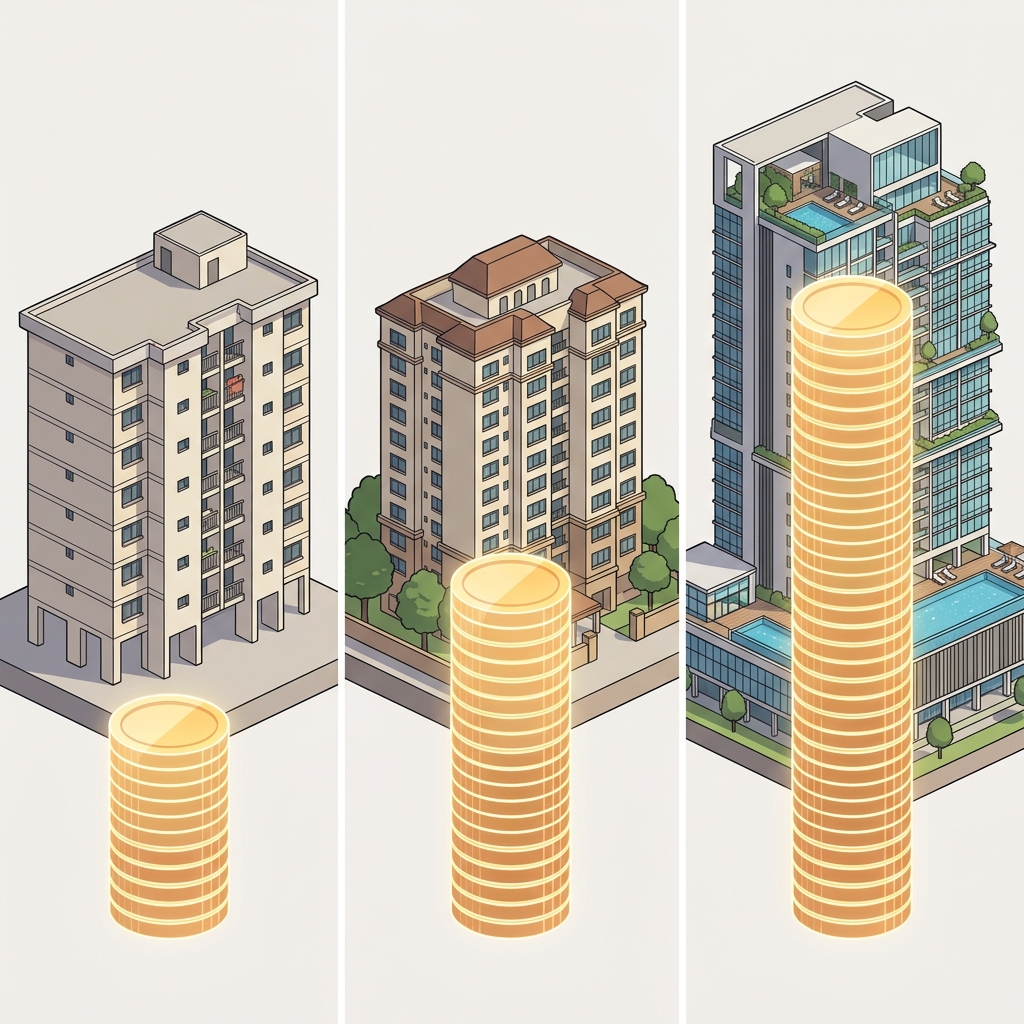
Private condominiums involve no income ceiling and no grant dependency, but require a minimum 25 percent cash or CPF downpayment (5 percent cash) and are subject to Additional Buyer’s Stamp Duty (ABSD) rates depending on citizenship and property count. This route may be suitable for profiles such as households above the $150,000 threshold who have already exhausted HDB grant options and prioritise immediate move-in over subsidy access.
Practical takeaway: Households below $150,000 combined income should compare BTO’s multi-year wait against resale’s immediate availability before ruling out HDB entirely; those above the threshold should treat private condos and resale HDB as the realistic shortlist.
Comparing Financial Entry Barriers: Stamp Duties and CPF Usage
The largest gap between BTO, resale, and private condo purchases lies in upfront cash requirements and stamp duty exposure, with private property carrying substantially higher entry costs and shorter-term exit penalties. Buyer’s Stamp Duty (BSD) applies to all three categories on a progressive scale up to 6% for the portion above $1.5 million, but the total quantum scales directly with purchase price, meaning a $1.2 million condo attracts significantly more BSD than a $500,000 resale flat. Additional Buyer’s Stamp Duty (ABSD) does not apply to HDB flats bought by Singapore Citizens but can add 20% for a second private residential purchase by a citizen, or 60% for foreigners, according to IRAS guidelines current as of 2025. Seller’s Stamp Duty (SSD) is another divergence point: HDB resale flats are not subject to SSD, while private condos purchased on or after 4 July 2025 face a 16% SSD if sold within the first year, tapering to 4% by the fourth year, per IRAS regulations.
CPF usage also differs by property type. BTO and resale flats allow broader use of CPF Ordinary Account savings under the Public Housing Scheme, subject to the Valuation Limit and Withdrawal Limit rules set by CPF Board. Private condo purchases follow the Residential Properties Scheme, with similar CPF withdrawal caps but no housing grants.

| Property Type | Typical Cash Outlay | Stamp Duty Impact | Eligibility/Restriction | Potential Liquidity |
|---|---|---|---|---|
| BTO | Low (5% option fee, grants may offset) | No SSD; BSD applies on lower base price | 5-year MOP; income ceiling $14,000 | Locked until MOP fulfilled |
| HDB Resale | Moderate (COV plus standard down payment) | No SSD; BSD on transacted price | MOP if applicable; ethnic quota (EIP) | Locked until MOP fulfilled |
| Private Condo | High (25% minimum cash/CPF down payment) | SSD up to 16% within 1 year; ABSD may apply | No MOP; financing-dependent | Sellable anytime, subject to SSD cost |
Practical takeaway: Buyers prioritising capital preservation and lower entry barriers may find BTO or resale flats align better with CPF usage rules, while those needing exit flexibility should budget for SSD exposure on private condos within the first four years of ownership.
Historical Capital Appreciation Trends: HDB vs Private Condominium
HDB resale flats and private condominiums have shown diverging price trajectories over the past decade, with HDB resale prices posting steadier but more moderate gains while private property has historically shown larger cyclical swings in both directions. According to HDB’s Resale Price Index, the index climbed from a base of 100 in Q1 2009 to 202.8 in Q2 2026 (flash estimate), meaning resale flat prices have roughly doubled over that period, though the trend has flattened recently with the RPI recording 203.7 in Q3 2025, 203.6 in Q4 2025, 203.4 in Q1 2026, and 202.8 in Q2 2026, three consecutive quarters of decline (Source: HDB, “2nd Quarter 2026 Public Housing Data and Upcoming Flat Supply,” Annex A, flash estimate for Q2 2026).
Private condominium price movements have historically been more volatile, with sharper run-ups during low interest rate periods and steeper corrections following cooling measures such as ABSD revisions. Based on URA Realis data tracked across multiple market cycles, private non-landed residential prices have tended to outperform HDB resale during upswings but also retrace more significantly when cooling measures or rate hikes take hold, a pattern consistent with private property’s higher price quantum and greater exposure to investor and foreign buyer demand.
For households comparing the two segments over a 5 to 10 year horizon, the practical distinction is not which asset class delivers higher appreciation, but which volatility profile matches the buyer’s holding period and financial buffer. Those planning to hold for under 5 years face SSD exposure of up to 16% within the first year under the framework effective 4 July 2025, which materially affects net returns from either asset class if sold early.

Practical takeaway: Buyers prioritising price stability have historically found HDB resale flats align better with shorter holding horizons, while those with longer timelines and higher risk tolerance may weigh private condominiums differently, subject to prevailing market conditions.
Impact of the 2025 SSD Policy on Holding Periods
The 2025 SSD policy extends the effective holding period for private condo buyers from three years to four years, directly reshaping the financial calculus for those weighing exit flexibility against private property upside. Under the revised schedule, effective for private residential properties purchased on or after 4 July 2025, sellers face 16% SSD within the first year, 12% within the second year, 8% within the third year, and 4% within the fourth year, calculated on the higher of the selling price or market value, according to IRAS and MAS guidelines. This is a meaningful shift from the prior three-year schedule, which capped exposure at the third year with no fourth-year penalty. For a $1.2 million condo sold within year one, this translates to a potential SSD liability of $192,000, a figure that would not have existed under the pre-4 July 2025 regime beyond year three.
Properties purchased before that date remain grandfathered under the old three-year, 12-8-4% structure, so buyers evaluating resale versus condo purchases need to confirm which schedule applies based on the transaction date, not the current date. This distinction matters most for buyers who anticipate upgrading, relocating for work, or responding to family changes within a four-year window, since HDB resale flats carry no SSD exposure at all, giving public housing a structural liquidity advantage over private condos purchased after the policy change.
Practical takeaway: Buyers targeting a condo purchase after 4 July 2025 should plan for a minimum four-year hold to avoid SSD, and factor a potential 16% cost into any exit scenario within the first year before comparing net returns against a resale flat’s SSD-free exit.

Which Property Type Aligns With Your Long-Term Financial Goals?
The property type that aligns with your long-term financial goals depends primarily on your holding horizon, liquidity needs, and whether you prioritise capital preservation or growth potential. Buyers targeting a 10 to 15 year horizon with lower volatility tolerance have historically gravitated toward HDB resale flats or BTO units. According to HDB’s Resale Price Index data through Q2 2026 (flash estimate), resale flats have delivered roughly 103 percent cumulative appreciation since Q1 2009, with the index recently plateauing between 202.8 and 203.7 over four consecutive quarters (Source: HDB, “2nd Quarter 2026 Public Housing Data and Upcoming Flat Supply,” Annex A). This suggests HDB may suit buyers prioritising predictable, moderate appreciation over aggressive capital gains.
Private condominium buyers, by contrast, are typically underwriting a different risk-return profile, one with historically larger price swings tied to interest rate cycles, foreign buyer sentiment, and ABSD adjustments. For this segment, exit timing matters considerably, particularly the 4-year SSD window on private properties purchased on or after 4 July 2025, since liquidity needs often shift faster than the minimum holding period dictates. A buyer who anticipates needing to sell within 3 years of purchase would still face an 8 percent SSD charge on the higher of selling price or market value, which can materially erode projected returns if not budgeted upfront.
Buyers weighing en bloc potential, rental yield, or eventual downsizing should map these regulatory holding periods against their own life-stage timeline rather than relying solely on historical index performance.
Practical takeaway: Match your property type to your realistic holding period first, then evaluate price trends, since a strong historical appreciation trend offers limited benefit if SSD or MOP restrictions force an unfavourable exit timeline.
Frequently Asked Questions
Is now a good time to buy a resale flat or should I wait for BTO?
It depends on urgency and budget: BTO offers lower entry prices but requires waiting through construction (typically 3-4 years) plus a 5-year Minimum Occupation Period before resale, while resale flats offer immediate occupation at current market rates. According to HDB’s Resale Price Index, resale prices have declined for three consecutive quarters (203.7 in Q3 2025 to 202.8 in Q2 2026 flash estimate), suggesting softer near-term price pressure that may favor patient resale buyers.
What is the SSD for condos bought after July 2025?
Under the revised schedule effective 4 July 2025, sellers face Seller’s Stamp Duty of 16% in year one, 12% in year two, 8% in year three, and 4% in year four, calculated on the higher of selling price or market value, according to IRAS and MAS guidelines. This is a one-year extension from the previous three-year, 12-8-4% framework, so a $1.2 million condo sold within the first year could incur $192,000 in SSD.
Does HDB resale have any Seller’s Stamp Duty?
No, HDB resale flats carry no SSD exposure at all, giving public housing a structural liquidity advantage over private condominiums purchased after 4 July 2025. This makes resale flats more suitable for buyers who anticipate needing to sell within a shorter timeframe without incurring exit penalties.
Are HDB resale prices falling in 2026?
Yes, according to HDB’s Q2 2026 flash estimate, the Resale Price Index fell to 202.8, marking a third consecutive quarterly decline from 203.7 in Q3 2025. The q-o-q change of -0.3% in Q2 2026 follows a -0.1% dip in Q1 2026 and a flat 0.0% reading in Q4 2025, signaling a flattening trend after years of post-pandemic appreciation.
Should I buy a condo if I might sell within 4 years?
If you purchased on or after 4 July 2025, selling within four years triggers SSD ranging from 16% in year one down to 4% in year four, calculated on the higher of selling price or market value per IRAS and MAS guidelines. Buyers uncertain about their holding horizon should factor this cost into net return projections or consider HDB resale, which has no equivalent SSD restriction.
Risks and Considerations
Interest rate exposure. Mortgage rates remain subject to global monetary policy shifts. Based on historical trends, SORA-pegged loan packages have fluctuated significantly over the past decade, and buyers should stress-test affordability at rates 2-3 percentage points above current levels before committing to a purchase, whether BTO, condo, or resale.
Extended waiting periods for BTO. Non-mature estate BTO projects typically involve construction timelines of 3-4 years, based on HDB completion data for recent launches. Buyers with urgent housing needs may find this timeline unsuitable. Mitigation may include considering resale flats or balance flat exercises as interim options.
SSD holding period constraints. Private residential properties purchased on or after 4 Jul 2025 are subject to a 4-year Seller’s Stamp Duty holding period, with rates of 16%, 12%, 8%, and 4% for years one through four respectively (Source: IRAS, effective 4 Jul 2025). Buyers anticipating a need for liquidity within this window should factor in these costs when evaluating condo purchases.
Resale price volatility. Resale flat and condo prices are influenced by factors including cooling measures, supply pipeline, and broader economic conditions. Historical price movements do not guarantee future performance, and projected valuations should be treated as estimates subject to market conditions.
Eligibility and financing restrictions. BTO and resale HDB purchases involve income ceilings, MOP requirements, and CPF usage rules that may change. Buyers should verify current eligibility criteria with HDB directly, as policy adjustments may affect financing options between application and completion.
These profiles may be relevant for different buyer circumstances, but individual financial situations vary considerably.
Need Clarity on Your Next Property Move?
One message. No obligations.
Data Sources
All figures sourced from official URA, HDB, CPF Board, and MAS publications, supplemented by Straits Times, Business Times, and EdgeProp reporting. Data current as of August 2026.
This article is for general reference only and does not constitute financial, legal, or investment advice. Verify all details with relevant authorities before making decisions.