

Upcoming Analysis



Before You Read The Numbers
Dunearn House is not a project where buyers should only ask, “cheap or expensive?”
The better question is: does the first private launch at the Turf City gateway give you enough location, school-belt and transformation upside to accept a 99-year leasehold tenure in a Bukit Timah precinct where many buyers still compare against freehold stock?
That is the real trade-off here.
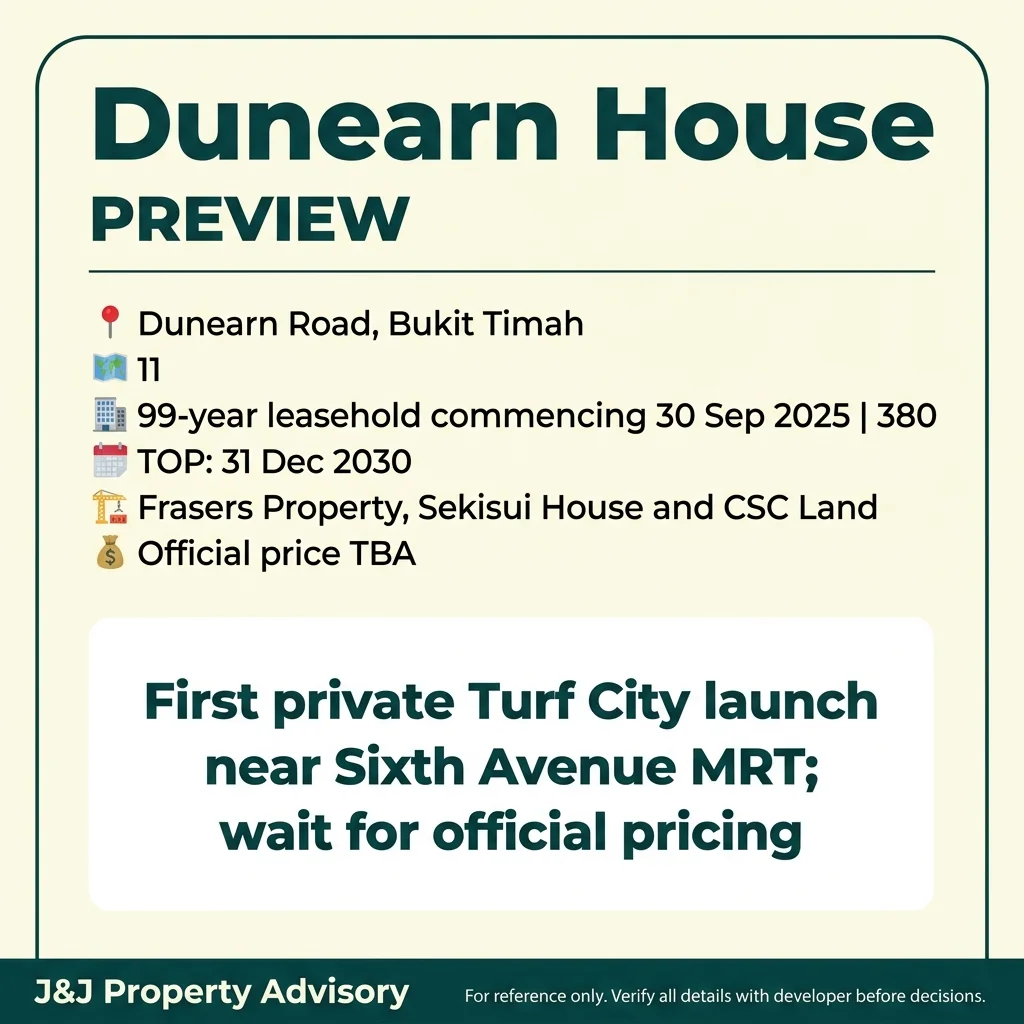
The land price is already known: S$1,410 PSF PPR. Analyst commentary points to a likely launch pricing region of around S$2,900–S$3,000 PSF, although the developer has not released the official price list. If the project does come out around that level, Dunearn House will not be a cheap mass-market new launch. But it may still create an opening for buyers who want a new District 11 address near Sixth Avenue MRT, without paying full freehold boutique pricing.
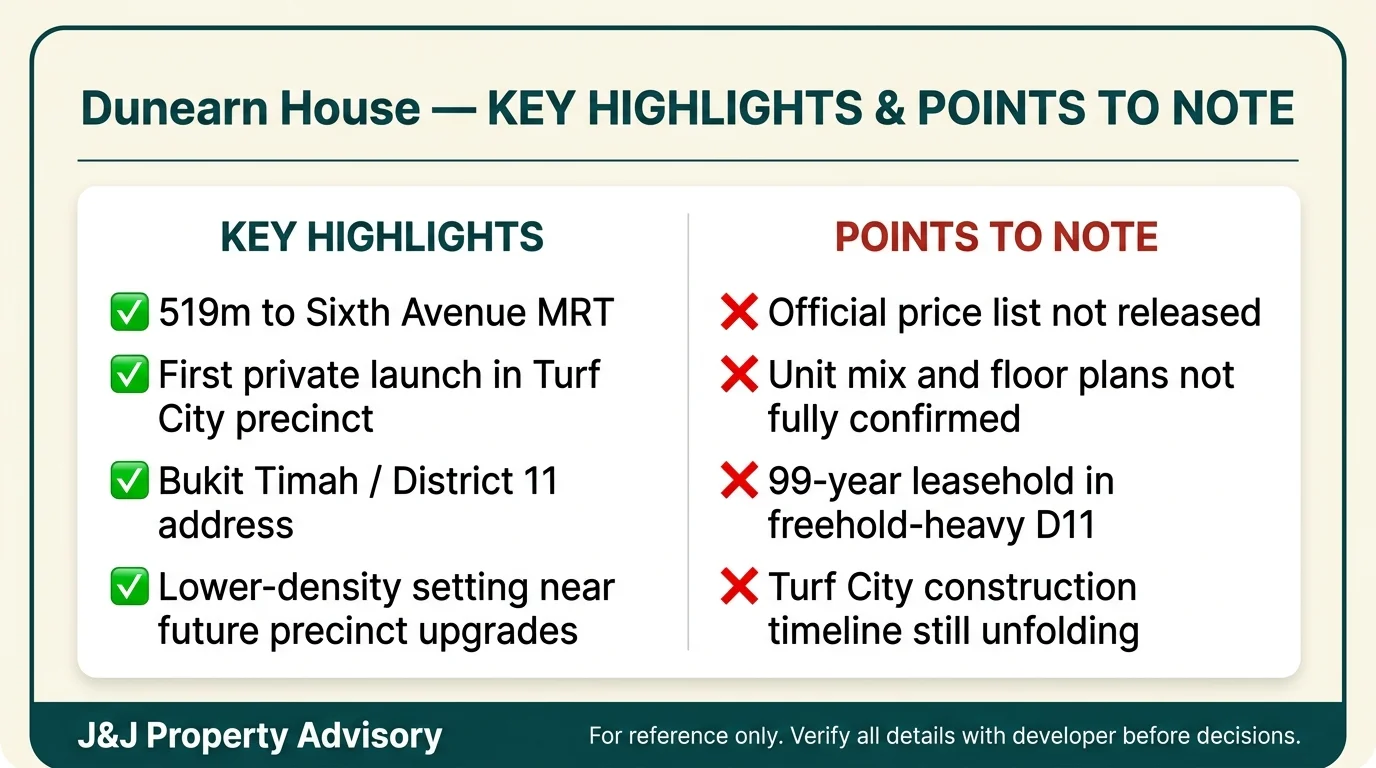
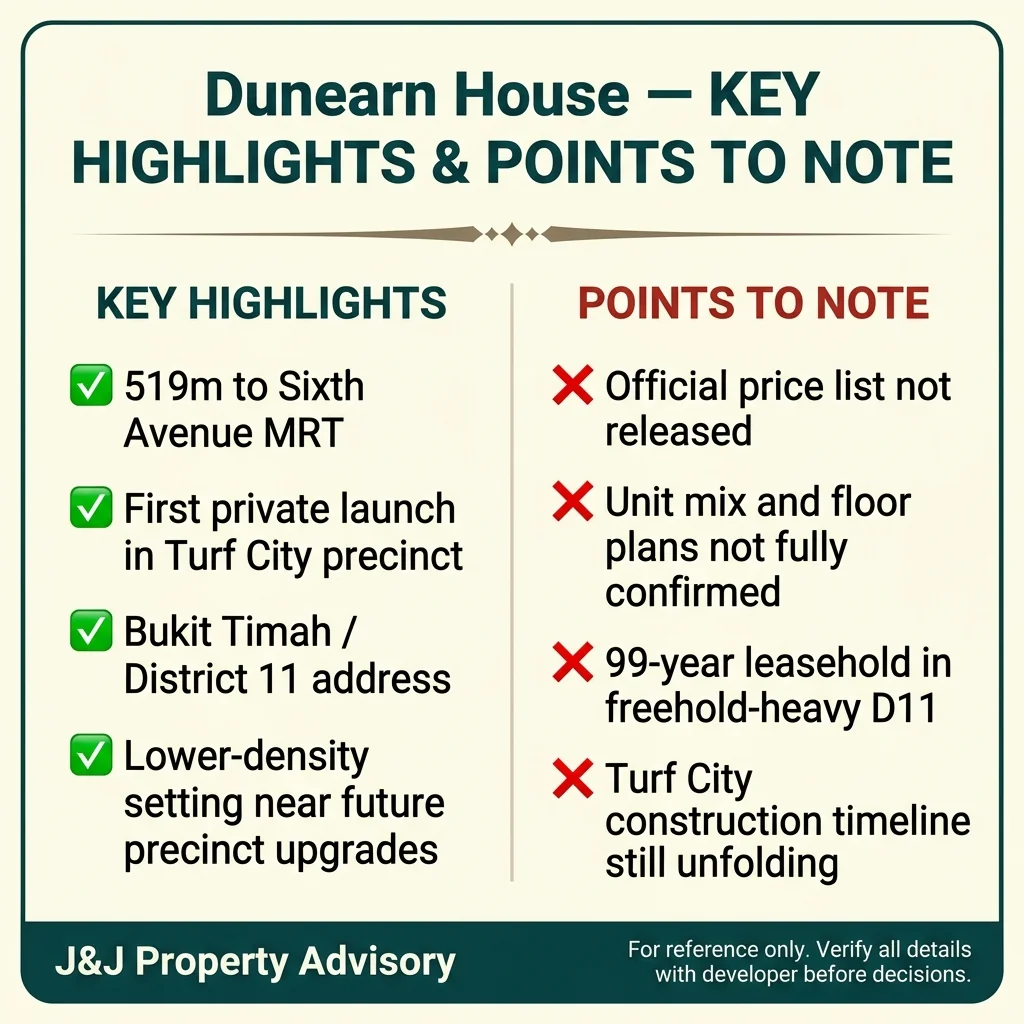
My view: this project can be interesting, but only if buyers are disciplined. The MRT access, Bukit Timah education belt, developer profile and Turf City first-mover angle are real positives. The risks are also real: 99-year leasehold tenure, unknown final unit mix, untested stack premiums, and a long wait to TOP in 2030.
Bottom Line
What works
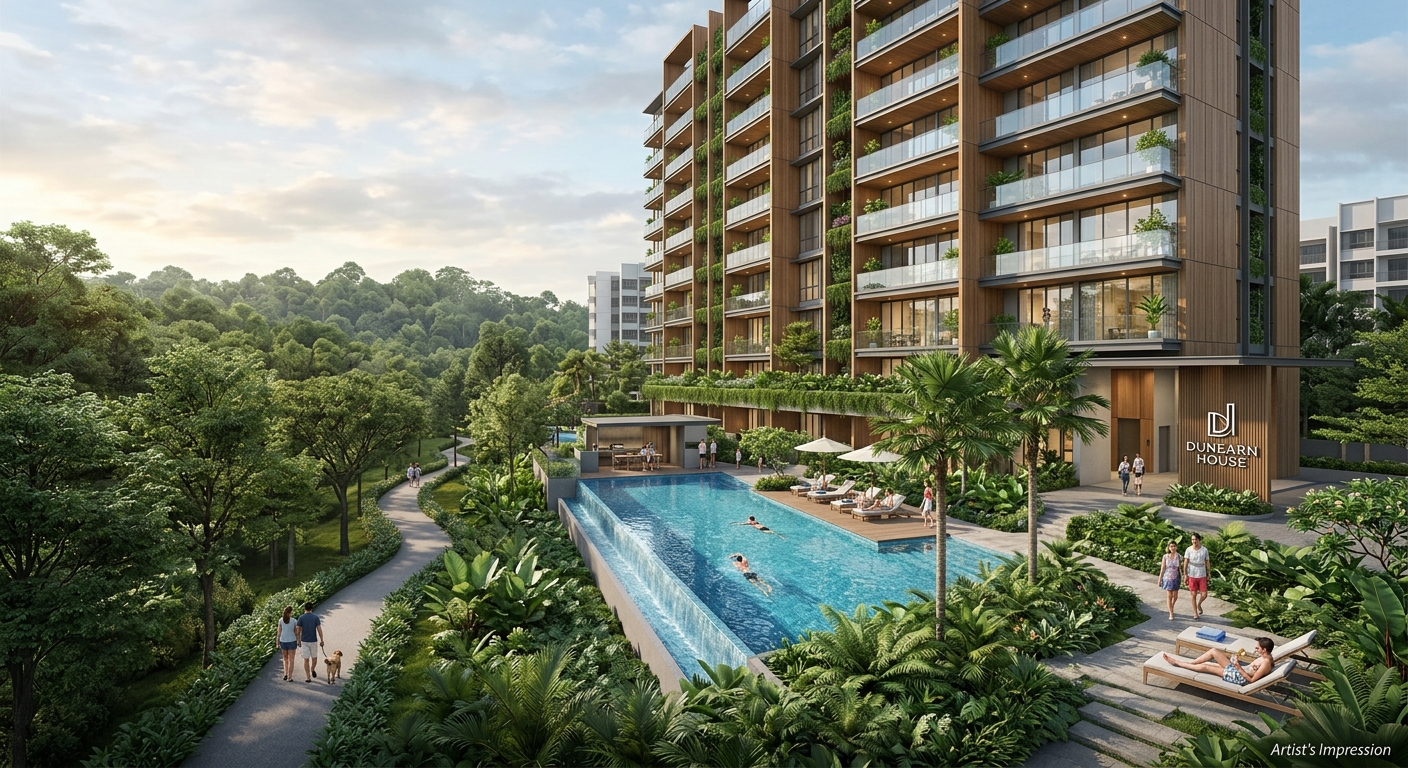
Dunearn House has a real location story: around 500m to Sixth Avenue MRT, a Bukit Timah school-belt address, credible developers, and first-mover positioning at the Turf City gateway. These are not empty marketing points. For own-stay buyers who want a new home in this part of Bukit Timah, the project deserves attention.
What holds me back
The 99-year leasehold tenure is the main trade-off, especially in a precinct where many buyers mentally compare against freehold options. The other issue is price. If pricing lands near S$2,900–S$3,000 PSF, the project must justify the premium through layout quality, stack selection, MRT convenience and a visible discount to the right freehold alternatives.
My current verdict
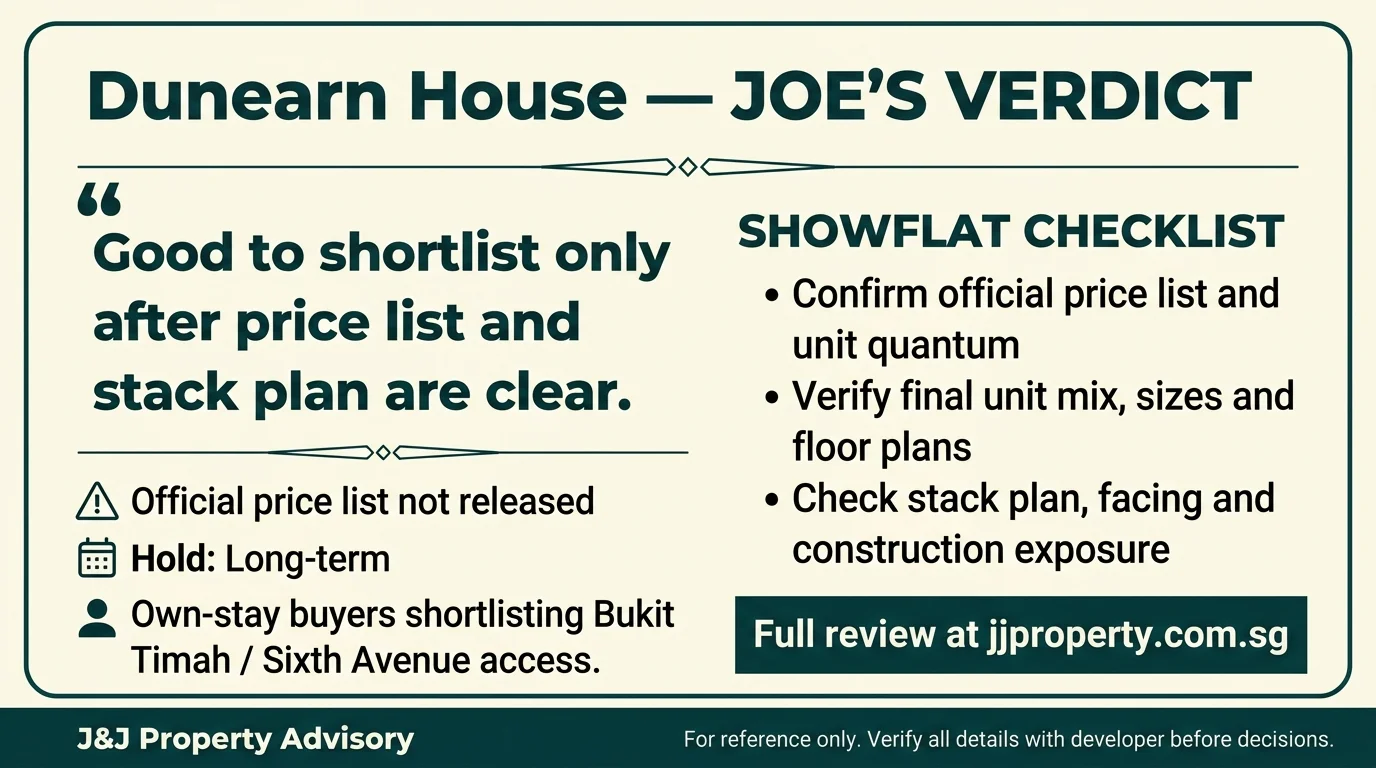
I would not dismiss Dunearn House just because it is leasehold. A well-priced 99-year project near Sixth Avenue MRT can still make sense, especially for buyers who value a new product, family-friendly location and future Turf City upside. But I also would not buy blindly for the transformation story. The final price list, unit sizes and stack premiums must make sense.
What to check before booking
Check the final unit mix, the smallest-unit sizes, the true entry quantum, school-distance eligibility, road-facing stacks, balcony efficiency, maintenance fees, and the price gap versus nearby resale and freehold options. If the discount is meaningful, Dunearn House can be a strong Bukit Timah consideration. If the developer prices it too aggressively, the leasehold trade-off becomes harder to accept.
Project Snapshot
| Attribute | Details |
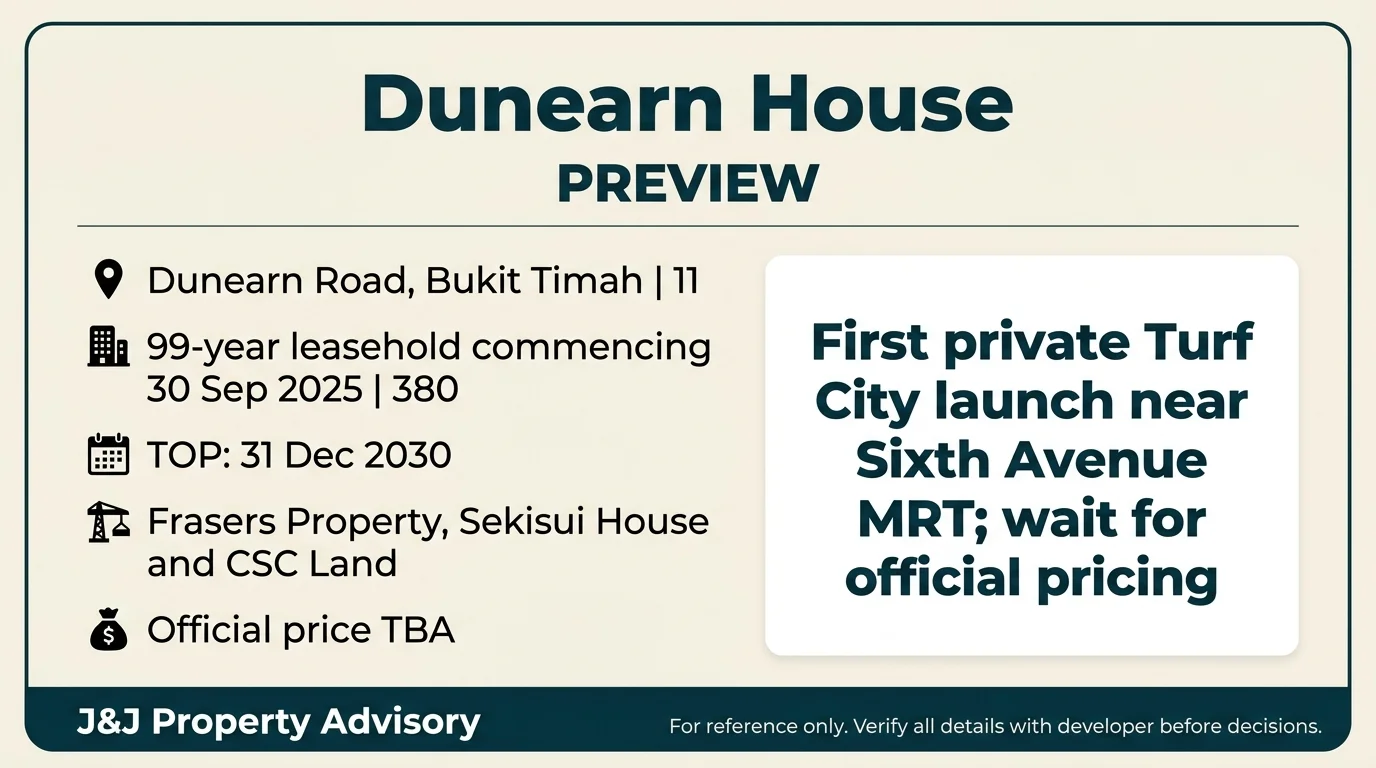
| Site Area | 13,491.9 sqm / approx. 145,225.5 sqft |
| Developer | Frasers Property, Sekisui House and CSC Land |
| Developer Entity | Phoenix Dunearn Pte Ltd |
| Tenure | 99-year leasehold from 30 Sep 2025 |
| Total Units | 380 |
| Blocks / Storeys | 5 blocks — two 19-storey blocks and three 10-storey blocks |
| Land Cost | S$491.45 million / S$1,410 PSF PPR |
| Plot Ratio | 2.4 |
| Architect | Ong & Ong |
| Expected TOP | 31 Dec 2030 |
| Expected CSC | 31 Dec 2033 |
| Car Park | 228 lots + 3 accessible lots indicated |
Dunearn House sits on a sizeable Dunearn Road GLS site, acquired by the Frasers Property, Sekisui House and CSC Land joint venture for S$491.45 million. At S$1,410 PSF PPR, this is not a low-cost land entry. The developer still needs to account for construction cost, financing cost, professional fees, marketing cost and margin.
That is why the analyst estimate of around S$2,900–S$3,000 PSF is believable as a market positioning guide. Buyers can use it as a working range to start assessing affordability while waiting for the official price list.
The site also matters because it is positioned as the first private residential launch within the Turf City masterplan area. That gives Dunearn House a first-mover story. Buyers get access to an established Bukit Timah address today, with potential upside from future precinct development later. The flip side is that early buyers also take on execution risk: the surrounding precinct, future retail, future traffic patterns and eventual tenant mix are not fully visible yet.
Location & Connectivity
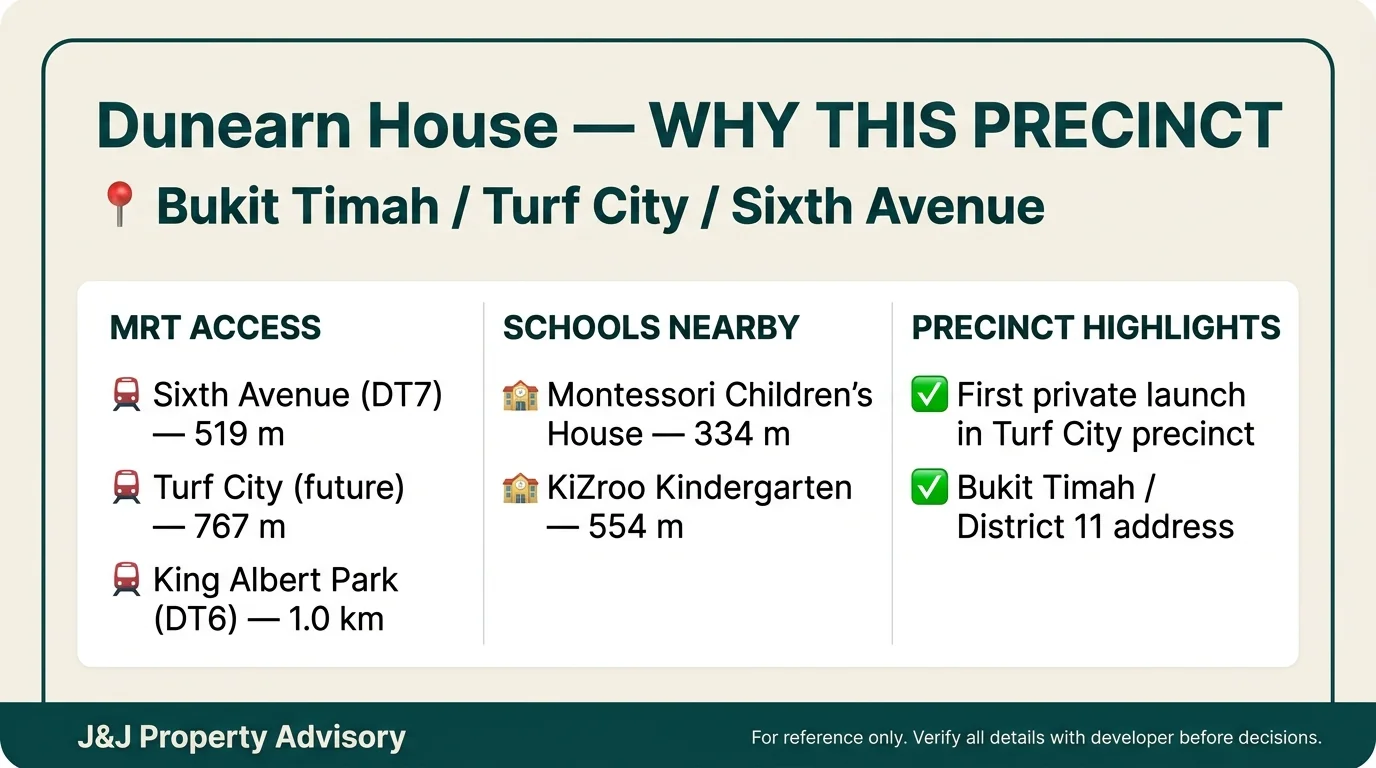
1. Around 500m to Sixth Avenue MRT
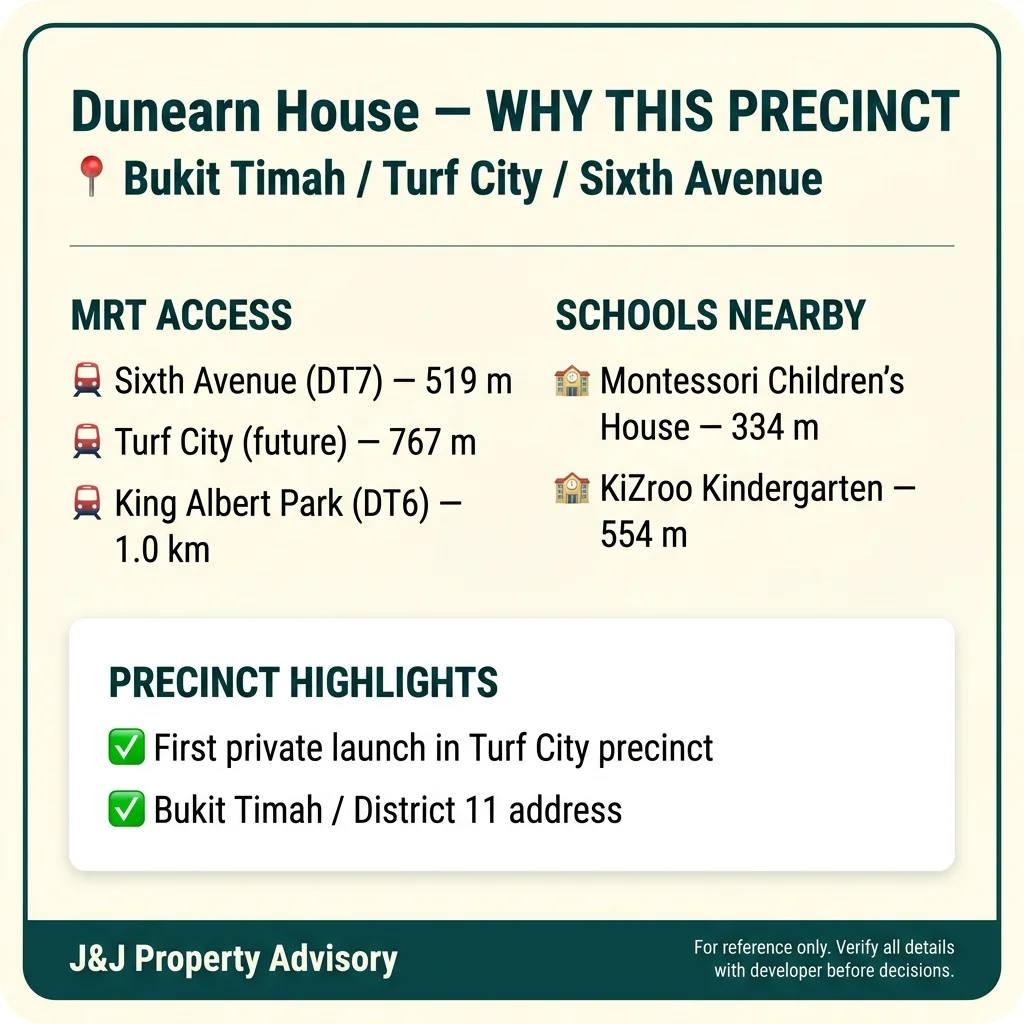
The MRT advantage is genuine. Source distance puts Sixth Avenue MRT at around 490m–519m, and a coordinate check also comes out at roughly 484m. In practical terms, this is fair to describe as around 500m, or about a 5-minute walk, depending on exact exit, walking route and individual pace.
This is one of the main strengths of Dunearn House. Sixth Avenue MRT sits on the Downtown Line, giving access to King Albert Park, Tan Kah Kee, Botanic Gardens, Stevens, Bugis and the CBD corridor. Orchard is also reachable in about six station movements via the Stevens/TEL transfer, so Orchard access is practical, although it is not a direct DTL ride.
2. Driving access to Orchard and the city
By car, Orchard is reasonably close. A fair advisory phrase is roughly 10–12 minutes’ drive in smooth traffic, subject to peak-hour congestion. This is still a Bukit Timah / Dunearn Road corridor, so buyers who drive daily should not ignore morning and evening bottlenecks, especially around Dunearn Road, Bukit Timah Road and PIE access points.
3. School-belt positioning
This is another real draw, but it should be written accurately. Nearby school-distance sources and coordinate checks put:
- Methodist Girls’ School at about 1.12–1.15km
- Raffles Girls’ Primary School at about 1.46–1.51km
- Pei Hwa Presbyterian Primary School at about 1.97–1.99km
So I would not market this as a “one-kilometre school-priority play”. That would be dangerous unless confirmed against MOE’s official Home-School Distance tool using the exact residential block address. But it is still fair to say Dunearn House sits within the broader Bukit Timah education corridor, near several established primary schools and family-focused amenities.
For parents, the practical takeaway is this: the school-belt appeal is real, but do not buy purely on assumed priority admission. Check the final postal code, block address and MOE distance before booking.
4. Amenities and lifestyle
The immediate neighbourhood gives access to Sixth Avenue dining, Guthrie House, Serene Centre, Coronation Plaza, King Albert Park and the wider Bukit Timah lifestyle belt. This is not the same as living above an integrated mall, but the trade-off is a more residential, green and school-oriented address.
The future Turf City precinct may eventually add more commercial and community amenities, but buyers should treat that as upside over time, not something to price in as if it already exists today.
5. Greenery and weekend lifestyle
Bukit Timah Nature Reserve, the Rail Corridor and surrounding green spaces strengthen the own-stay story. For family buyers and right-sizers, this is part of the appeal: MRT access and centrality, but not a dense inner-city feel.
Developer Track Record
Dunearn House is developed by a joint venture comprising Frasers Property, Sekisui House and CSC Land via Phoenix Dunearn Pte Ltd.
Frasers Property brings scale and master-planning experience. Sekisui House brings a Japanese homebuilding and construction background, with prior Singapore joint-venture experience. CSC Land adds local development participation. The architect, Ong & Ong, is an established Singapore firm with residential, institutional and commercial work.
For a 380-unit project with five blocks and a 2030 TOP, the developer profile matters because buyers are not only buying land and location. They are also depending on execution: layout planning, specifications, common-area design, maintenance planning, construction quality and defect handling.
This combination is credible, but it does not remove the need for showflat-level due diligence. Buyers should still check ceiling height, kitchen and bathroom specifications, storage space, balcony and AC ledge efficiency, maintenance fees, lift-to-unit ratio, car-park provision and the developer’s handover process.
For buyers, the developer angle supports confidence, but it should not replace price discipline. A good developer at the wrong entry price can still become a mediocre investment.
Pricing Context & Estimated Entry Quantum
| Size Example | At S$2,900 PSF | At S$3,000 PSF |
| 530 sqft | approx. S$1.54M | approx. S$1.59M |
| 600 sqft | approx. S$1.74M | approx. S$1.80M |
| 700 sqft | approx. S$2.03M | approx. S$2.10M |
| 870 sqft | approx. S$2.52M | approx. S$2.61M |
| 1,180 sqft | approx. S$3.42M | approx. S$3.54M |
| 1,380 sqft | approx. S$4.00M | approx. S$4.14M |
The factual anchor is the land cost: S$1,410 PSF PPR.
Based on typical cost-basis thinking, a rough breakeven band of 1.7–1.8x land cost points to around S$2,397–S$2,538 PSF before final margin and market positioning. This does not tell us the final launch price, but it explains why buyers should not expect a low-PSF product.
The more useful market reference is the analyst estimate. CBRE analyst Tricia Song, as reported in EdgeProp/Tavily-sourced research, indicated a possible launch pricing region around S$2,900–S$3,000 PSF. I would use this as a working affordability range before the official price list arrives.
Property portal signals also show early visible ranges around S$2,794–S$2,801 PSF, and quantum indications from about S$1.9 million to S$3.3 million. These are not developer price-list figures, but they are still useful as early market signals.
Estimated entry math
If smaller units are eventually around 530 sqft and pricing lands near S$2,900–S$3,000 PSF, the simple mathematical entry estimate is about:
- 530 sqft × S$2,900 PSF = approx. S$1.54M
- 530 sqft × S$3,000 PSF = approx. S$1.59M
For larger homes, the numbers move quickly:
This is why Dunearn House may look more accessible than freehold Bukit Timah stock on a PSF-adjusted basis, but still feel expensive on absolute quantum once buyers move into family-sized units.
For HDB upgraders, this is not a broad mass-market upgrade play. It is more likely to suit stronger upgraders with meaningful sale proceeds, cash buffer and TDSR room, especially if they are targeting smaller or compact units. Families needing proper 3-bedroom or 4-bedroom space should expect the affordability test to be much tougher.
Unit Mix & Floor Plans
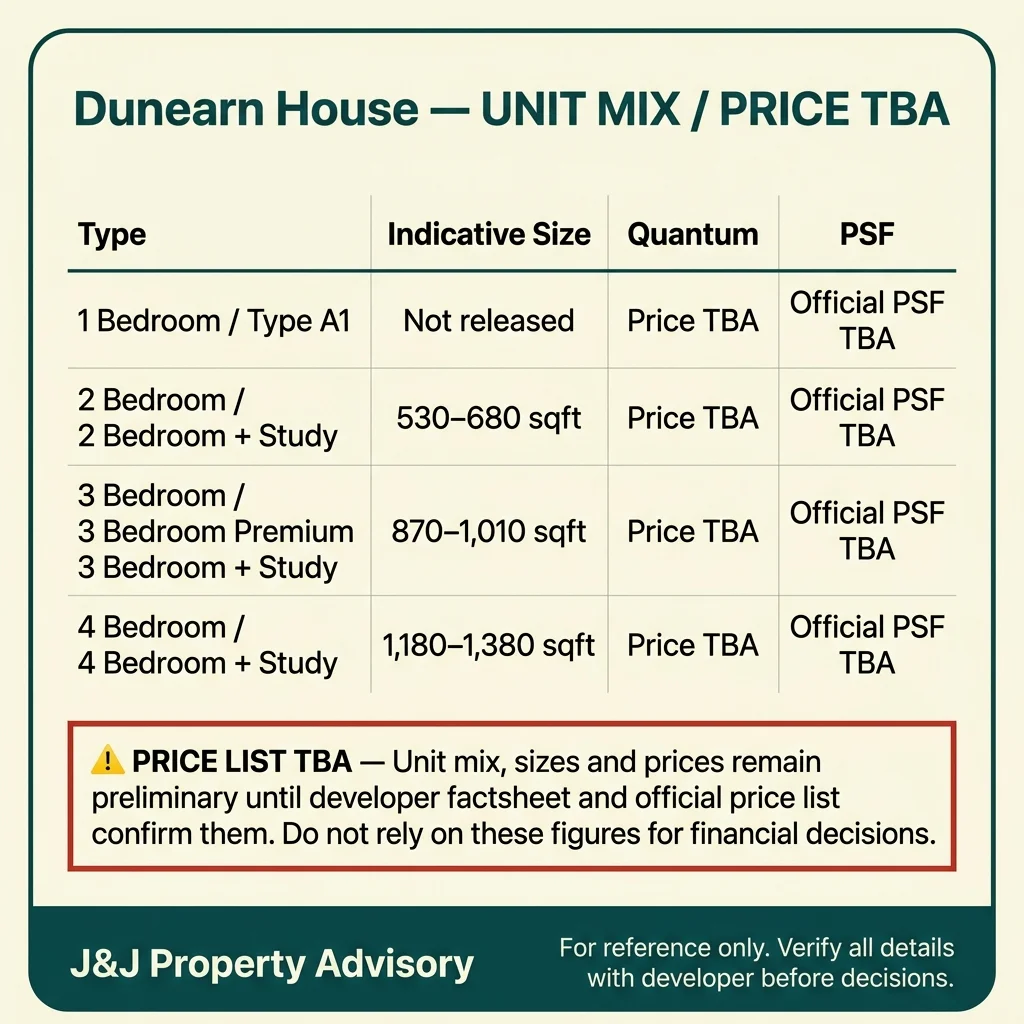
| Category | Preliminary Portal Signal | Source-State Note |
| 1 Bedroom | Official floor-plan category appears, but count/size not clear | Confirm against final e-brochure |
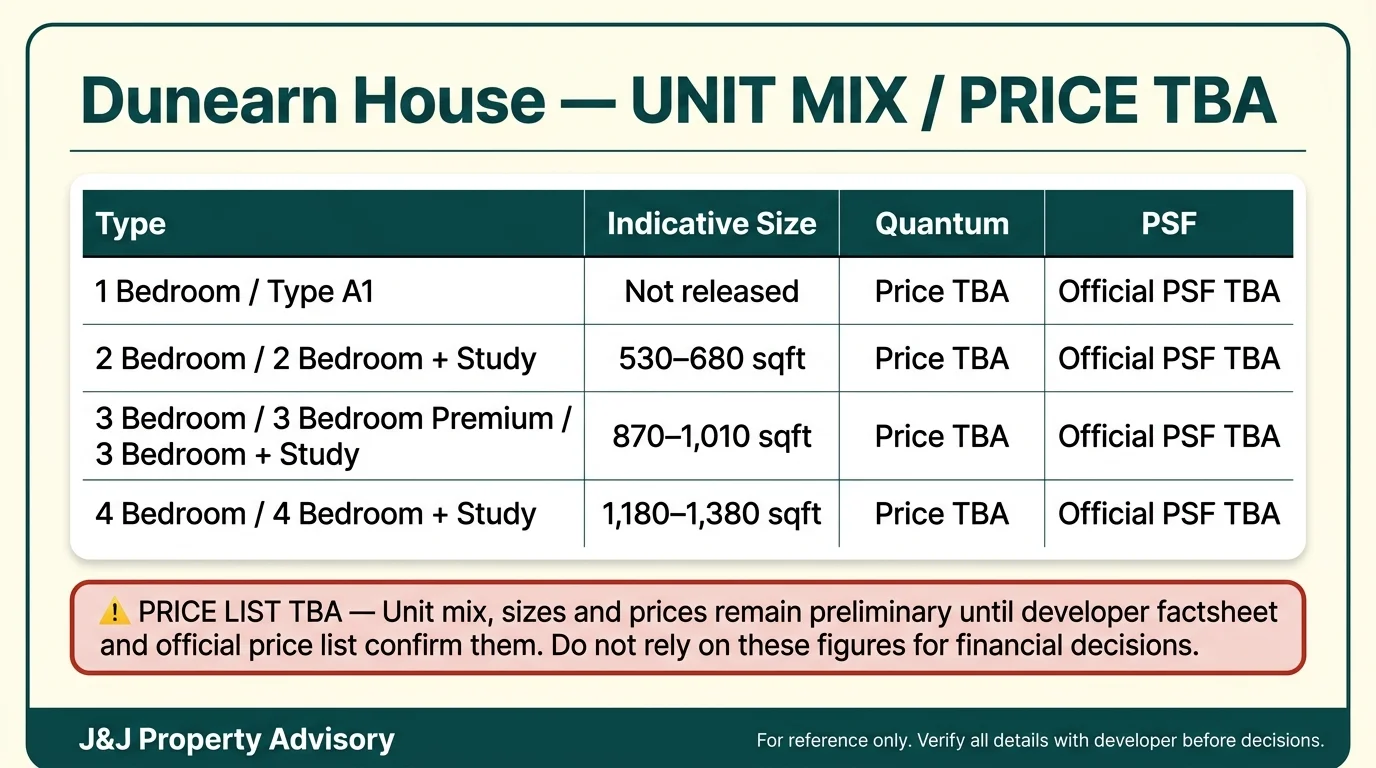
| 2 Bedroom / 2 Bedroom + Study | 530–680 sqft / 176 units indicated | Portal signal, not final official mix |
| 3 Bedroom / 3 Bedroom Premium / Study | 870–1,010 sqft / 96 units indicated | Portal signal, not final official mix |
| 4 Bedroom / 4 Bedroom + Study | 1,180–1,380 sqft / 108 units indicated | Portal signal, not final official mix |
The official floor-plan page currently shows categories for:
- 1 Bedroom
- 2 Bedroom / 2 Bedroom + Study
- 3 Bedroom / 3 Bedroom Premium
- 4 Bedroom / 4 Bedroom + Study
However, the full official unit mix, stack distribution, detailed sizes and final price list are not fully released in the scraped public materials.
There is also a source conflict. NewLaunches-style project data still treats unit types as to-be-released, while portal snippets indicate a possible 2BR to 4BR-heavy mix, including:
The important buyer insight is not “nothing can be said”. The useful point is this: if the portal-indicated mix is broadly accurate, Dunearn House is not just a tiny-unit investor product. It appears to be positioned more toward family buyers, Bukit Timah school-belt demand and larger own-stay households.
But until the final e-brochure and price list are released, buyers still need to check:
- whether the smaller units are efficient or compromised
- whether 3BR sizes are family-liveable or too compact
- whether 4BR units carry heavy quantum premiums
- which stacks face Dunearn Road traffic versus quieter internal or greenery-facing views
- how much balcony / AC ledge / corridor inefficiency exists
This is where the actual purchase decision will be made.
Market Comparables
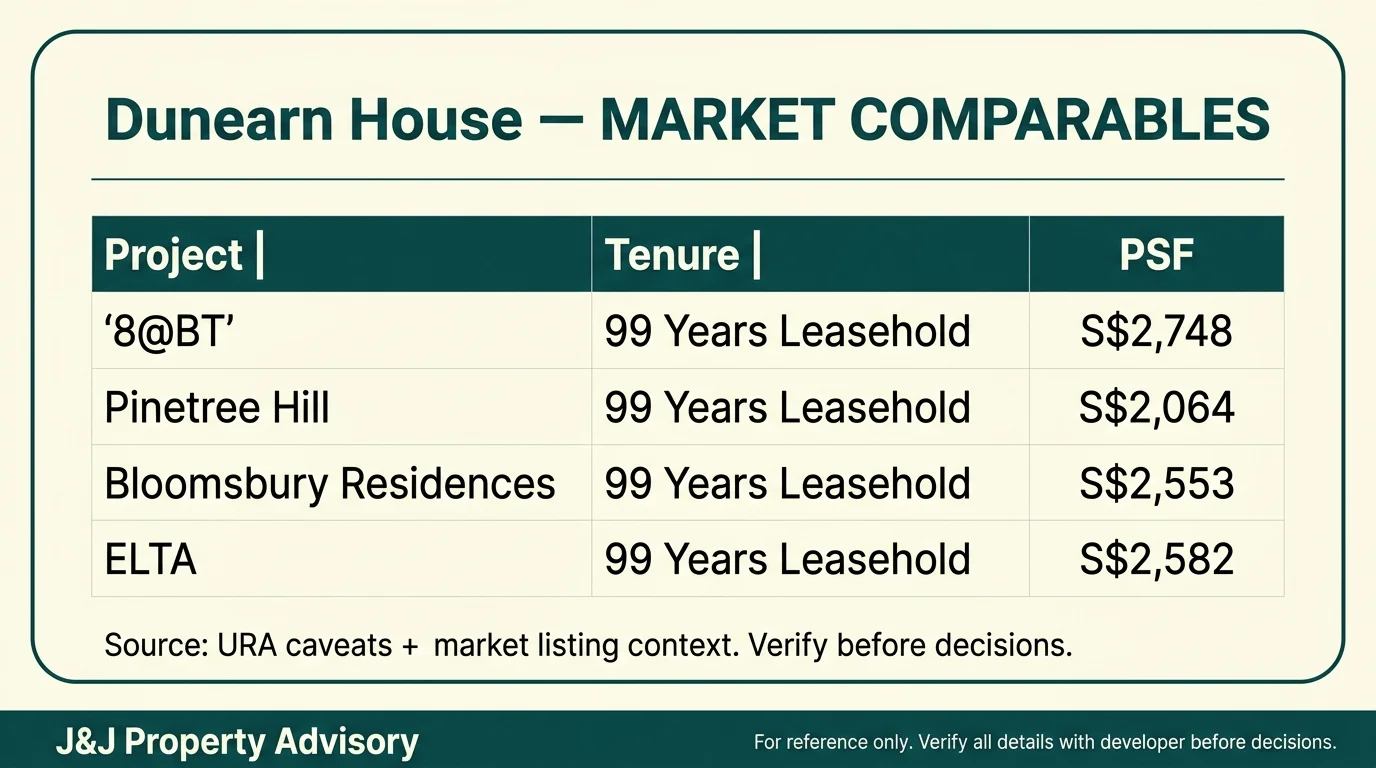
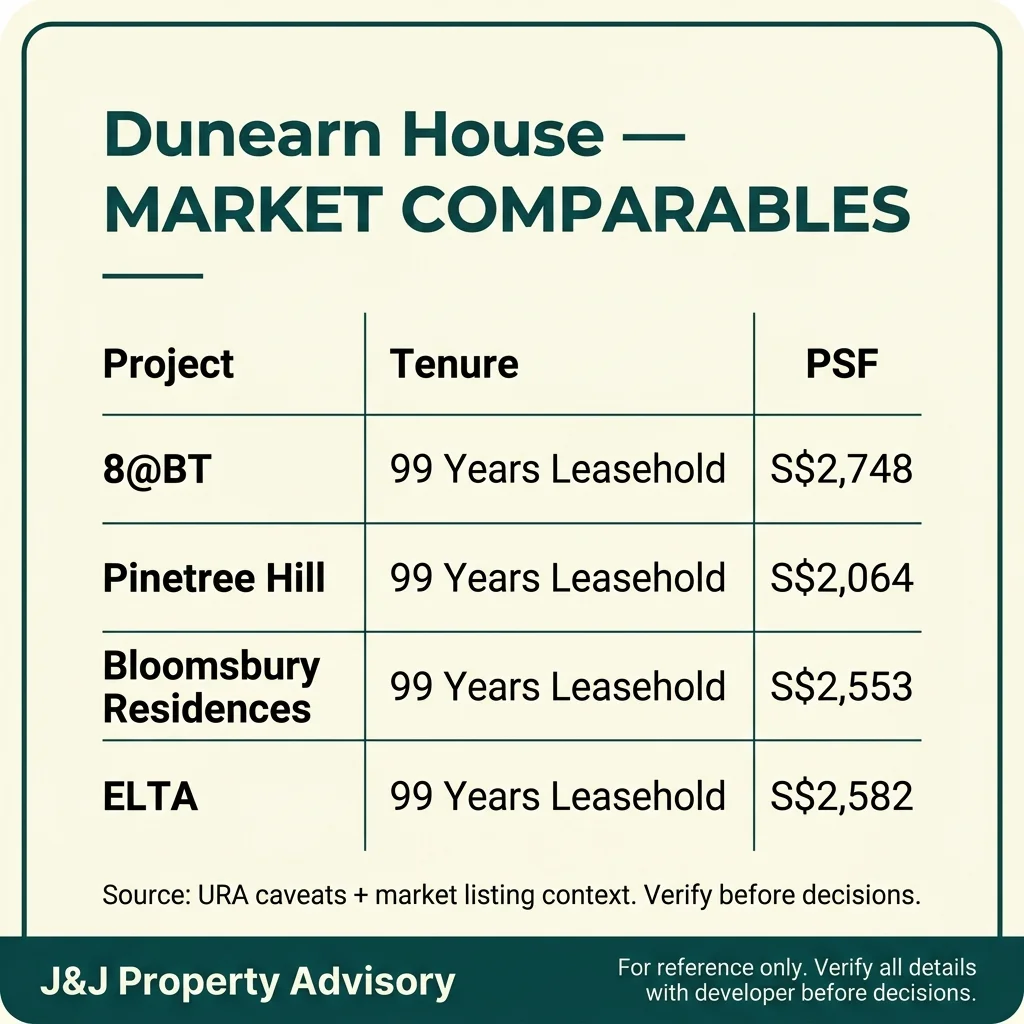
| Project | Reference PSF | Tenure | TOP / Status | Note |
| Dunearn House | S$2,900–S$3,000 PSF | 99-year leasehold | Expected TOP 2030 | Analyst estimate, not official pricing |
| 8@BT | from around S$2,748 PSF | 99-year leasehold | Expected TOP 2027 | Portal “from” pricing context |
| Pinetree Hill | URA median around S$2,064 PSF / portal references higher | 99-year leasehold | Expected TOP 2027 | URA caveat context; not a perfect like-for-like |
| Bloomsbury Residences | from around S$2,553 PSF | 99-year leasehold | Expected TOP 2029 | Portal “from” pricing context |
| ELTA | from around S$2,582 PSF | 99-year leasehold | Expected TOP 2031 | Portal “from” pricing context |
| District 11 resale condos | median around S$2,089 PSF | Mixed | Resale market | 754 transactions over past two years |
The comparison should be read in three layers.
First, compare Dunearn House against nearby 99-year new launches such as 8@BT, Pinetree Hill, Bloomsbury Residences and ELTA. This tells you whether the new-launch premium is reasonable.
Second, compare it against freehold Bukit Timah / District 11 alternatives. This is where tenure matters. If Dunearn House is priced too close to freehold stock, the 99-year lease becomes harder to defend.
Third, compare it against the broader D11 resale market, where transactions show a median around S$2,089 PSF over the past two years. This is not a direct ceiling because the resale basket includes older projects, mixed tenures and different locations. But it gives buyers a sanity check on how much premium they are paying for new-build status, MRT proximity and the Turf City story.
In simple terms: Dunearn House becomes compelling if the price gap versus freehold and resale alternatives is visible enough. If the developer prices it too close to premium freehold options, buyers need to be much more selective on stack and layout.
Rental Yield & Investment View
For investors, Dunearn House should not be sold as a high-yield product. Bukit Timah / District 10 / District 21 rental demand can be strong, especially for families near schools and MRT, but the entry price is also high.
Using nearby URA rental median references as a rough guide:
- Mayfair Modern: around S$6.25 psf/month in 2026Q1
- Mayfair Gardens: around S$5.81 psf/month in 2026Q1
- Forett @ Bukit Timah: around S$5.80 psf/month in 2026Q1
- The Linq @ Beauty World: around S$6.44 psf/month in 2025Q3
- Fourth Avenue Residences: around S$7.32 psf/month in 2026Q1
If Dunearn House enters around S$2,900–S$3,000 PSF, a simple rent-PSF yield calculation suggests the illustrative gross yield may sit around the low-to-mid 2% range, with stronger outcomes possibly moving closer to high-2% or near-3% if rents are closer to the stronger Fourth Avenue-type benchmarks.
This is before maintenance fees, property tax, vacancy, agent fees, repair cost and financing cost. So for investment buyers, the real thesis is not pure rental yield. It is more about:
- scarcity of new family-sized homes near Sixth Avenue / Bukit Timah
- tenant demand from families who value schools and MRT access
- potential precinct uplift from Turf City over time
- whether the developer prices the project with enough leasehold discount versus freehold alternatives
If you are buying purely for rental yield, there may be easier projects. If you are buying for a mix of own-stay flexibility, tenantability and long-term Bukit Timah demand, Dunearn House becomes more interesting.
Key Strengths
First private launch at the Turf City gateway
This is the biggest story. First-mover projects can benefit if the precinct matures well, because later plots, retail, transport improvements and public-realm upgrades can make the address more attractive over time. But first-mover advantage only pays off if the entry price leaves room for future buyers to see value.
Real MRT walkability
Around 500m to Sixth Avenue MRT is a genuine strength. This is not a “near MRT by marketing language only” situation. The walkability supports both own-stay convenience and rental demand.
Bukit Timah family appeal
Even without claiming one-kilometre school priority, the broader education corridor is relevant. MGS, Raffles Girls’ Primary and Pei Hwa Presbyterian are all within roughly 1–2km based on current distance references, and the surrounding area has the kind of enrichment, lifestyle and family infrastructure that keeps Bukit Timah demand resilient.
Developer profile
Frasers Property, Sekisui House and CSC Land is a credible joint venture. For a 380-unit project with five blocks and a 2030 TOP, execution matters. A stronger developer team reduces some buyer anxiety, even though final product quality still needs to be assessed from floor plans, specs and delivery.
Potential quantum gap versus freehold Bukit Timah stock
The 99-year tenure is a disadvantage over the long term, but it can also create a lower entry quantum versus freehold alternatives. If the discount is meaningful enough, some buyers may accept the trade-off.
Points To Watch
Pricing discipline
This is the number-one issue. At around S$2,900–S$3,000 PSF, smaller units may still start from the mid-S$1.5M range if the size assumptions hold. But family-sized units can quickly move above S$2.5M to S$4M. The project becomes attractive only if the final price list gives enough value relative to nearby new launches, resale alternatives and freehold options.
99-year tenure in a freehold-heavy mindset
Bukit Timah buyers often care about tenure. A 99-year leasehold project can still do well if the entry price is right, but it cannot be evaluated the same way as freehold stock. The longer the holding period, the more the leasehold trade-off matters.
Unknown stack and layout quality
A good address can still be weakened by poor stack choice, road noise, inefficient layouts or high quantum for the best units. Buyers should not book just because the project name and location look good. The final floor plans and stack premiums will decide a lot.
Turf City execution timeline
Future precinct growth is a plus, but it is not instant. Early buyers may face years where the surrounding area is still developing. If future commercial offerings are delayed or underwhelming, the first-mover premium may take longer to show.
Rental yield may not be exciting
The tenant pool can be good, but the entry price is high. This is likely more of a balanced own-stay / long-term capital story than a high-yield rental play.
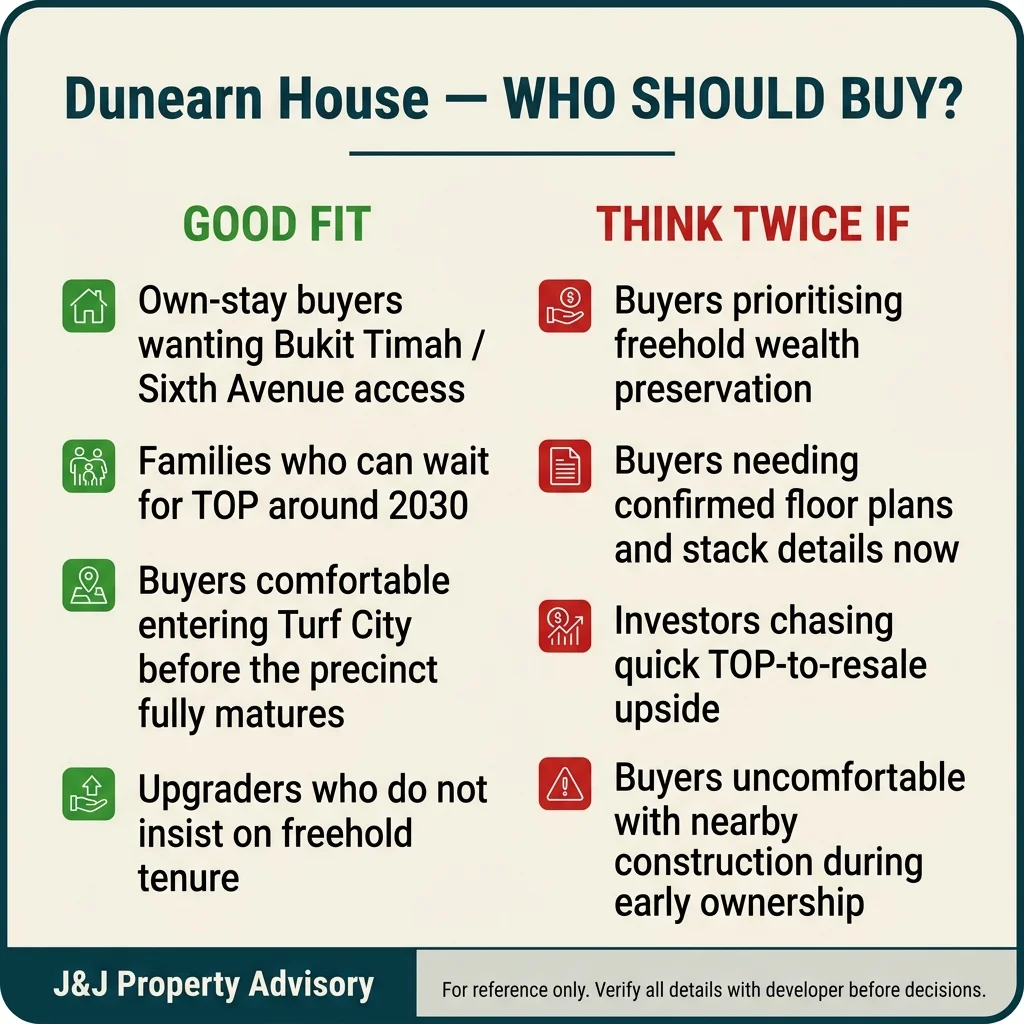
Who Is This For
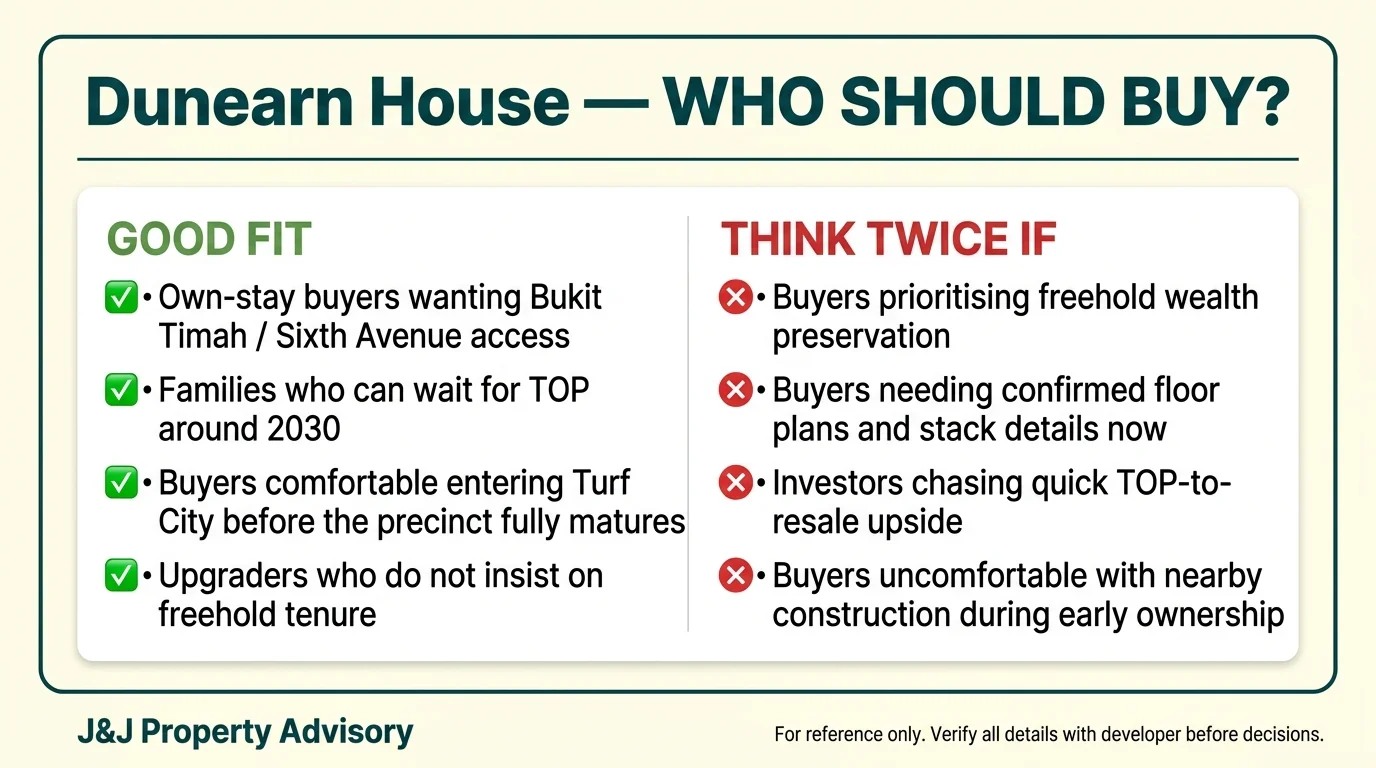
Good fit:
- Families who want Bukit Timah / Sixth Avenue access, but prefer a new launch over older resale maintenance and renovation risk
- Buyers who like the Turf City transformation story, but still want an established neighbourhood today rather than a purely future-dependent location
- Stronger HDB upgraders or private-property buyers who can handle a mid-S$1.5M and above entry estimate, subject to the final price list
- Buyers who value MRT walkability, schools nearby and a greener residential environment more than integrated-mall convenience
- Investors who want tenantability and long-term location demand, not purely maximum rental yield
- Right-sizers or landed-home families who want a new condominium product in a familiar Bukit Timah corridor
Not ideal for:
- Buyers who insist on freehold tenure for long-term legacy planning
- Investors looking for high gross yield or quick flip returns
- Budget-sensitive families who need proper 3BR or 4BR space but cannot stretch beyond S$2.5M–S$3M
- Buyers who are not prepared to compare the final price list against resale and freehold alternatives
- Drivers who dislike Dunearn / Bukit Timah peak-hour congestion
- Buyers who need confirmed layouts, stack views and exact quantum before shortlisting

Analysis Date: June 2026
Agent: Joe Chow | CEA Reg No.: R072635C
Agency: SRI Pte Ltd | Licence: L3010738A
Contact: +65 8098 0916
This is a pre-launch analysis based on publicly available information, analyst estimates, portal signals and market comparables. Official pricing, final unit mix and floor plans should be verified against the developer’s documents before any purchase decision. This is not financial advice.