
With the gap between HDB resale prices and private non-landed property prices showing specific trends as of Q1 2026, many homeowners are re-evaluating the financial viability of an upgrade. According to HDB data released in January 2026, the Resale Price Index (RPI) reached 203.6 in Q4 2025, representing cumulative price growth of 2.9% for the full year of 2025. While HDB prices have shown resilience, the entry price for a suburban three-bedroom private condominium has consistently hovered above the S$1.5 million mark, creating a significant capital bridge for the average household.
- Calculate a ‘Price Gap Ratio’ by dividing target private property price by current HDB valuation – a ratio exceeding 2.2 often indicates significant strain on cash reserves and future CPF contributions
- Maintain combined monthly debt obligations below 45% of gross income (instead of the official 55% TDSR limit) to provide safety buffer for interest rate fluctuations, and stress-test affordability at 4.5% interest rates
- Private condo total holding costs are 3-4 times higher than HDB: maintenance fees alone jump from $70-$100/month (HDB) to $350-$600/month (private), plus higher mortgage rates at 3.5% vs 2.6% HDB concessionary rate
For those considering a transition, the decision often hinges on whether the current HDB valuation can sufficiently cover the 25% downpayment and associated transaction costs of a private property without over-leveraging the family’s monthly cash flow. This evaluation is further complicated by the prevailing interest rate environment, which, while stabilising compared to the 2023–2024 peak, remains a primary consideration for debt servicing ratios. Understanding the macro-economic shifts and policy nuances is essential for any HDB owner looking to progress.
As we move further into 2026, the intersection of supply-side factors from the Government Land Sales (GLS) programme and demand-side cooling measures continues to define the boundaries of what is financially prudent for the Singaporean middle class.
Understanding the Price Gap Between HDB and Private Condominiums in 2026
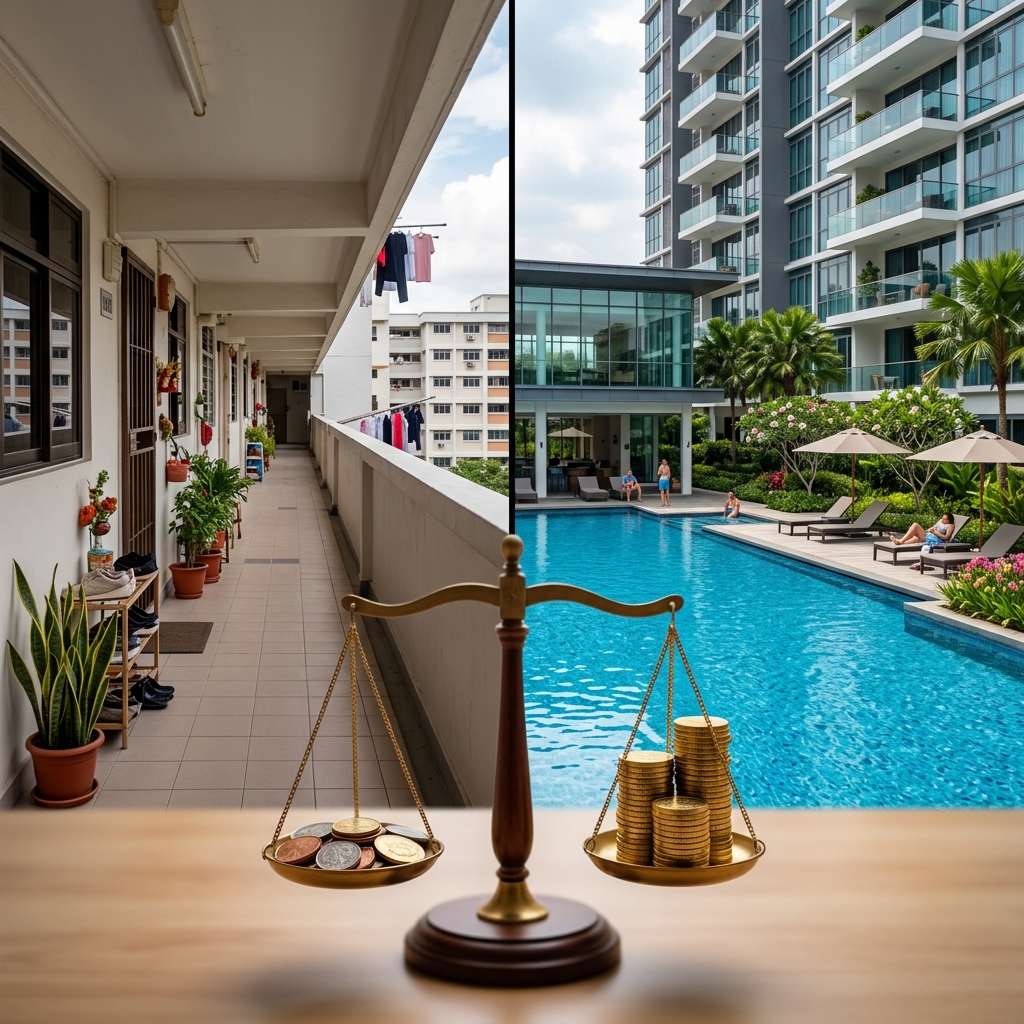
The price disparity between public and private housing serves as the primary barrier for most upgraders. Based on historical data from URA Realis and HDB, the price-per-square-foot (PSF) gap between a 5-room resale HDB flat in a mature estate and a new launch Executive Condominium (EC) or OCR private condominium has widened over the last five years.
In Q4 2025, the HDB RPI stood at 203.6, a slight decline from 203.7 in Q3 2025 (Source: HDB Resale Price Index, Q4 2025), indicating a plateauing of resale prices after the rapid climbs of 2021–2023. Conversely, private non-landed property prices have remained supported by high land costs and construction overheads.
In the current Q1 2026 market, an upgrader selling a 5-room HDB flat in a central location such as Bishan or Toa Payoh might achieve a sale price between S$900,000 and S$1.1 million, based on HDB resale transaction data from 2025. However, moving into a comparable 1,000 sq ft private condominium in the Rest of Central Region (RCR) typically requires a budget exceeding S$2.2 million. This creates a “valuation gap” of over S$1 million. When HDB price growth slows to the 2.9% recorded in 2025, the ability of the HDB asset to keep pace with private property price movements diminishes.
This dynamic may be suitable for profiles such as those who have already achieved significant capital gains and possess high cash reserves, but it poses a challenge for younger families relying solely on the sale proceeds of their first home.
Furthermore, the price gap is not uniform across all districts. Data from the URA Master Plan suggests that certain suburban regions undergoing rejuvenation may see a temporary narrowing of this gap, yet the premium for private status — including amenities, exclusivity, and land tenure — remains a fixed market constant. Buyers must analyse whether the PSF they are paying for a private unit translates to actual functional space, as modern condominium layouts often prioritise balconies and air-conditioning ledges over the larger internal living areas found in older HDB flats.

Practical takeaway: Upgraders should calculate the “Price Gap Ratio” by dividing the target private property price by their current HDB valuation; a ratio exceeding 2.2 often indicates significant strain on cash reserves and future CPF contributions.
Impact of Current ABSD and TDSR Regulations on Upgraders
The regulatory framework set by the Monetary Authority of Singapore (MAS) and IRAS remains the most critical gatekeeper for HDB upgraders in 2026. The Total Debt Servicing Ratio (TDSR) threshold, currently maintained at 55% of gross monthly income (Source: MAS TDSR Guidelines, updated 2024), dictates the maximum loan amount a household can secure. For an HDB upgrader, this means all existing liabilities — including car loans, personal loans, and credit card balances — must be factored into the 55% limit alongside the new private mortgage. Based on MAS historical policy stances, these measures are designed to prevent systemic over-leveraging during periods of interest rate volatility.
Additional Buyer’s Stamp Duty (ABSD) remains a pivotal consideration for those who wish to buy a private property before selling their HDB flat. Under current IRAS regulations as of Q1 2026, Singapore Citizens purchasing a second residential property face an ABSD rate of 20% (Source: IRAS ABSD Schedule, Q1 2026). While a remission is available for married couples who sell their first matrimonial home (HDB) within six months of purchasing the private property (for completed units) or the TOP date (for uncompleted units), the upfront cash requirement is substantial. Many households find the “Buy First, Sell Later” route prohibitive because they must have the liquidity to pay the 20% ABSD within 14 days of signing the Sale and Purchase Agreement.
For many, the “Sell First, Buy Later” strategy is more viable in 2026 to avoid the ABSD bottleneck and to unlock the cash proceeds from the HDB sale for the next downpayment. However, this necessitates finding temporary housing, which adds to the overall transition cost. Loan-to-Value (LTV) limits also remain at 75% for the first housing loan, meaning a minimum 25% downpayment is mandatory, of which at least 5% must be in cash (Source: MAS LTV Guidelines, updated 2024).
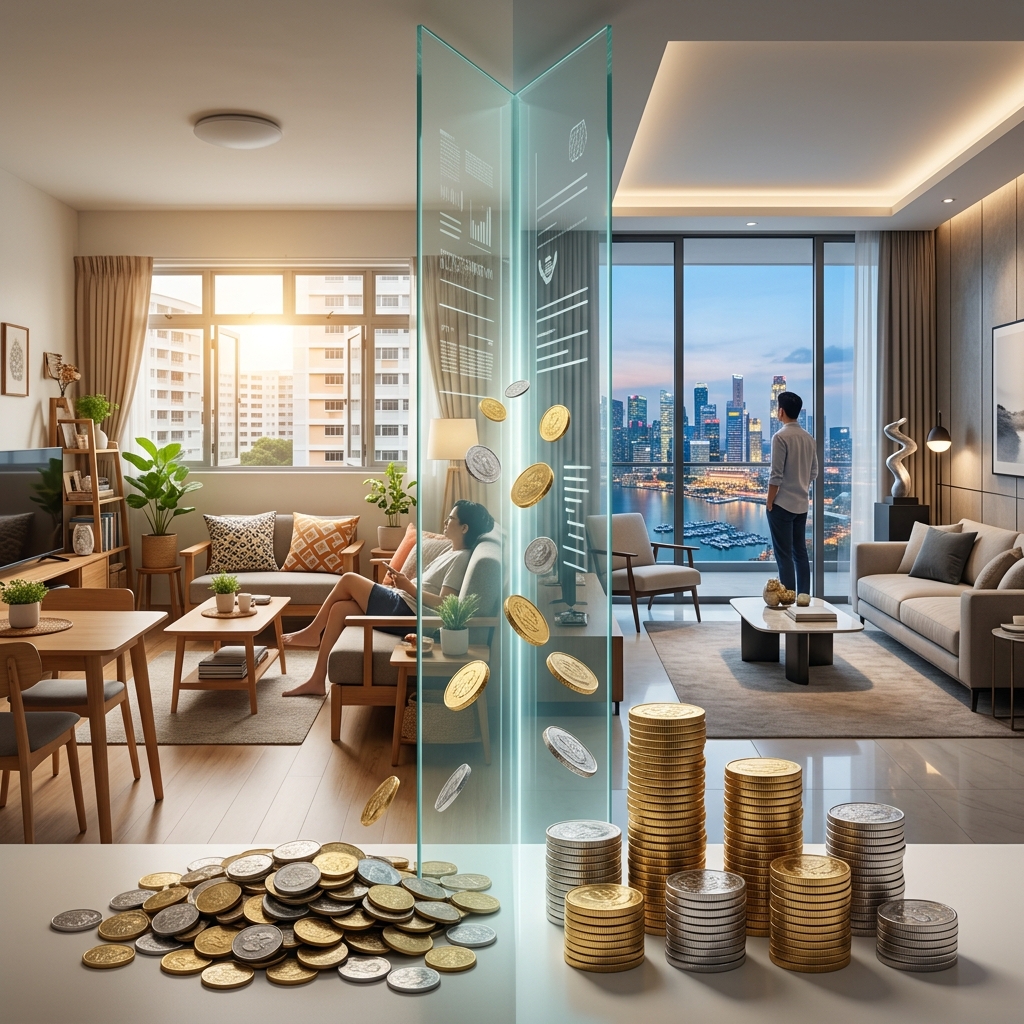
Practical takeaway: Ensure combined monthly debt obligations do not exceed 45% of gross income to provide a safety buffer below the official 55% TDSR limit, allowing for potential interest rate fluctuations.
Comparing Ongoing Holding Costs: Maintenance Fees and Interest Rates
Transitioning from an HDB flat to a private condominium involves a shift from subsidised conservancy charges to market-rate maintenance fees. In 2026, Service and Conservancy Charges (S&CC) for a 5-room HDB flat typically range from S$70 to S$100 per month, depending on the Town Council. In contrast, maintenance fees for a mid-tier private condominium are estimated to range between S$350 and S$600 per month, based on the share value of the unit. These fees cover the upkeep of facilities such as swimming pools, gyms, and 24-hour security, but they represent a perpetual drain on monthly liquidity that does not contribute to equity.
Have a question about this? WhatsApp Joe — no obligations, just clarity.
Interest rates continue to be a dominant factor in the holding cost equation. With the estimated average mortgage rate for Q1 2026 hovering around 3.5%, the interest component of a monthly mortgage payment is materially higher than the 2.6% concessionary rate offered by HDB for those using an HDB loan. On a S$1.2 million loan over 25 years at a 3.5% rate, the estimated monthly repayment is approximately S$6,000, based on standard amortisation schedules. In the early years of the mortgage, more than 50% of this payment may go toward interest rather than principal reduction.
Property taxes also differ. While HDB flats benefit from lower Annual Values (AV) and owner-occupier concessionary rates, private properties generally carry higher AVs, leading to higher annual tax liabilities. Based on IRAS 2025/2026 tax brackets, the tiered tax system means that as the AV of a property increases, the effective tax rate rises progressively. For an upgrader, the total cost of ownership — comprising mortgage interest, maintenance fees, and property taxes — could be three to four times higher than their previous HDB holding costs.
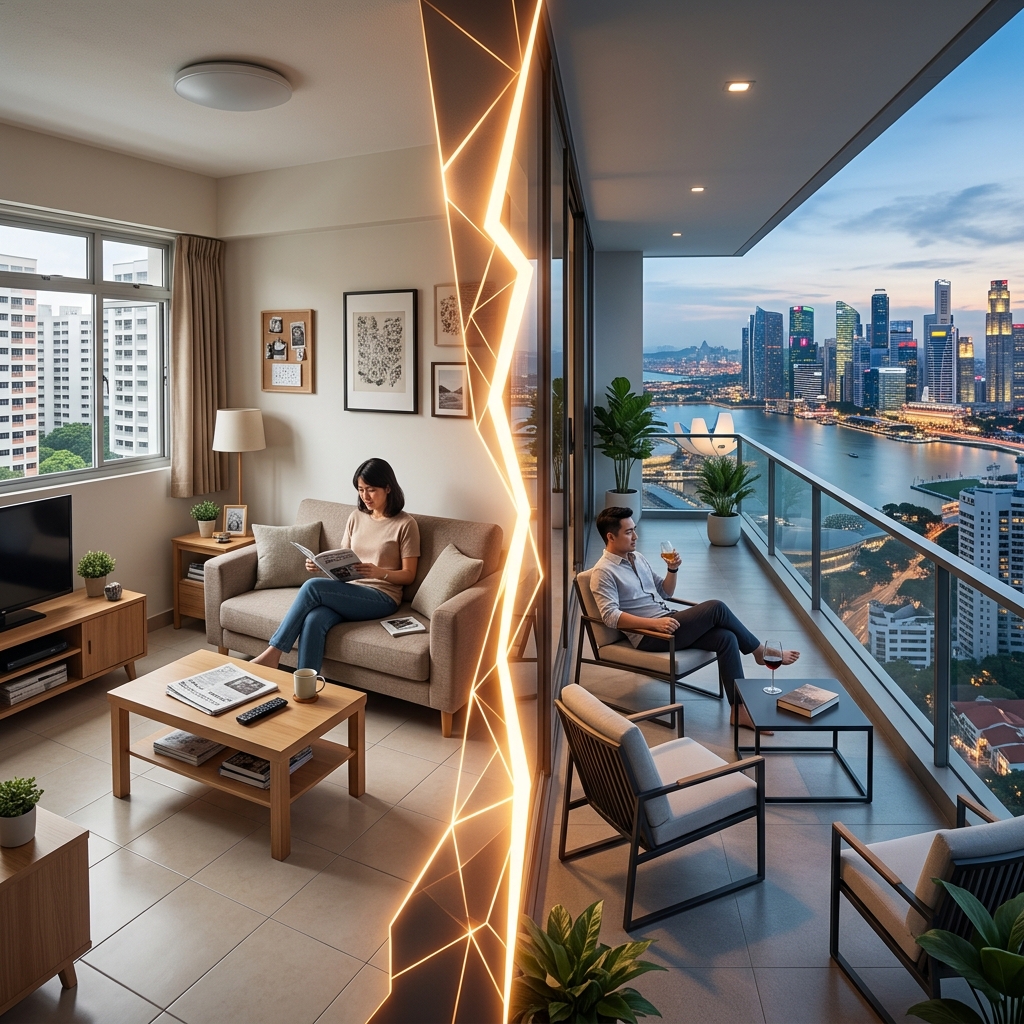
Practical takeaway: Before committing, perform a stress-test by simulating a 4.5% interest rate environment to ensure monthly holding costs remain manageable even if global central bank policies shift.
Projected Cash Flow Analysis for HDB to Private Transitions
A successful upgrade requires a granular understanding of the cash flow transition. The liquidity unlocked from a resale HDB flat is often partially “trapped” by the need to refund the CPF Ordinary Account (OA) used, plus accrued interest. In 2026, many sellers who bought their flats 10 to 15 years ago find that a substantial portion of their sale proceeds must be returned to their CPF accounts. While this money can be reused for the next property purchase, it cannot be applied toward the mandatory 5% cash downpayment or certain transition expenses such as renovation and furniture.
The table below illustrates the estimated financial components for a typical transition based on Q1 2026 market conditions.
| Financial Component | HDB (Resale — 5-Room) | Private Condo (Non-landed — 3-Bed) |
|---|---|---|
| Typical Purchase Price | S$650,000 – S$950,000 | S$1,700,000 – S$2,200,000 |
| Typical Downpayment | 20% – 25% | 25% (Min. 5% Cash) |
| Mortgage Tenure | Up to 25 years (HDB/Bank) | Up to 30 years (Bank) |
| Stamp Duty (Buyer) | BSD (Tiered) | BSD (Tiered) + potential ABSD |
| Maintenance Fees | S$70 – S$100 (S&CC) | S$350 – S$600 (MCST) |
| CPF Usage Limits | Valuation Limit applies | Valuation Limit / Withdrawal Limit |
Source: HDB Resale Statistics and IRAS Stamp Duty Rates, Q1 2026. Figures are estimated ranges based on prevailing market conditions and are subject to change.
The most overlooked aspect is the opportunity cost of liquidating a fully-paid HDB flat versus the interest expense of a new private mortgage. If an HDB flat is fully paid, the owner essentially lives cost-free in terms of housing debt, allowing for more aggressive wealth accumulation in other asset classes. By upgrading, the household takes on a significant debt obligation. Based on historical trends, the capital appreciation of the private property must exceed the combined cost of mortgage interest, maintenance fees, and the 2.5% per annum interest that CPF funds would have otherwise earned if left in the OA (Source: CPF Board OA Interest Rate, 2025).
For a household with a combined monthly income of S$15,000, a S$1.5 million mortgage at an estimated 3.5% rate consumes approximately 40% of gross income. This leaves reduced room for retirement savings and emergency funds, particularly if the “negative cash sale” scenario occurs — where the sale proceeds of the HDB flat do not cover the full CPF refund plus accrued interest.
Practical takeaway: Always request a “Net Proceeds” statement from the HDB portal to understand exactly how much cash will be available after the CPF refund and any outstanding loan settlement.
Long-Term Capital Appreciation Trends and Market Liquidity
The primary motivation for upgrading to a private condominium in Singapore is often the potential for superior capital appreciation relative to HDB flats. Historical data from URA Realis suggests that over 10-year cycles, private residential properties have generally outperformed HDB resale flats in terms of percentage price growth. This is largely attributable to the limited supply of private land and the aspirational nature of private homeownership in Singapore. However, market liquidity is a critical factor; while an HDB flat in a mature estate is generally straightforward to sell given the large pool of eligible buyers, a high-quantum private condominium has a materially smaller pool of prospective purchasers.
In 2026, the rental market also plays a role in the appreciation narrative. While HDB rental yields have historically trended higher — often in the 4% to 6% range due to lower entry prices — private property yields have traditionally hovered between 2% and 3% (Source: EdgeProp Market Analytics, 2025). However, private properties offer the potential for en-bloc sales, which are subject to aging building conditions and URA rezoning plans. Buyers should be mindful of leasehold decay in 99-year private projects. Based on industry research from EdgeProp and StackedHomes (2025), the price divergence between freehold and leasehold properties often becomes more pronounced once a leasehold project crosses the 20-year mark.
Market liquidity for private properties is also influenced by exit strategy. An upgrader must consider who the next buyer will be. If a project is located in an area with an oversupply of similar units, capital appreciation may be muted regardless of property type. Trends in Q1 2026 suggest that buyers are increasingly prioritising lifestyle components and proximity to major employment hubs or upcoming infrastructure such as the Cross Island Line (CRL).
We note that forward-looking appreciation estimates are subject to market conditions and should not be treated as projected outcomes without reference to current URA or HDB data at the time of any purchase decision.
Practical takeaway: Focus on projects where the entry price aligns closely with the estimated land cost plus construction margin, as these provide a stronger price floor, based on historical trends, for future capital appreciation.
Risks and Considerations
While the prospect of upgrading carries financial merit under the right conditions, it involves inherent risks that must be mitigated through meticulous planning and conservative financial estimates.
- Interest Rate Volatility: Although rates are estimated at 3.5% for this analysis, they remain subject to global economic shifts. A 1% increase in rates can add several hundred dollars to monthly repayments. Mitigation: Opt for fixed-rate packages where available, or maintain a mortgage buffer equivalent to 12 months of instalments in a liquid account.
- CPF Accrued Interest and Negative Cash Sales: If an HDB flat is held for a long period, the accrued interest on CPF funds used can grow substantially. Upon sale, if the price has not appreciated sufficiently, the seller may receive little to no cash proceeds. Mitigation: Perform regular checks on the CPF “Property” dashboard to track accrued interest and plan sale timing accordingly.
- Liquidity Risk: Private properties are not as liquid as cash or listed securities. In a market downturn, selling a high-quantum unit can take six months or longer. Mitigation: Ensure you are not “house poor” — maintain at least 6 to 12 months of emergency expenses outside of property equity.
- Policy and Cooling Measure Changes: The Singapore government actively monitors the property market. New measures could be introduced at any time, affecting LTV ratios or ABSD rates. Mitigation: Always base purchase decisions on current regulations rather than anticipating future policy relaxations.
- Lease Decay for Older Private Projects: Buying an older 99-year leasehold condominium to reduce upfront costs can lead to difficulty in reselling as the remaining lease shortens. Mitigation: Prioritise freehold or newer 99-year leasehold projects if the intended holding period exceeds 15 years.
Data Sources
- Government Sources (Tier 1): HDB Resale Price Index, Q4 2025 (released January 2026); URA Realis Private Residential Property Price Index, historical trends 2021–2025; MAS TDSR and LTV Guidelines, updated 2024; IRAS Property Tax Rates and BSD/ABSD Schedule, Q1 2026; CPF Board OA Interest Rate, 2025.
- Established Media and Industry Research (Tier 2–3): EdgeProp Market Analytics, 2025; StackedHomes Editorial Analysis, 2025; PropNex and ERA Research Reports, January 2026.
If you are navigating the HDB-to-private upgrade decision and would like a personalised financial framework based on your specific flat value, income profile, and target property type, [reach out for a no-obligation consultation].
Agent: Joe Chow | CEA Reg No.: R072635C
Agency: SRI Pte Ltd | Licence: L3010738A
Contact: +65 8098 0916
This article is for general reference only and does not constitute financial, legal, or investment advice. Verify all details with relevant authorities before making decisions.
Frequently Asked Questions
What is the ABSD rate for Singapore citizens buying second property in 2026?
Singapore Citizens purchasing a second residential property face an ABSD rate of 20% under current IRAS regulations as of Q1 2026. However, married couples can get a remission if they sell their first matrimonial home (HDB) within six months of purchasing the private property.
How much downpayment do I need for private condo vs HDB in 2026?
Private condominiums require a minimum 25% downpayment (with at least 5% in cash), while HDB flats typically require 20-25%. For a $2 million private condo, you’d need $500,000 downpayment with $100,000 minimum in cash.
What is the price gap between 5-room HDB and private condo in 2026?
A 5-room HDB flat in central locations like Bishan or Toa Payoh sells for $900,000-$1.1 million, while a comparable 1,000 sq ft private condominium in RCR requires over $2.2 million, creating a valuation gap of over $1 million.
How much higher are private condo maintenance fees vs HDB conservancy charges?
HDB Service and Conservancy Charges range from $70-$100 per month for a 5-room flat, while private condominium maintenance fees range between $350-$600 per month – about 3-6 times higher.
What TDSR limit should I maintain when upgrading from HDB to private property?
While the official TDSR limit is 55% of gross monthly income, the article recommends keeping combined monthly debt obligations below 45% to provide a safety buffer for potential interest rate fluctuations.
Need Clarity on Your Next Property Move?
One message. No obligations. We’ll help you see the full picture.