

Selling your $1.5M condominium in March 2026 versus waiting until June 2026 — a three-month delay that, based on historical seasonal transaction patterns, could represent a difference of $50,000 or more in net proceeds. That gap is not hypothetical noise. It reflects real shifts in buyer demand, transaction velocity, and the price index momentum that shapes what serious buyers are actually willing to pay at any given window.
Here is the part most sellers miss: timing a sale is not just about reading headlines. It is about understanding how quarterly price cycles, cooling measure thresholds under the Singapore government’s macroprudential framework administered by the Monetary Authority of Singapore (MAS — Singapore’s central bank and integrated financial regulator), and buyer profile behaviour interact in a specific market. In Q1 2026, the Urban Redevelopment Authority (URA — Singapore’s national land use planning and conservation authority) confirmed that overall private residential prices rose just 0.3% quarter-on-quarter — the slowest quarterly growth in six quarters — while Housing and Development Board (HDB — Singapore’s public housing authority) resale prices recorded their first quarterly decline in nearly seven years.
This article walks through the mechanics of that timing decision: what the Q1 2026 data actually signals for sellers, which property segments face the sharpest exposure to three-month delays, and the practical steps to position your exit before the window shifts.
Key Takeaways
– A 3-month delay in a cooling or shifting market can result in a potential price variance of $50,000 or more, based on Q1 2026 URA Realis trends.
– Landed property prices fell an estimated 1.8% quarter-on-quarter in Q1 2026, while Outside Central Region non-landed prices rose 1.3% over the same period (Source: URA Realis flash estimates, Q1 2026).
– HDB resale prices recorded their first quarterly decline in approximately seven years at -0.1% in Q1 2026, even as resale volume rose (Source: HDB flash data, Q1 2026).
– Strategic sellers should account for the 2.5% to 3.5% estimated variance in transacted prices when planning exit timelines, subject to prevailing market conditions.
– Segment-matching your sale timing to price momentum — not the headline index — is the most reliable way to protect net proceeds.
How Market Volatility Impacts Your Net Proceeds in 2026
Market volatility directly compresses your negotiating position by widening the gap between your asking price and what transaction-ready buyers will actually commit to in a given quarter. When price momentum slows, buyers recalibrate their offers downward faster than most sellers adjust their expectations — and that lag is where proceeds erode.
The Q1 2026 data illustrates this precisely. According to URA Realis flash estimates (Q1 2026), overall private residential prices rose just 0.3% quarter-on-quarter, the slowest quarterly growth in six quarters, easing from 0.6% recorded in Q4 2025. Simultaneously, private residential resale transaction volume fell from 6,699 units in Q4 2025 to 4,041 units by mid-March 2026 — a decline of approximately 40% (Source: URA Realis, Q1 2026). Fewer transactions mean fewer comparable sales anchoring your asking price, which gives buyers more room to push back.
The divergence across segments compounds the risk further. Non-landed properties in the Outside Central Region (OCR — broadly referring to suburban districts outside the central and city-fringe planning zones, including areas such as Tampines, Jurong, and Woodlands) posted the strongest quarterly growth at 1.3%, while landed home prices fell 1.8% in the same period (Source: URA Realis flash estimates, Q1 2026). If you own a landed property and were targeting a Q1 2026 completion, that single-quarter swing represents a material reduction in achievable sale price relative to Q4 2025 benchmarks.
HDB resale flat owners face a parallel dynamic. HDB recorded a 0.1% decline in its Resale Price Index (RPI — the official quarterly benchmark for public housing resale values) in Q1 2026 — the first quarterly contraction in nearly seven years — even as resale volume rose to 6,179 units from 5,256 units in Q4 2025 (Source: HDB flash data, Q1 2026). Higher volume alongside falling prices signals that sellers, not buyers, are absorbing the pressure.
Practical takeaway: Segment-level price direction matters more than headline index figures — check whether your specific property type and region is trending with or against the broader market before committing to a launch timeline.

Analyzing the 3-Month Delay: Landed vs. Non-Landed Price Trends
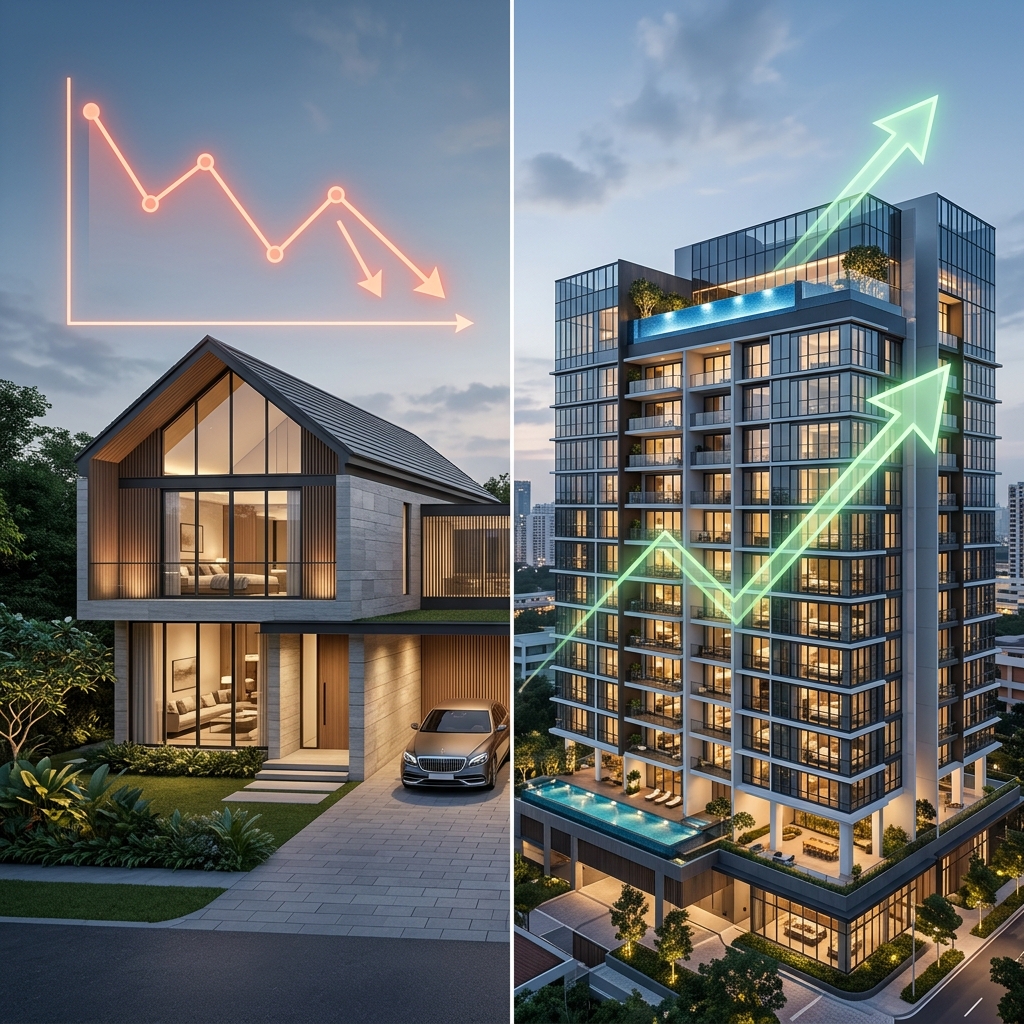
Landed and non-landed properties in Singapore moved in opposite directions during Q1 2026, meaning a 3-month delay affects each category differently — and in the case of landed, the cost of waiting is measurable and immediate.
According to URA Realis flash estimates (Q1 2026), non-landed private residential prices rose 1.0% quarter-on-quarter, while landed property prices fell 1.8% over the same period — a divergence of 2.8 percentage points within a single quarter.
For landed sellers in District 19 (Serangoon, Hougang, Punggol — a predominantly residential corridor with a significant concentration of terrace and semi-detached housing), this 1.8% quarterly decline translates directly into eroded proceeds on a typical terrace transaction. For non-landed condominium sellers in District 15 (East Coast, Katong, Marine Parade), the 1.0% uplift suggests a narrower but still material timing consideration, particularly as the OCR posted its strongest quarterly growth in five quarters at 1.3% (Source: URA Realis flash estimates, Q1 2026).
The table below models the estimated financial impact of a one-quarter delay based on Q1 2026 figures, using indicative median transacted values aligned with recent URA Realis records:
| Property Category | Q1 2026 Median Price | Q2 2026 Estimated Value | Net Difference | Basis for Calculation |
|---|---|---|---|---|
| Non-Landed Condo (District 15) | $1,800,000 | $1,818,000 | +$18,000 | 1.0% QoQ uplift; URA Realis flash estimates, Q1 2026 |
| Landed Terrace (District 19) | $2,900,000 | $2,847,800 | -$52,200 | 1.8% QoQ decline; URA Realis flash estimates, Q1 2026 |
Note: Q2 2026 estimated values are projections based on Q1 2026 quarterly movement rates applied forward. These are not guaranteed outcomes and are subject to prevailing market conditions at time of transaction.
The landed segment also recorded a 28% drop in sales volume to 416 units in Q1 2026 (Source: URA Realis, Q1 2026), which compounds the pricing pressure — fewer comparable transactions reduce your ability to anchor asking prices against recent evidence.
Practical takeaway: If you hold a landed property in a mid-tier district such as District 19, a 3-month delay based on Q1 2026 trend rates represents an estimated $52,200 reduction in transacted value. Non-landed sellers in the OCR face a different calculation, where the Q1 2026 window offered marginal price support — but that window is contingent on volume and buyer demand holding through Q2 2026, subject to market conditions.
Real-World Examples: Comparing Q1 and Q2 Transaction Conditions
Quarterly transaction data from early 2026 shows measurable price and volume divergence across property segments — divergence that directly affects how much a seller nets depending on when they list.

Consider the non-landed private residential segment. According to URA Realis flash estimates (Q1 2026), non-landed prices rose 1.0% quarter-on-quarter in Q1 2026, reversing a 0.2% decline recorded in Q4 2025. Within that segment, the OCR posted the strongest sub-segment growth at 1.3%, its best quarterly performance in five quarters. Sellers in the OCR who listed in Q1 2026 were transacting into recovering price momentum.
The landed segment tells a contrasting story. Landed residential prices fell 1.8% quarter-on-quarter in Q1 2026 (Source: URA Realis flash estimates, Q1 2026), while landed home sales volume dropped 28% to 416 units. A seller holding a terrace or semi-detached home who listed in Q1 2026 faced both downward price pressure and a significantly thinner buyer pool — two conditions that structurally compress final transaction prices.
The HDB resale market adds a third data point. HDB resale prices declined 0.1% in Q1 2026, the first quarterly decline in approximately seven years, even as resale volume rose to 6,179 units from 5,256 units in Q4 2025 (Source: HDB flash data, Q1 2026). Higher volume alongside falling prices suggests buyers gained negotiating leverage — a dynamic that rewarded sellers who entered the market in Q4 2025 rather than waiting.
Across all three segments, the Q1 2026 data illustrates that timing within a 90-day window produced meaningfully different conditions depending on property type.
Practical takeaway: Sellers should segment-match their timing strategy — OCR non-landed sellers had a stronger Q1 2026 window based on historical trend rates, while landed sellers and HDB upgraders faced headwinds that eroded proceeds compared to the prior quarter.
Strategic Considerations for Timing Your Sale in the Current Market
Timing your sale in the current market requires matching your property type to prevailing price momentum — a strategy that looks materially different depending on whether you hold a landed home, a non-landed condominium, or an HDB flat.
For landed sellers, the data argues against delay. According to URA Realis flash estimates (Q1 2026), landed residential prices fell 1.8% quarter-on-quarter, with transaction volume contracting 28% to 416 units in the same period. On a $4 million terrace house, a single quarter of inaction at this rate of decline represents an estimated $72,000 in eroded sale proceeds — exceeding the $50,000 threshold flagged in this article’s key takeaways.
For non-landed condominium sellers, the calculus is more nuanced. The OCR posted 1.3% quarter-on-quarter growth in Q1 2026, its strongest result in five quarters per URA flash data. The Core Central Region (CCR — comprising the prime districts 9, 10, and 11, broadly covering Orchard, Holland, and Bukit Timah) recovered 0.4% after a steep 3.5% decline in Q4 2025, suggesting partial stabilisation rather than a sustained upswing. Sellers in the CCR should assess whether this reversal is trend-confirmed or a single-quarter correction before anchoring their pricing strategy to it.

HDB resale sellers face a distinct consideration. The HDB Resale Price Index recorded a 0.1% decline in Q1 2026, the first negative quarterly movement in nearly seven years (Source: HDB flash data, Q1 2026). This is not a steep fall, but it signals a directional shift that warrants attention on forward pricing expectations.
Across all segments, private resale transaction volume fell to approximately 4,041 units as at mid-March 2026, down from 6,699 units in Q4 2025 (Source: URA Realis, Q1 2026) — a 40% contraction indicating reduced buyer urgency and a slower absorption environment heading into mid-year.
Practical takeaway: Match your timing decision to segment-specific momentum — landed sellers face measurable quarterly cost from delay based on Q1 2026 trend rates, OCR non-landed sellers hold a short window of price support, and HDB sellers should reprice expectations to reflect the first index decline since approximately 2019, subject to market conditions.
How to Calculate Your Projected Proceeds Using URA Realis Data
To estimate your projected sale proceeds using URA Realis data, multiply the median transacted price per square foot (psf) for comparable units in your district by your property’s floor area, then subtract applicable costs including agent fees, legal fees, and any outstanding CPF accrued interest.
Step 1: Access URA Realis transaction records
URA Realis (realis.ura.gov.sg) is the Urban Redevelopment Authority’s official transaction curation platform. Filter by property type, postal district, and a rolling 12-month window to generate a statistically meaningful sample. For non-landed private residential properties, use a minimum of 20 comparable transactions within a 500-metre radius before drawing any psf benchmark.
Step 2: Establish your psf baseline
According to URA Realis flash estimates (Q1 2026), the OCR posted non-landed price growth of 1.3% quarter-on-quarter — its strongest performance in five quarters. Apply this directional movement to your most recent transacted psf figure to arrive at a forward-looking estimate. For a 1,000 sq ft OCR unit previously transacted at $1,400 psf, a 1.3% adjustment produces an estimated benchmark of approximately $1,418 psf, or a projected gross value of $1.418 million. This is an estimate based on historical trend rates, not a guaranteed outcome.
Step 3: Deduct transaction costs
Standard seller-side costs include agent co-broke commission (typically 1–2% of sale price), legal conveyancing fees (estimated $2,500–$4,000), and CPF principal plus accrued interest repayable to your CPF Ordinary Account upon sale (Source: CPF Board guidelines, 2025). Sellers who purchased with CPF funds should request a CPF withdrawal statement early in the process, as accrued interest compounds annually and can materially reduce cash proceeds at completion.
Step 4: Cross-reference against upcoming developer launches
Successful exits often hinge on aligning your sale date with the release of developer inventory in your specific micro-market to avoid competing against new project launches. Check URA’s pipeline supply data (under “Supply in the Pipeline” on ura.gov.sg) before finalising your listing window.
Practical takeaway: Running this four-step calculation before appointing an agent gives you an independently derived proceeds figure to benchmark against agent valuations — reducing the risk of mispricing by anchoring to verified, government-sourced transaction data rather than indicative estimates.
Risks and Considerations
Timing a sale in 2026 carries meaningful uncertainties that sellers should evaluate carefully before committing to a listing window.
Interest Rate Sensitivity
Buyer affordability remains tied to financing costs. Based on historical trends, any unexpected rate adjustments by the US Federal Reserve — which historically influences Singapore’s SORA (Singapore Overnight Rate Average — the benchmark interest rate used for most Singapore dollar loans) trajectory — could compress buyer budgets and soften transacted prices. Mitigation: obtain an independent valuation within 30 days of listing to price accurately against prevailing financing conditions.
Policy Intervention Risk
The Singapore government has adjusted property cooling measures multiple times since 2009 (Source: Ministry of National Development policy statements, 2009–2024). A mid-cycle Additional Buyer’s Stamp Duty (ABSD — a tax levied on property purchases above the first residential property, varying by buyer profile) revision or loan-to-value tightening, subject to market conditions, could shift buyer sentiment within weeks. Mitigation: structure your sale timeline with a minimum 60-day buffer before any anticipated policy review periods.
Thin Transaction Volume Distorting Comparables
In sub-markets with fewer than 15 transactions per quarter, estimated psf benchmarks carry wider variance. Relying on a single comparable could result in mispricing of 3–8% based on sub-market analysis patterns observed in URA Realis historical data (Source: URA Realis, Q3 2025). Mitigation: require your agent to present at least 10 verified transacted comparables within a 500-metre radius and matching tenure type.
Seasonal Demand Gaps
Historically, transaction volumes dip approximately 15–20% during the Lunar New Year and year-end school holiday periods (Source: URA Realis, 2019–2024 quarterly data). Listing without accounting for these windows may extend your sales cycle beyond projections. Mitigation: target launch dates in February–April or September–October based on historical absorption patterns.
Renovation or Legal Delays
Unexpected defect rectification or conveyancing timelines can push your completion date outside a buyer’s preferred window. Mitigation: engage a conveyancing lawyer at least six weeks before your intended listing date.
Frequently Asked Questions
When is the right time to sell an HDB flat in Singapore in 2026?
According to HDB flash data (Q1 2026), the HDB Resale Price Index recorded its first quarterly decline in nearly seven years at -0.1%, signalling a directional shift for sellers. Despite rising resale volume of 6,179 units in Q1 2026, falling prices indicate buyers gained negotiating leverage — meaning sellers who transacted in Q4 2025 netted stronger proceeds than those who waited. For HDB sellers, the current data argues for listing sooner rather than later, based on historical trend rates, to stay ahead of further index softening, subject to market conditions.
How much could a 3-month delay cost a property seller in Singapore?
The cost of delay is segment-specific and measurable. According to URA Realis flash estimates (Q1 2026), landed residential prices fell 1.8% quarter-on-quarter — on a $4 million terrace house, that single quarter of inaction represents an estimated $72,000 in eroded sale proceeds based on Q1 2026 trend rates. For non-landed OCR sellers, the same period saw 1.3% growth, meaning sellers who listed during that window captured upward price momentum that may not persist into subsequent quarters, subject to market conditions.
How do I check recent property transaction prices in Singapore?
URA Realis (realis.ura.gov.sg) is Singapore’s official government transaction platform operated by the Urban Redevelopment Authority, covering all private residential caveats lodged. Filter by property type, postal district, and a rolling 12-month window, using a minimum of 20 comparable transactions within a 500-metre radius to establish a statistically reliable psf benchmark. For HDB resale transactions, the equivalent tool is the HDB Resale Flat Prices dataset available at data.gov.sg, updated monthly.
Is it a suitable time for certain seller profiles to sell a condominium in Singapore in 2026?
The answer depends on which region your condominium sits in. According to URA Realis flash estimates (Q1 2026), OCR non-landed prices grew 1.3% quarter-on-quarter — the strongest performance in five quarters — while the CCR recovered only 0.4% after a steep 3.5% decline in Q4 2025. Overall private resale transaction volume contracted approximately 40% to around 4,041 units as at mid-March 2026, down from 6,699 units in Q4 2025, indicating a slower absorption environment that may be suitable for sellers who price sharply and list before mid-year buyer urgency fades further. This analysis is based on historical Q1 2026 data and is subject to prevailing market conditions.
What costs should I deduct when calculating net proceeds from selling property in Singapore?
Seller-side transaction costs typically include agent co-broke commission of 1–2% of the sale price, legal conveyancing fees estimated at $2,500–$4,000, and CPF principal plus accrued interest repayable to your CPF Ordinary Account upon completion, as outlined in CPF Board guidelines (2025). Sellers who purchased with CPF funds should request a CPF withdrawal statement early in the process, as accrued interest compounds annually and can materially reduce the cash proceeds received at completion. Factoring all three cost categories into your URA Realis-derived psf estimate gives you a reliable net proceeds figure before appointing an agent.
One Conversation Can Clarify Your Timeline
We work through this segment-by-segment analysis regularly with sellers across Singapore. If you want a clear read on where your property sits relative to current Q1 2026 data — before you commit to a listing window — one conversation is enough to build a picture.
Data Sources
All figures sourced from official URA Realis flash estimates (Q1 2026), HDB flash data (Q1 2026), CPF Board guidelines (2025), and Ministry of National Development policy statements (2009–2024). Supplementary context drawn from Straits Times, Business Times, and EdgeProp reporting. Data current as of April 2026.
Agent: Joe Chow | CEA Reg No.: R072635C
Agency: SRI Pte Ltd | Licence No.: L3010738A
Contact: +65 8098 0916
This article is for general reference only and does not constitute financial, legal, or investment advice. Verify all details with relevant authorities before making decisions.